
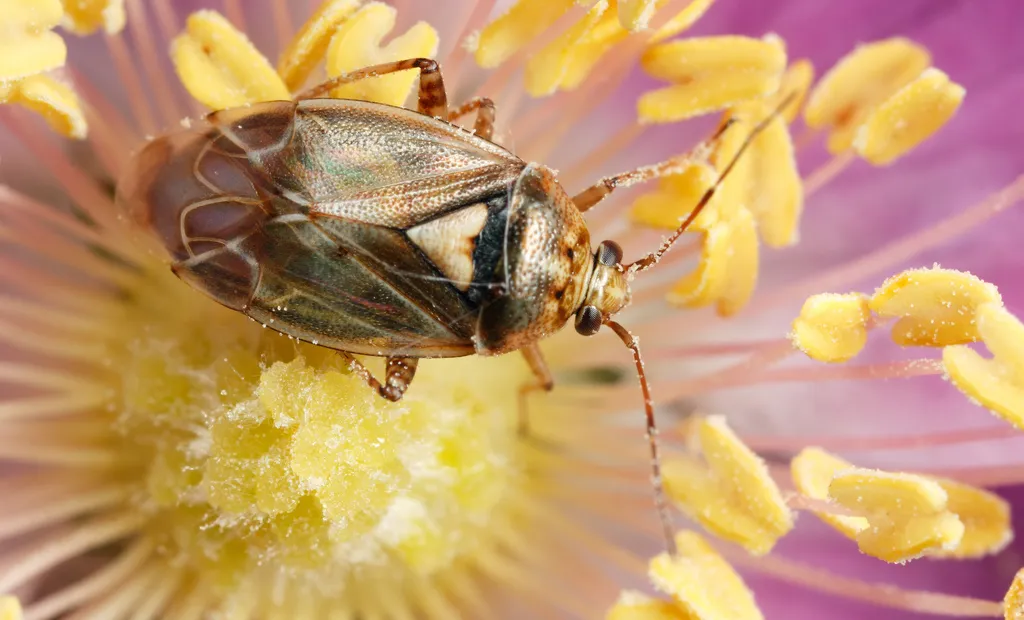
Tarnished plant bug
Lygus lineolaris (Palisot de Beauvois)Tarnished plant bug overview
The tarnished plant bug, Lygus lineolaris, is a mobile true bug that pierces buds, flowers, shoots, fruit and developing seeds on many crops and ornamentals. Feeding can deform new growth, scar stems, cause blossom or fruit injury, and reduce cotton fruit retention. Because similar damage may be caused by stink bugs or poor pollination, confirm the insect through scouting before treatment.
Typical conditions
Overview
Adults are typically about 1/5 to 1/4 inch long, flattened, and mottled brown, tan, reddish and yellowish. A pale triangular or V-shaped marking is often visible near the middle of the back. Nymphs are green, wingless and fast-moving; older nymphs develop wing pads and characteristic dark spots. Eggs are inserted into plant tissue, leaving only a small cap visible.
Identification from injury alone is uncertain because stink bugs, other mirids, poor pollination and weather-related fruit deformities can produce similar symptoms. Look for adults or nymphs on the affected plant, especially during early morning or other mild, calm conditions.
Symptoms and identification
- Young leaves, shoots, stems and petioles may show pits, scars, brown spots, distorted growth or small holes that become more obvious as tissue expands.
- Buds and flowers may abort, become discolored or fail to develop normally.
- Fruit may be pitted, misshapen or develop corky, sunken or cat-faced areas. Strawberries may have large, hollow, straw-colored seeds around feeding sites.
- In cotton, feeding can cause small squares to shrivel and drop, injure floral tissues, damage terminal growth and reduce development of young bolls and seeds.
- In vegetables, developing leaves, stems and fruit may be dwarfed, scarred or distorted.
Causes and spread
Adults and nymphs cause injury while extracting plant fluids and injecting saliva into plant tissues. Populations often build on weeds, legumes, alfalfa, cover crops and other flowering vegetation, then move into crops when those hosts dry, are mowed, are disked or become less suitable. Adults are strong fliers and may enter from field borders or surrounding habitats. Eggs are laid within stems, petioles, buds or other plant tissue, which makes them difficult to detect and remove.
Life cycle and persistence
Tarnished plant bugs overwinter mainly as adults in protected plant debris, weeds and field margins. In spring, females insert eggs into plant tissue. Eggs hatch into green nymphs that pass through five instars before becoming winged adults. Development and the number of generations vary with latitude, temperature, host availability and crop system; several generations may occur during a growing season in warmer parts of the United States. Monitoring is most useful during spring migration and whenever flowering weeds or nearby crops begin to dry down.
Treatment and control
Confirm tarnished plant bugs by direct observation, sweep-net sampling, beat sampling or careful inspection of buds and growing points. Adults are mobile and often hide, so sample several locations and repeat scouting. Use crop-specific economic thresholds where available; thresholds differ substantially among cotton, strawberries, vegetables, seed crops and ornamentals.
Prioritize early detection of first- and second-instar nymphs, which are generally more susceptible to control than adults. Treat only when confirmed populations and expected injury justify intervention. Use spot treatment or border-focused management when the infestation is localized, and avoid unnecessary broad-spectrum applications that can flare spider mites, aphids or other secondary pests.
Low-impact and biological control
- Use weed, cover-crop and crop-border management to reduce breeding and migration sources.
- Protect and conserve generalist predators and parasitoids; avoid disruptive sprays when monitoring shows low pest pressure.
- Use row covers or screening on susceptible crops.
- For low to moderate infestations, repeated vacuuming may reduce bugs, although effectiveness varies and equipment can also remove beneficial insects or spread disease spores.
- On certified-organic farms, use only substances permitted by the Organic Materials Review Institute or the applicable certifier, such as appropriately labeled insecticidal soaps, selected azadirachtin products or microbial insecticides. Coverage and repeated contact are important, particularly against exposed nymphs.
Prevention
- Scout crop borders and nearby weeds before planting and throughout spring and summer, especially when flowering vegetation begins to dry.
- Remove or mow weed hosts before large numbers of adults develop, while avoiding practices that drive mature adults directly into the crop.
- Manage alfalfa, cover crops and trap crops with timing that prevents lygus nymphs from maturing and dispersing.
- Use insect-excluding row covers or screening on susceptible small vegetable plantings where practical.
- Remove heavily infested plant material and keep nursery stock separated and inspected before it enters production areas.
- Maintain flowering resources for beneficial insects only with monitoring, because some flowering plants can also increase lygus populations.
Interesting facts
- Lygus lineolaris feeds on hundreds of plant species, including crops, weeds and native plants.
- Injury may become visible only after the bug has left, because expanding plant tissue enlarges the original puncture or feeding scar.
- Bt traits used in some crops do not provide dependable control of tarnished plant bugs.
- Sticky traps are not consistently reliable for estimating field populations in many crop systems; sweep nets, beat sampling and direct observation are often more informative.
- The name “tarnished” refers to the insect’s mottled, weathered-looking coloration.
Use only insecticides legally authorized and currently labeled for tarnished plant bug control on the specific crop and use site in the United States. Follow the current product label for rate, timing, personal protective equipment, reentry interval, preharvest interval, pollinator precautions and resistance-management requirements. Do not treat weeds or noncrop areas unless the label permits that use. Verify registration and crop legality with the current EPA-approved label and local Extension guidance.
Affected plants
The plants below are linked to this problem by structured host-plant data. The list updates automatically as new plant profiles are added.
 Apple tree (Malus domestica) care guideMalus domestica
 Wild Celery (Apium graveolens) care guideApium graveolens
 Beet (Beta vulgaris) care guideBeta vulgaris
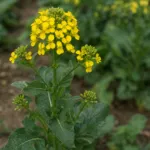 Ethiopian Rape (Brassica carinata) care guideBrassica carinata
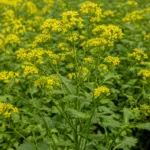 Brown Mustard (Brassica juncea) care guideBrassica juncea
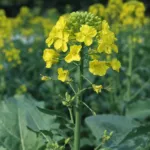 Rapeseed (Brassica napus) care guideBrassica napus
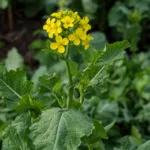 Urnip rape (Brassica rapa) care guideBrassica rapa
 Collard greens (Brassica oleracea) care guideBrassica oleracea
 He tepary bea (Phaseolus acutifolius) care guidePhaseolus acutifolius
 Snap bean (Phaseolus coccineus) care guidePhaseolus coccineus
 Butter bea (Phaseolus lunatus) care guidePhaseolus lunatus
 String Bean (Phaseolus vulgaris) care guidePhaseolus vulgaris