
Rice blast
Magnaporthe oryzaeRice blast overview
Rice blast is a destructive fungal disease caused by Magnaporthe oryzae, best known for diamond-shaped lesions on rice leaves and damaging infections of the collar, neck, panicle and grain. In the United States it is especially important in southern rice-growing regions. Disease pressure rises when susceptible varieties, prolonged leaf wetness, drought stress, excess nitrogen or inadequate flood depth occur together.
Typical conditions
Overview
Rice blast is one of the most important diseases of rice worldwide and a recurring production problem in the southern United States. The pathogen can infect leaves, collars, nodes, panicles, necks, peduncles, seeds and occasionally roots. Leaf blast may reduce photosynthetic area, but neck and panicle blast are usually more damaging because infection can interrupt movement of water and nutrients into the developing panicle, causing partially filled or empty grains.
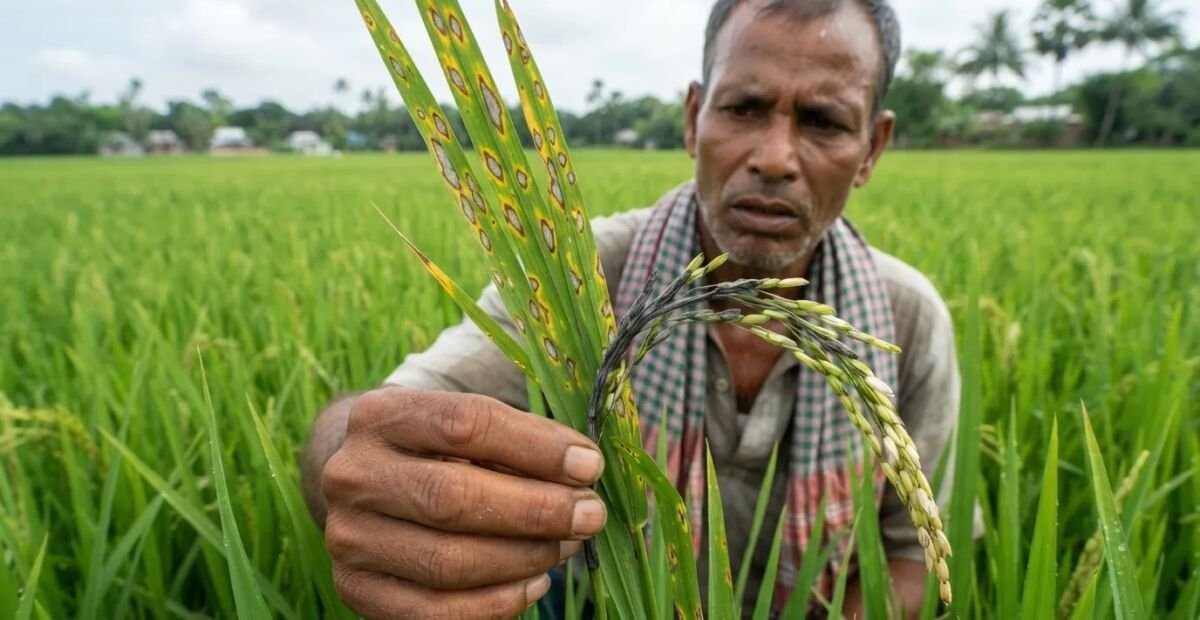
The familiar leaf symptom is a spindle- or diamond-shaped lesion with a gray, tan or whitish center and a brown to reddish margin. Lesion appearance varies with rice cultivar, pathogen isolate and environmental conditions. The scientific name Magnaporthe oryzae is used for the rice-associated pathogen; Pyricularia oryzae refers to its common asexual spore stage.
Symptoms and identification
Symptoms can occur at multiple growth stages:
- Leaves: small gray-green, brown or water-soaked spots enlarge into diamond- or spindle-shaped lesions with pale gray centers and darker margins. Lesions may merge and kill large portions of the leaf.
- Collars and sheaths: elongated brown lesions may occur where the leaf blade joins the sheath.
- Necks, nodes and panicles: gray-brown to blackened lesions girdle the neck or panicle branches. Infected panicles may remain partly emerged, turn gray-brown and produce poorly filled or blank grains.
- Seeds: brown spots, blotches or discoloration may develop on husks and kernels.
- Seedlings: severe leaf blast can cause stunting, yellowing or death under highly favorable conditions.
Gray fungal sporulation may be visible in lesion centers during prolonged humidity, especially on susceptible plants. Brown spot, herbicide injury, nutrient stress and other leaf diseases can resemble early blast.
Causes and spread
Magnaporthe oryzae produces airborne, three-celled conidia on infected tissue. Spores are moved by wind, splashing rain and contact with wet foliage. They may also be associated with infected seed, crop residue and volunteer rice or susceptible grasses. After landing on a wet plant surface, a spore germinates and forms a specialized penetration structure called an appressorium.
Risk is highest in susceptible cultivars and fields with a history of blast, prolonged dew or fog, frequent rain, dense canopies, tree-line shade, drought-stressed levees, sandy or poorly flooded areas, and excessive or poorly timed nitrogen. Uneven flood management and furrow irrigation can increase stress and disease risk. Pathogen populations are genetically variable and can overcome resistance in some cultivars, so a previously resistant variety should still be scouted.
Life cycle and persistence
The disease cycle begins when a conidium lands on a susceptible rice surface and remains wet long enough to germinate. The germ tube differentiates into a melanized appressorium, which builds high internal pressure and produces a penetration peg that enters the plant cell. The fungus initially grows with limited visible symptoms, then develops invasive hyphae and causes expanding necrotic lesions.
Under humid conditions, conidiophores emerge from lesions and produce new conidia. Sporulation and wind dispersal can repeat several times during a rice season. Infection of the neck or panicle near heading is particularly dangerous because it can cause severe grain loss. The sexual stage can be produced under laboratory conditions, but it has not been a significant field stage reported in the United States.
Treatment and control
Confirm the diagnosis before treating. Open the canopy and inspect lower leaves for characteristic lesions, then examine collars and panicle necks as heading approaches. If symptoms are unusual, widespread, or confused with brown spot or herbicide injury, submit representative material to a state diagnostic laboratory or county Extension office.
For flooded rice, promptly correcting drought stress and maintaining an appropriate continuous flood can suppress further blast development. Leaf blast alone does not automatically justify a fungicide application; decisions depend on cultivar susceptibility, disease activity, crop stage, field history, weather and irrigation limitations. The highest-value protection is generally directed at susceptible fields as the panicle and neck emerge, because late neck and panicle blast can cause much greater yield loss than isolated leaf lesions.
Fungicides are preventive or protectant tools and work best when timed before severe neck or panicle infection. Use local Extension disease guides and current product labels for crop registration, timing, resistance-management restrictions, preharvest interval and application limits. Do not rely on a late rescue treatment after panicles are heavily infected.
Low-impact and biological control
No reliably curative organic treatment eliminates established Magnaporthe oryzae infections. In an organic or low-input system, emphasize resistant or less susceptible cultivars, clean seed, balanced fertility, adequate water management, canopy ventilation, field sanitation and removal of volunteer rice and heavily infected plants where feasible.
Biological products and organically compliant fungicides may be available in some U.S. states, but performance and legal status vary by formulation, crop use and label. Treat them as components of an integrated program rather than substitutes for cultivar selection, scouting, flood management and prevention. Confirm organic certification status with the certifier and follow the current product label.
Prevention
Integrated prevention should begin before planting:
- Choose cultivars with the best available blast resistance for the state, field history and production system, while recognizing that resistance can be defeated by changing pathogen populations.
- Use high-quality, clean seed and commercially labeled seed treatments where appropriate; seed treatment reduces seed-associated inoculum but does not provide season-long control.
- Plant at an appropriate date and avoid unnecessarily dense stands or excessive nitrogen that produces lush, humid canopies.
- Base nitrogen rate and timing on the cultivar, soil test information and local rice recommendations. Avoid overfertilization and correct other stresses that weaken plants.
- In flooded systems, establish and maintain a sufficiently deep, continuous flood where local recommendations and field conditions allow. University of Arkansas guidance commonly emphasizes about 4 inches of flood depth for suppressing blast development.
- Scout lower leaves, field edges, levees, tree lines, low-lying areas and dense nitrogen-rich patches from tillering through heading.
- Manage volunteer rice and grassy hosts, clean equipment between fields when practical, and incorporate or otherwise manage infected residue according to local production recommendations.
Interesting facts
- The asexual spore-forming stage is commonly called Pyricularia oryzae, while the sexual name used for the rice-associated pathogen is Magnaporthe oryzae.
- The appressorium functions as a pressurized infection structure and can mechanically penetrate the rice epidermis.
- Rice-associated and wheat-associated blast populations are host-specialized; the name M. oryzae does not mean that every isolate infects every grass host.
- Neck blast can cause severe grain loss even when leaf blast earlier in the season appeared limited.
- Blast resistance is often isolate-specific and can become less effective as pathogen populations change.
Use only fungicides legally authorized and currently labeled for rice blast on the crop and site in your state and country. Follow the current label exactly, including rate, timing, personal protective equipment, preharvest interval, maximum applications and resistance-management requirements. Product registrations and recommendations change; consult the current state Extension rice guide or a licensed crop adviser. Rotate labeled modes of action and do not make off-label applications.