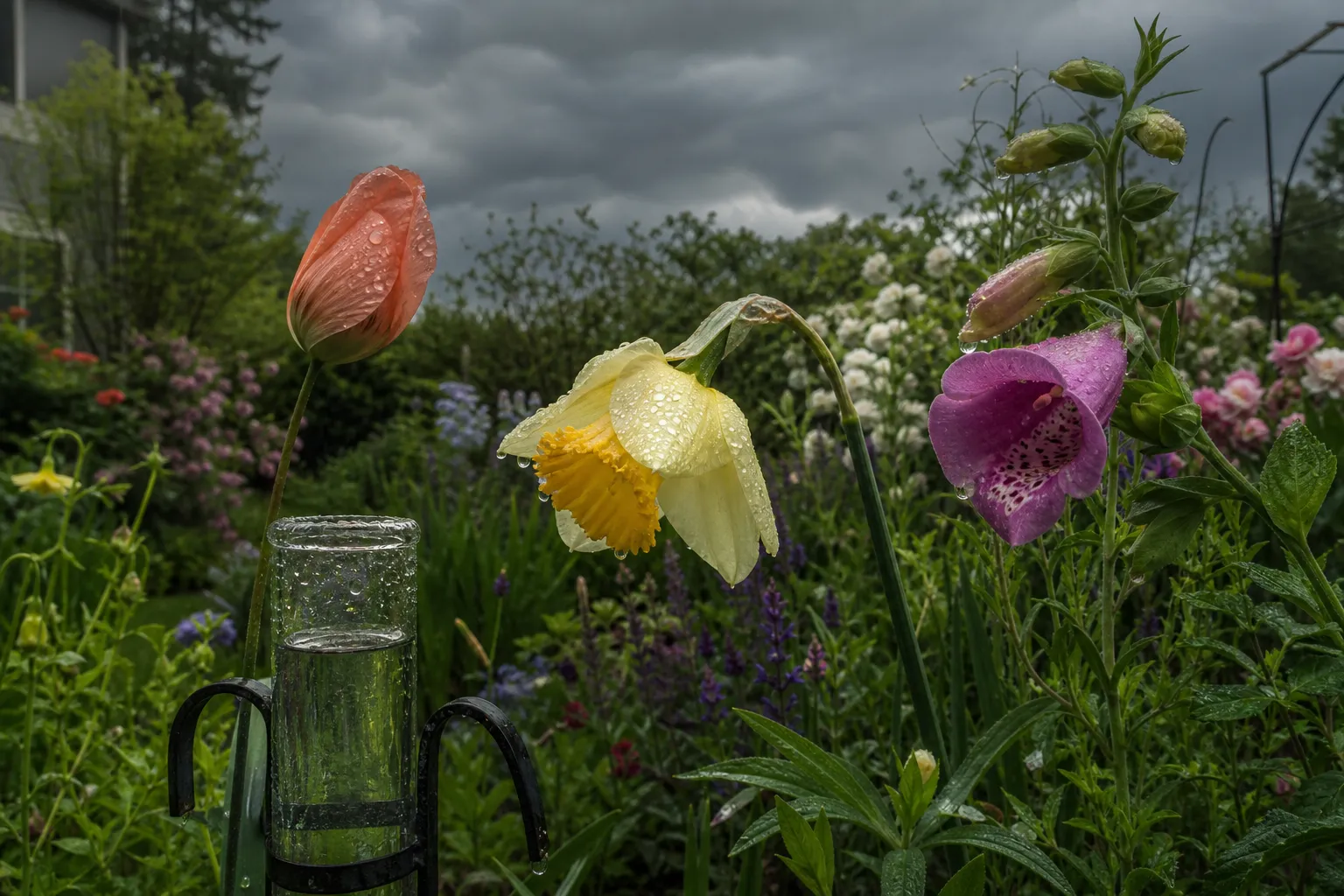
Have you ever watched a flower fold its petals just before a summer shower, while the plant next to it carries on as if nothing is happening? This small garden mystery has a surprisingly practical explanation: flowers have different ways of protecting—or exposing—their reproductive parts.
Some species close their petals when light fades, humidity rises or raindrops strike. Others tilt downward, tuck their pollen inside a tube, shelter it beneath a hood or produce pollen that tolerates moisture better. A few simply stay open, accepting the risks of wet weather in exchange for other advantages.
Once you understand these strategies, a rainy garden becomes much more interesting. Instead of seeing a closed bloom as a damaged flower, you can recognize it as a plant making a temporary adjustment to the weather.
Closing is often a form of pollen protection
A flower’s most important job is reproduction. Its petals attract pollinators, while the stamens produce pollen and the stigma receives it. Rain can interfere with both sides of that process.
Water may knock loose pollen grains, dilute nectar or leave the pollen too wet for effective transfer. In some flowers, rain can also fill the floral cup or wash pollen away before bees, butterflies or other visitors have a chance to use it.
Closing the petals creates a short-lived shelter around the anthers and stigma. Research on lesser celandine, a spring-flowering woodland plant, found that flowers allowed to close retained more pollen and had a greater proportion of viable pollen than flowers held open during wet conditions. That does not mean every closing flower behaves identically, but it provides strong evidence that closure can improve reproductive protection.
What does “closing before rain” really mean?
Not every flower forecasts a storm in the way a weather station does. A plant may respond to signals that commonly arrive before or during rain, including:
- lower light under thick clouds;
- higher humidity;
- a drop in temperature;
- water landing on the flower or nearby plant tissue;
- changes in air movement or physical vibration.
Some flowers also follow a daily rhythm. They open in daylight and close at night, even in a sheltered greenhouse. If a storm arrives late in the day, the flower may appear to “predict” rain when it is actually responding to its normal evening schedule combined with dimming light.
In other cases, a flower can react directly to physical stimulation. Raindrops, wind or movement may trigger a rapid change in the petals or flower stalk. The exact cue varies by species, and scientists still do not have a complete explanation for every flower that opens and closes.
Why some flowers stay open
Remaining open does not necessarily mean a flower is unprotected. Many flowers have built-in designs that reduce the effect of rain without folding their petals.
Downward-facing blooms act like umbrellas
A nodding or pendant flower directs water away from its reproductive organs. The petals may remain open, but the anthers sit beneath a natural roof. Rain runs off the outside rather than pooling around the pollen.
Narcissus, cyclamen and many bell-shaped flowers illustrate this general strategy. Their shapes and angles can protect pollen even when the visible petals remain spread.
Tubes, hoods and hidden anthers provide shelter
Some flowers place their stamens deep inside a tubular corolla. Others use overlapping petals, a hooded upper lip or a narrow opening that limits direct exposure. A flower may look completely open from the side while its pollen remains tucked into a relatively dry space.
This is one reason you should not judge a flower’s rain tolerance by petal position alone. Look closely at where the anthers sit. If they are exposed on the surface, rain may be a greater threat than if they are recessed inside the bloom.
Some pollen is simply more moisture-tolerant
Flowering plants vary in how well their pollen withstands water. In broad comparisons across many species, pollen that is exposed to rain tends to be associated with other protective features, such as water-resistant pollen, extended pollen release or a flower structure that limits flooding.
That combination can explain why certain open flowers continue functioning after a shower while a more delicate flower nearby appears to have lost its reproductive potential. The plant may have invested in pollen that can tolerate conditions its petals cannot avoid.
Rain response is a trade-off, not a universal rule
Closing protects a flower, but it also hides the visual signals and scents that attract pollinators. A bee cannot easily reach a tightly folded blossom, and a butterfly may move on if the landing platform disappears.
For a plant, the best strategy depends on its pollinators, habitat and flowering season. A species that relies on daytime bees may benefit from closing during a cold, wet afternoon when few pollinators are active. A night-blooming plant faces a different balance: it must remain available to moths or other nighttime visitors, even when humidity is high.
Flower behavior can also vary within a single species. Plants growing in wetter regions may show more downward-facing blooms or stronger protection around their pollen. Individual cultivars can differ in petal thickness, flower angle and how long blooms remain attractive after rain.
Compare varieties instead of assuming they all behave alike
If you grow several varieties of the same flower, watch them side by side. For example, petunias with large, thin, double flowers may hold more water than simpler single-flowered types. A compact flower with overlapping petals may react differently from an open, trumpet-shaped cultivar.
Roses and peonies can also demonstrate a separate rain problem called flower balling. In this condition, densely layered petals absorb water and fail to unfold properly. The flower has not necessarily performed a useful protective closure; it may simply be physically stuck. Thin-petaled, double flowers are especially prone to this problem during prolonged wet weather.
Try comparing:
- single flowers with double flowers;
- upright blooms with nodding blooms;
- thin petals with waxy or thicker petals;
- flowers with exposed stamens and flowers with recessed stamens;
- older cultivars with newer rain-tolerant selections.
A simple garden experiment: who closes first?
You can investigate rain response without special equipment. Choose three or four flowering plants that receive similar light and grow in the same bed or containers. Good subjects might include a calendula, a tulip, a petunia and a daffodil, although the best comparison is whatever is already blooming in your garden.
Record the weather and flower position
- Choose several buds or newly opened flowers on each plant and mark them with loose, weatherproof labels.
- At the same time each morning and afternoon, record whether each flower is open, partly closed, fully closed, upright or downward-facing.
- Note air temperature, cloud cover, wind and whether the plant is wet.
- Take a quick photograph from the same angle each time.
- Continue for at least five days, including one dry day and one rainy period if possible.
Do not conclude that a flower responds to rain after observing only one storm. A bloom may be closing because of evening light, age, heat stress or ordinary daily timing. Repeated observations are much more useful than a single dramatic photograph.
Measure the rainfall or irrigation
For a more precise comparison, place a small rain gauge near the plants. Record the amount in inches after each shower. If you want to simulate rain, use a watering can with a rose attachment or a gentle sprinkler rather than a strong hose stream.
A useful trial might compare flowers after:
- no added water;
- 0.05 inch of water;
- 0.10 inch of water;
- 0.25 inch of water.
Measure the water with a marked container or by checking the rain gauge. Apply it evenly over a measured area. For example, if your test bed covers 10 square feet, note how much water you use and distribute it across the entire area rather than soaking one bloom.
Keep the amounts gentle. This experiment is meant to imitate rainfall, not create runoff or flatten the plants. Avoid testing during extreme heat, when wet foliage can remain damp for a long time and introduce other sources of stress.
What should you look for?
Record more than whether the petals close. Also note:
- how long closure lasts;
- whether the flower reopens after sunshine returns;
- if pollen remains visible on the anthers;
- whether nectar appears diluted or absent;
- if the flower stalk bends or changes angle;
- how many days the bloom remains attractive afterward.
You may find that one flower closes quickly after a small amount of water, another reacts only to dim light and a third never closes but turns downward. That is not a failed experiment—it is the pattern you are trying to discover.
What open flowers can tell you after a storm
After heavy rain, inspect flowers before removing them. A wilted-looking bloom may recover when it dries, especially if the plant has healthy buds waiting behind it. Other flowers may show clear damage: washed-out pollen, bruised petals, water-filled throats or a bent stem.
Compare the flowers’ structures. A petunia with an exposed center may show more direct rain damage than a cyclamen whose reproductive parts face downward. A daffodil may use the curve of its flower and the angle of its stalk to shed water. These differences reveal several ways plants solve the same environmental problem.
Rain also affects pollinators. During a cool downpour, many bees and butterflies reduce their activity or seek shelter. A flower that closes during those conditions may lose little by becoming temporarily unavailable. When the weather improves, it can reopen for the next useful pollination period.
Practical care for rain-sensitive flowers
You do not need to protect every flower from every shower. Most established garden plants can manage ordinary rainfall. However, a few simple choices can reduce avoidable damage.
- Give rain-sensitive plants good air circulation so foliage and petals dry more quickly.
- Use a site with morning sun when possible, especially for dense, double-flowered plants.
- Support tall stems before storm season so wet flowers do not bend to the ground.
- Water the soil rather than repeatedly wetting open blooms when irrigation is necessary.
- Check crowded flowers after long wet periods and remove badly collapsed blooms.
- Choose simpler, sturdier flower forms if your garden regularly experiences heavy summer rain.
For containers, move vulnerable plants beneath a temporary roof or porch during exceptionally heavy storms, but do not keep them in deep shade for long periods. Good light remains important for strong growth and continued flowering.
When you water, measure rather than guess. A rain gauge can show whether a recent storm supplied a light sprinkle or a substantial soaking. If the soil is still moist several inches below the surface, wait before irrigating again. The exact need depends on the plant, soil and weather, so use the gauge as one piece of information alongside a finger test and the plant’s appearance.
The bigger lesson: flowers solve rain in different ways
A closed flower is not automatically healthier than an open one, and an open flower is not automatically vulnerable. Plants may protect pollen by folding petals, turning downward, enclosing the anthers, changing when pollen is released or tolerating moisture directly.
Those strategies reflect long-term adaptation, but your garden also contains variety created by breeding, local weather and growing conditions. The same cultivar may behave differently during a cool spring shower than during a warm summer storm.
Next time dark clouds gather, choose one flower to watch. Note when it closes, how much rain falls and whether it reopens in the next bright spell. With a notebook, a rain gauge and a little patience, you can turn an ordinary storm into a close-up study of plant behavior—and make better choices about which flowers belong in your own rainy-season garden.