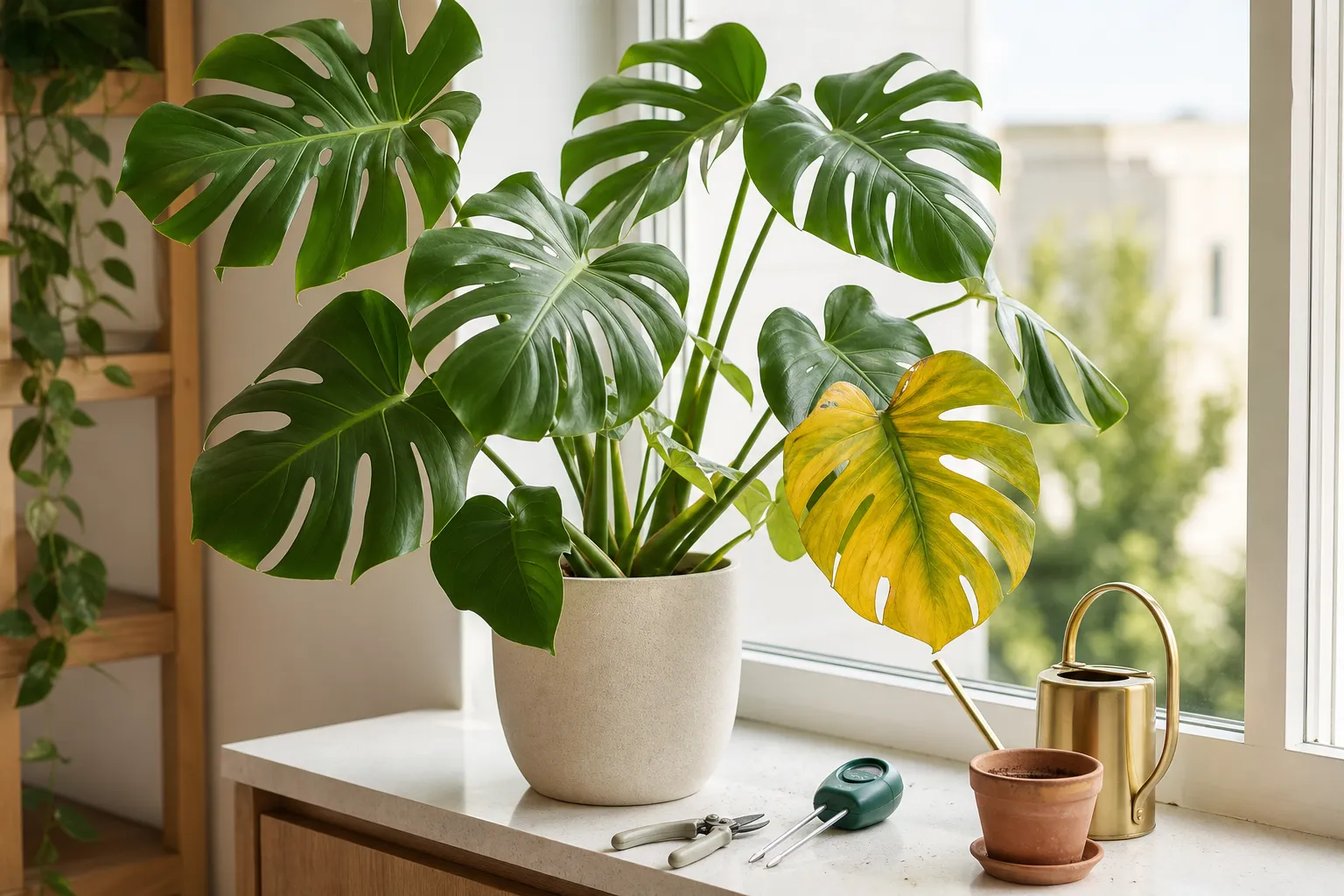
Monstera plants are wonderfully expressive houseplants. Give them the right light, a little room to climb, and a sensible watering routine, and they can reward you with large, dramatic leaves for years. But when those leaves start turning yellow, it is easy to assume the plant is in serious trouble.
Usually, yellowing is a message rather than a disaster. Your Monstera may be holding too much water, drying out between drinks, receiving too little light, reacting to a change in location, or simply retiring an older leaf. The key is to read the pattern instead of treating every yellow leaf the same way.
First, look at the pattern of yellowing
Before you change the plant’s soil or reach for fertilizer, take two minutes to inspect the whole plant. Note whether the yellow leaves are old or new, whether the soil feels wet or dry, and whether the discoloration is even or appears as spots.
- One or two oldest leaves turning evenly yellow: This can be normal aging, especially when the plant is producing healthy new growth.
- Several lower leaves yellowing while the soil stays wet: Suspect overwatering, poor drainage, or damaged roots.
- Pale, small, or widely spaced new leaves: The plant may not be receiving enough light, or its roots may be struggling.
- Yellow patches with brown, crispy areas: Consider intense direct sun, dry soil, cold exposure, or inconsistent watering.
- Fine speckling, silvery marks, webbing, or sticky residue: Inspect carefully for pests.
Yellow leaves rarely identify one cause by themselves. Think of the symptoms as clues that become more useful when you compare them with the plant’s soil, roots, light, and recent history.
The most common cause: watering problems
Monstera deliciosa and related species prefer a thorough drink followed by a period in which the potting mix becomes partly dry. They do not enjoy sitting in constantly saturated soil. At the same time, a plant that repeatedly dries out completely can develop yellow, curling, or brown-edged leaves.
How overwatering causes yellow leaves
Overwatering does not simply mean giving too much water in one session. More often, it means watering again before the root zone has had time to drain and breathe. Waterlogged mix contains less air, and stressed roots cannot function normally. In severe cases, roots become dark, soft, and damaged.
Check for this combination of signs:
- The top of the soil remains damp for many days.
- Several older leaves turn yellow at once.
- The plant looks limp even though the soil is wet.
- The pot has no drainage hole, or the saucer stays full of water.
- The soil smells sour or musty.
If these clues fit, pause watering and move the plant to brighter indirect light with good air movement. Empty the saucer after watering. If the mix remains wet for an unusually long time or the plant continues declining, slide the root ball from the pot and inspect the roots. Healthy roots are generally firm; rotting roots may be brown or black, soft, and easy to strip.
How underwatering can also turn leaves yellow
A very dry Monstera may wilt, curl, develop crispy edges, and shed older leaves. The potting mix may pull away from the sides of the container, and water may run rapidly down the gap instead of soaking the root ball evenly.
When the soil is extremely dry, water slowly over two or three passes. Allow each pass to soak in before adding more. Water until a little drains from the bottom, then empty the saucer. Avoid keeping the plant in a shallow tray of water as a routine solution.
A practical watering test you can repeat
Calendar-based watering is unreliable because indoor conditions change. A Monstera near a sunny window in July may use water much faster than the same plant in a dim room during January.
Try this simple measurement-based experiment:
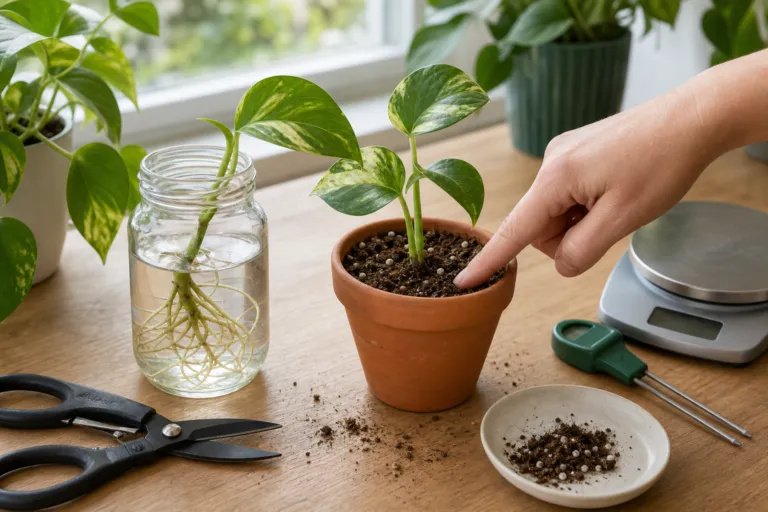
- Insert your finger about 2 inches into the potting mix, or use a wooden chopstick as a moisture check. If the chopstick comes out with damp mix clinging to it, wait.
- When the upper 2 to 3 inches feel mostly dry, weigh the pot in your hands or record its weight on a bathroom scale before watering.
- Water slowly until approximately 10 to 15 percent of the water drains from the bottom. For a 10-inch container, this may mean roughly 2 to 4 quarts of water, but the exact amount depends on the soil and pot.
- Let the pot drain fully, empty the saucer, and weigh it again if you are tracking the experiment.
- Check the soil every two or three days. Record how many days pass before the upper 2 to 3 inches dry again.
The goal is not to force every Monstera onto a fixed schedule. The goal is to learn how long your particular plant takes to dry at home. In a bright, warm room, that interval may be about a week; in a cool or low-light room, it may be considerably longer. Treat those figures as observations, not rules.
Light: too little, too much, or a sudden change
Monstera plants generally grow best in bright, indirect light. A spot near an east-facing window often works well. A bright south- or west-facing window can also work if you filter intense midday sun with a sheer curtain or place the plant a few feet back.
Too little light can slow growth and reduce water use. If you continue watering on a bright-season schedule while the plant is sitting in a dim corner, the soil may stay wet and the leaves may yellow. Low light can also produce smaller leaves, longer spaces between leaves, and stems that lean toward the window.
Too much direct sun can bleach or scorch foliage. Look for pale tan patches, crispy brown areas, or damage on the side facing the glass. Move the plant gradually rather than taking it from a dark room into several hours of intense sun all at once.
Compare common Monstera types
Not every Monstera behaves identically. Monstera deliciosa is usually a vigorous, large-growing plant that can tolerate a broad range of indoor conditions once established. Monstera adansonii often has thinner leaves and a more trailing or climbing habit, so it may show dry-air or watering stress more quickly. Variegated forms, including popular cultivars such as ‘Thai Constellation’ and ‘Albo,’ contain less green tissue and often grow more slowly than fully green plants.
Variegated plants should not automatically be placed in harsh direct sun. They still need protection from scorching, and their slower growth means the potting mix may dry at a different rate. Compare the plant’s own soil and growth pattern rather than assuming that every Monstera needs the same amount of water.
Root trouble: the problem below the soil line
Yellow leaves sometimes begin with roots rather than leaves. Root problems can follow repeated overwatering, a pot that is too large, compacted soil, poor drainage, or a recent period of cold stress.
Inspect the roots if the plant is yellowing quickly, the soil stays wet, or the plant wilts despite damp soil. Gently remove the root ball and loosen only enough soil to see what is happening. Trim away clearly dead, mushy roots with clean scissors, then repot into a container with a drainage hole and a fresh, airy houseplant mix.
Choose a pot only about 1 to 2 inches wider than the remaining root ball. A dramatically oversized pot holds more wet soil around the roots and can make recovery harder. Do not add a layer of gravel to the bottom as a substitute for drainage; it does not correct a potting mix that stays waterlogged.
Fertilizer: helpful in moderation, harmful when excessive
During active growth, Monstera plants can benefit from a balanced houseplant fertilizer used according to the label. Fertilizer is not a cure-all for yellow leaves, however. Applying extra nutrients to a plant with poor light, damaged roots, or wet soil can add stress rather than solve the original problem.
Use these guidelines:
- Feed only when the plant is actively growing and the soil is already appropriately moist.
- Follow the product label and avoid increasing the dose because the leaves look pale.
- Reduce or stop feeding during slow winter growth unless the plant is clearly growing under strong indoor light.
- If you suspect fertilizer buildup, flush the pot thoroughly with plain water and allow it to drain completely.
Yellowing between the veins can have multiple causes, including nutrient imbalance, but it is difficult to diagnose accurately from a photograph alone. Check the basics first: light, moisture, roots, and pests. Consider a soil or water analysis if the issue persists across several plants or new growth remains abnormal.
Pests and leaf-spot symptoms
Inspect both sides of every leaf, especially where leaves meet stems. Thrips, spider mites, scale, and other indoor-plant pests can cause stippling, distorted growth, yellow flecks, or general decline.
Isolate an affected plant while you investigate. Wipe or rinse leaves gently with lukewarm water, paying attention to the undersides. Remove heavily damaged leaves with clean pruners, and choose any pest-control product according to its label. Repeat inspections are important because one treatment rarely addresses every life stage of an insect.
Yellow halos around brown or black spots may indicate a leaf-spot problem rather than a watering issue. Keep leaves from remaining wet for long periods, improve air circulation, and remove badly affected foliage. Avoid spraying an unfamiliar product on the entire plant without checking that it is labeled for indoor ornamentals.
Seasonal changes can trigger temporary yellowing
Many Monstera plants slow down when indoor light decreases in fall and winter. A plant moved indoors from a patio or porch may also lose a leaf or two as it adjusts to lower light, different humidity, and a new watering pattern.
When bringing a Monstera inside, inspect it for pests, place it in bright indirect light, and reduce watering if the soil is drying more slowly. Keep it away from heating vents, fireplaces, and cold drafts. Tropical houseplants can be damaged by chilly conditions, so protect them from temperatures near or below 50°F.
What to do with a yellow leaf
A fully yellow leaf will not turn green again. Once you have corrected the underlying problem, remove it if it is more than half yellow, soft, or declining. Use clean scissors and cut the leaf stalk close to the main stem without injuring the stem itself.
If only a small section is yellow and the rest of the leaf is healthy, you can leave it in place. Removing leaves too quickly can make it harder to judge whether your care changes are working.
A two-week recovery plan
When you are unsure what caused the yellowing, avoid changing everything at once. Use this measured approach:
- Day 1: Check the soil depth, drainage hole, saucer, light level, and undersides of the leaves.
- Days 2–3: If the soil is saturated, stop watering. If it is bone-dry, rehydrate it slowly and thoroughly.
- Days 3–7: Move the plant to bright indirect light and keep it away from drafts or heat sources.
- Days 7–10: Recheck roots only if the plant continues to wilt or the soil remains wet for an unusually long time.
- Days 10–14: Look for stable stems, firmer leaves, or healthy new growth. Do not expect yellow leaves to recover; judge success by the plant’s condition going forward.
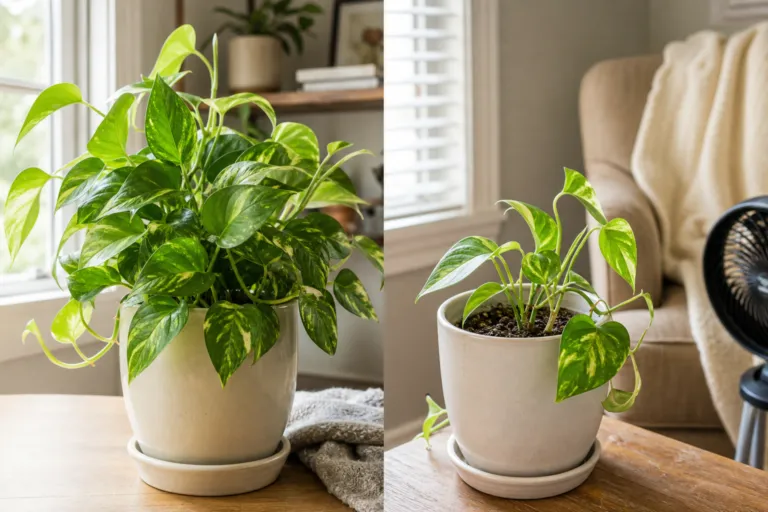
In a small home experiment, compare two similar plants or two locations for fourteen days. Record the pot weight, soil moisture depth, number of yellowing leaves, and hours of bright light. This simple log often reveals that the “same” watering routine produces very different results in a sunny living room and a darker bedroom.
The encouraging takeaway
Yellow Monstera leaves are frustrating, but they are also useful feedback. Start with the most likely causes: check moisture, confirm drainage, assess light, inspect roots, and look closely for pests. Make one or two careful changes, then give the plant time to respond.
With a breathable potting mix, bright indirect light, thorough but well-timed watering, and regular observation, most household Monsteras can recover from ordinary care mistakes. You do not need a perfect routine—just a repeatable one that responds to what your plant and its soil are telling you.