
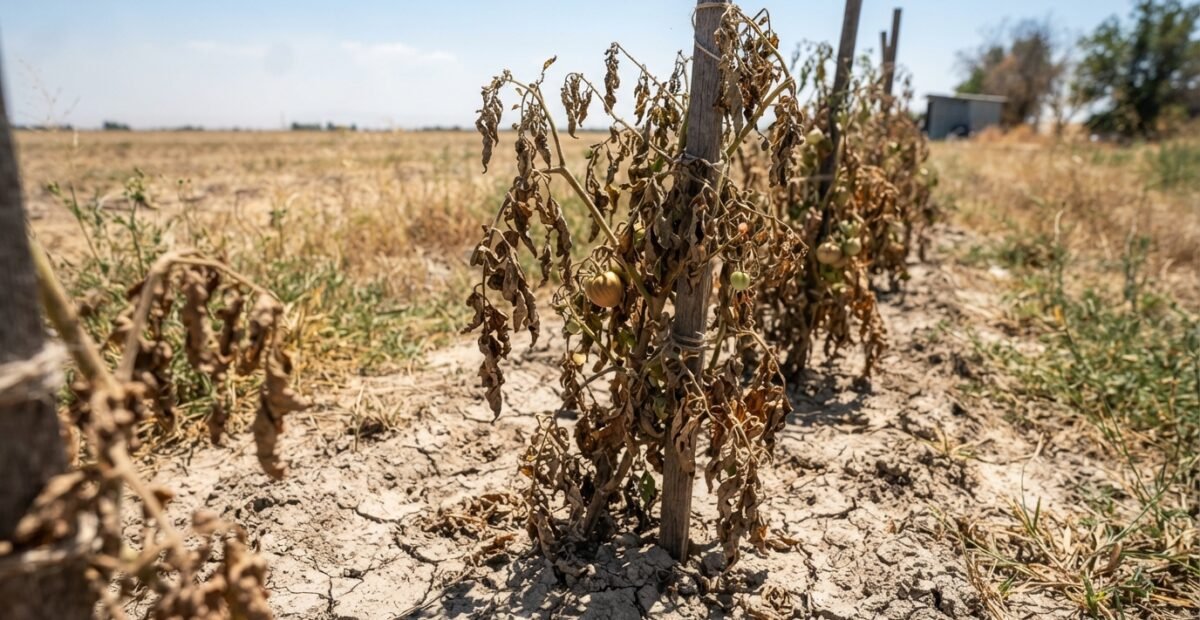
Heat stress
Heat stress overview
Heat stress is a noninfectious environmental disorder that occurs when high air or soil temperatures, intense sunlight, hot wind, and rapid water loss overwhelm a plant’s ability to cool itself and maintain normal growth. Symptoms range from temporary midday wilting and leaf curl to scorch, blossom drop, poor fruit set, sunscald, stalled growth, and permanent tissue death.
Typical conditions
Overview
Plants cool leaves mainly through transpiration: water moving from roots and evaporating through leaves removes heat. During extreme heat, hot wind or dry air can make water loss exceed root uptake, even when the soil is not completely dry. High temperatures can also impair photosynthesis, pollen development, fertilization, root growth and nutrient uptake.
Heat stress often overlaps with drought stress, sunscald, fertilizer injury, herbicide injury and infectious diseases. Diagnosis should consider recent weather, irrigation history, soil moisture, plant distribution and whether symptoms are worst on sun-exposed tissues. Affected plants may recover when temperatures moderate, but scorched tissue will not become green again.
Symptoms and identification
Common symptoms include:
- Temporary midday wilting, drooping or inward leaf curl, sometimes followed by evening recovery.
- Leaf-edge browning, crisping, bleaching, gray-tan patches and premature leaf senescence.
- Stalled growth, reduced photosynthesis, yellowing or poor canopy development.
- Blossom drop, flower abortion, poor pollination and reduced fruit set, especially in tomato, pepper, cucumber and other fruiting crops.
- Small, soft, unevenly ripened or sunscalded fruit; exposed fruit may develop pale, bleached or tan sunburned areas.
- Bolting or bitter flavor in cool-season greens such as lettuce, spinach and cilantro.
- Root injury, wilting that no longer recovers overnight, branch dieback or plant death after severe or prolonged exposure.
Causes and spread
Heat stress is triggered by unusually high daytime or nighttime temperatures, intense solar radiation, hot dry wind, overheated pavement or containers, and high soil temperatures. Water shortage, compacted or shallow soil, restricted roots, transplant shock, inadequate mulch and damaged irrigation increase risk. High heat can also reduce root growth and nutrient uptake; therefore, symptoms may occur even when fertilizer is present.
This disorder does not spread from plant to plant like a disease. However, a regional heat wave, reflected heat or a shared irrigation failure can produce similar symptoms across many plants. Heat-weakened plants may subsequently become more vulnerable to pests, pathogens and drought injury.
Life cycle and persistence
There is no pathogen or pest lifecycle. Heat stress develops when the combined heat load and water loss exceed the plant’s capacity for cooling and repair. Symptoms may appear within hours on tender leaves, flowers and fruit. Mild stress can reverse overnight if roots remain functional; repeated hot days progressively reduce photosynthesis, flower fertility and growth. Permanent scorch, cambial injury or root death can follow prolonged exposure, with recovery determined by the survival of buds, roots and vascular tissues.
Treatment and control
First verify soil moisture at root depth rather than relying only on leaf appearance. If soil is dry, slowly soak the root zone and repeat as needed to rehydrate the plant; do not make repeated shallow “sips.” If soil is already moist, avoid flooding, because waterlogged roots cannot supply oxygen or function normally.
- Move containers to morning sun and afternoon shade, and provide temporary shade for vulnerable garden plants.
- Refresh mulch, reduce wind exposure and stop unnecessary pruning until temperatures moderate.
- Do not remove every damaged leaf immediately; partially green leaves may still support recovery. Remove fully dead tissue after the heat event, using clean tools.
- Harvest mature vegetables and fruits promptly, and protect exposed fruit from direct afternoon sun with foliage or shade.
- Monitor for secondary pests, root problems and diseases. If wilting persists in cool conditions despite adequate moisture, seek help from a county Extension office or plant diagnostic laboratory.
Low-impact and biological control
Heat stress has no pesticide cure. The most effective low-input measures are organic mulch, compost-improved soil structure where appropriate, shade cloth, wind protection, careful hand watering, drip or soaker irrigation, and selection of locally adapted cultivars. Maintain even moisture rather than alternating drought and saturation. Avoid foliar products during extreme heat unless the product label specifically permits use under those conditions, because sprays can intensify leaf injury.
Prevention
Choose plants and cultivars suited to the local USDA hardiness zone and summer heat, and use heat- or drought-tolerant selections where appropriate. Plant cool-season crops so flowering and harvest avoid the hottest part of summer when practical. Acclimate transplants gradually rather than moving shade-grown plants directly into full sun.
- Maintain consistent soil moisture with deep watering at the root zone; check soil before irrigating and comply with local water restrictions.
- Water early in the morning. Drip irrigation, soaker hoses and low-evaporation delivery are generally more efficient than high overhead sprinklers.
- Apply about 1–2 inches of organic mulch, keeping it slightly away from stems and trunks, to reduce evaporation and soil temperature.
- Provide temporary 20–40% shade cloth during extreme heat, especially for lettuce, leafy greens, seedlings and newly transplanted crops.
- Protect containers from hot pavement and afternoon sun; use larger containers, insulating cover or afternoon shade.
- Use windbreaks, suitable spacing and healthy root systems. Avoid major pruning, transplanting and high-nitrogen fertilization during a heat wave.
Interesting facts
- Flowers and pollen are often more heat-sensitive than leaves, so a plant can remain green while fruit set fails.
- Tomato heat stress commonly causes blossom abortion and poor fruit set during hot days and nights; cultivar response varies.
- Leaf curling can be a protective response that reduces exposed surface area and water loss, but persistent curl does not prove that the soil is dry.
- High soil temperatures can slow root growth and nutrient uptake, adding nutritional-looking symptoms to the direct effects of heat.
- Sunscald is a heat-and-light injury on exposed tissue, not an infectious disease, although injured fruit may later be colonized by decay organisms.
- Heat stress is species- and growth-stage-dependent: lettuce may bolt or wilt at temperatures that tomatoes tolerate more readily, while tomato flowers can fail during heat that leaves appear to withstand.
No pesticide treats heat stress. Use only products legally authorized for the specific crop and problem in the United States, and follow the current product label, including temperature, application-timing, crop-safety and re-entry requirements. Do not apply fertilizer, foliar nutrients or plant-growth products as a substitute for correcting heat, irrigation or root-zone conditions.