European brown rot and blossom blight
Monilinia laxa (Aderhold & Ruhland) HoneyEuropean brown rot and blossom blight overview
European brown rot, caused by the fungus Monilinia laxa, is a disease of stone fruits that can kill blossoms and short shoots and rot ripening fruit. In the United States it is especially important in California and parts of the Pacific Northwest, although confirmed cases also occur elsewhere. Accurate species identification may require laboratory testing because several Monilinia species cause similar symptoms.
Typical conditions
Overview
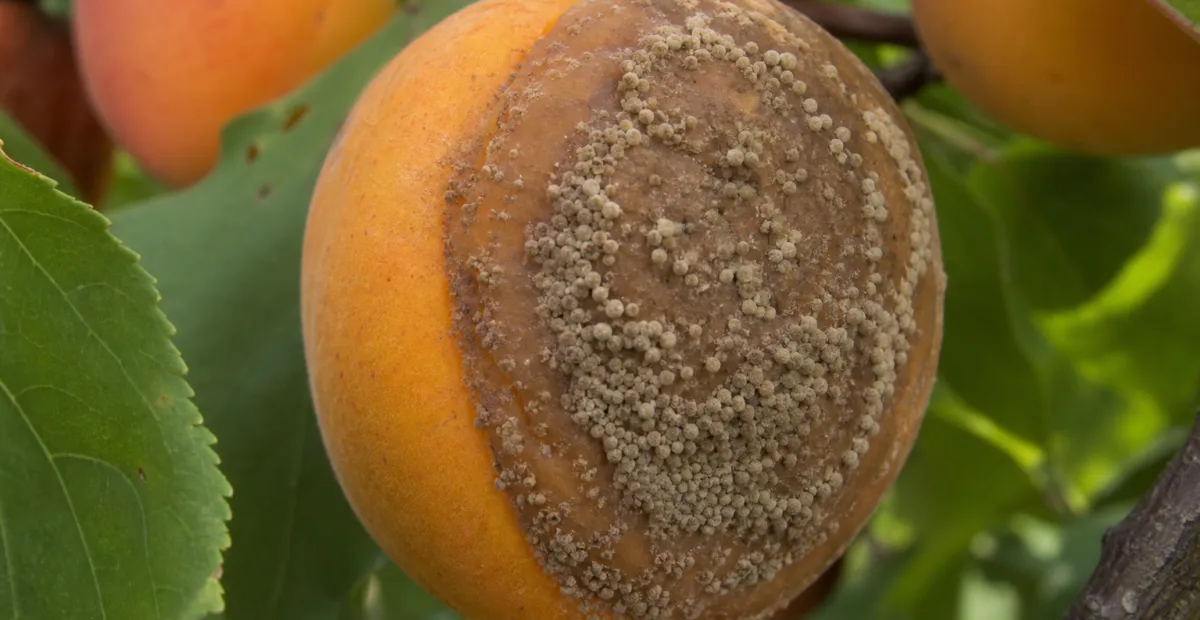
Monilinia laxa infects flowers, short fruiting spurs, shoots and fruit, with the most conspicuous losses usually occurring during bloom and as fruit ripens. Dead blossoms often remain attached to the tree, and infection may extend into the spur or twig, producing a canker and dieback. Fruit develops a firm brown spot that enlarges quickly, followed by tan-to-gray powdery spore masses and eventual shriveling into a mummy.
In the United States, M. laxa is relatively widespread in California and is an important brown-rot pathogen in parts of the Pacific Northwest; it has also been confirmed in selected Midwestern and northeastern locations. Because M. fructicola and M. laxa produce overlapping symptoms, a laboratory diagnosis may be needed for species-level identification.
Symptoms and identification
- Flowers: Blossoms turn brown, collapse and remain attached; sticky amber gum may appear at the flower base.
- Shoots and twigs: Sunken brown areas or cankers develop below infected blossoms. Leaves beyond a girdling canker wilt, turn brown and may remain attached. Small tan-gray spore tufts can form in humid weather.
- Fruit: A small brown, often firm spot expands rapidly on ripening fruit. The fruit may remain attached, become covered with concentric or scattered tan-gray sporulation, then shrivel into a dry mummy.
- Postharvest: Rot can spread rapidly between touching fruit in bins, bags or other warm, humid storage conditions.
Brown blossom blight and twig dieback are particularly characteristic of M. laxa, but these signs are not sufficient by themselves to distinguish it from other brown-rot fungi.
Causes and spread
The pathogen survives between seasons mainly in mummified fruit left on the tree or ground and in infected twigs, spurs and cankers. In spring, wet weather stimulates spore production. Wind and rain move spores to blossoms, and several hours of flower wetness may be sufficient for infection depending on temperature.
Later infections are favored by ripening fruit, especially where fruit has been injured by insects, hail, cracking, pruning or contact with neighboring fruit. Dense canopies, poor air movement, prolonged rainfall, overhead irrigation and abandoned or unmanaged fruit nearby increase inoculum and humidity.
Life cycle and persistence
Monilinia laxa overwinters as mycelium in fruit mummies and diseased woody tissue. During cool, wet spring conditions it produces conidia on mummies, dead blossoms and cankers. Spores infect open flowers and may grow from the flower into the spur or twig, creating cankers that continue to produce secondary spores.
Fruit is generally most vulnerable as it approaches maturity or when the skin is wounded. Infected fruit develops brown rot and abundant conidia, allowing rapid secondary spread within fruit clusters and after harvest. The shriveled fruit and infected twigs then serve as inoculum for the next season.
Treatment and control
Begin with sanitation and pruning: remove rotten fruit, fallen mummies and infected woody tissue, and take the material out of the orchard or garden. Improve airflow and reduce canopy wetness. Remove badly rotted fruit before it touches neighboring fruit, and keep harvested fruit cool, dry and uninjured.
Where brown rot has caused repeated losses, a preventive fungicide program may be needed during bloom and again near fruit ripening, particularly when wet weather is forecast. Timing, permitted active ingredients, resistance-management requirements and preharvest intervals vary by crop and state. Confirm the diagnosis and consult current local extension recommendations before applying any product.
Low-impact and biological control
Organic management relies primarily on reducing inoculum and avoiding infection conditions: remove mummies and cankered wood, improve ventilation, prevent overhead wetting, promptly remove infected fruit, and minimize insect and weather injury. Copper products or other materials may be permitted in some certified-organic systems and crops, but effectiveness and burn risk vary with timing, cultivar and weather. Use only products registered for the specific crop and disease under the applicable U.S. label and organic-certification rules.
Biological products may be available for selected crops, but performance is highly dependent on preventive timing and local conditions. They should supplement, not replace, sanitation and canopy management.
Prevention
- Remove and destroy or dispose of all mummified fruit before bud break, including fruit on the tree and on the orchard floor.
- Prune out dead shoots, infected spurs and cankers during the dormant season, cutting well below visibly diseased tissue. Disinfect tools between cuts when practical.
- Thin dense canopies and prune for good sunlight penetration and air circulation.
- Use drip or low-angle irrigation rather than sprinklers that wet blossoms, fruit and foliage.
- Harvest promptly as fruit ripens, handle fruit gently and cool it quickly after harvest.
- Control insects and other causes of fruit injury, and remove rotten fruit promptly during the season.
- Choose locally adapted cultivars with lower brown-rot susceptibility when reliable regional information is available.
Interesting facts
- The name “European brown rot” reflects the prominence of M. laxa in Europe; the same species is established in parts of the United States.
- Dead blossoms may remain attached because the infection kills the flower and then extends into its spur or twig.
- Fruit mummies are not merely old crop waste: they can remain a major source of spores for the following bloom period.
- Species identification based only on field appearance is unreliable because M. laxa, M. fructicola and sometimes other Monilinia species produce very similar brown-rot symptoms.
- In the United States, M. fructicola is generally the more widespread brown-rot species, so a suspected M. laxa diagnosis should be confirmed when species-level accuracy matters.
Use only fungicides legally authorized in the United States for the specific crop and brown-rot problem, and follow the current EPA-approved product label, state restrictions, rate, protective-equipment, reentry and preharvest requirements. Do not copy a spray schedule from another crop, state or year. Rotate effective fungicide groups according to current university extension and resistance-management guidance; never apply copper after bloom unless the current crop label specifically permits it.
Affected plants
The plants below are linked to this problem by structured host-plant data. The list updates automatically as new plant profiles are added.