
 Source:
 European Grapevine Moth
Lobesia botranaEuropean Grapevine Moth overview
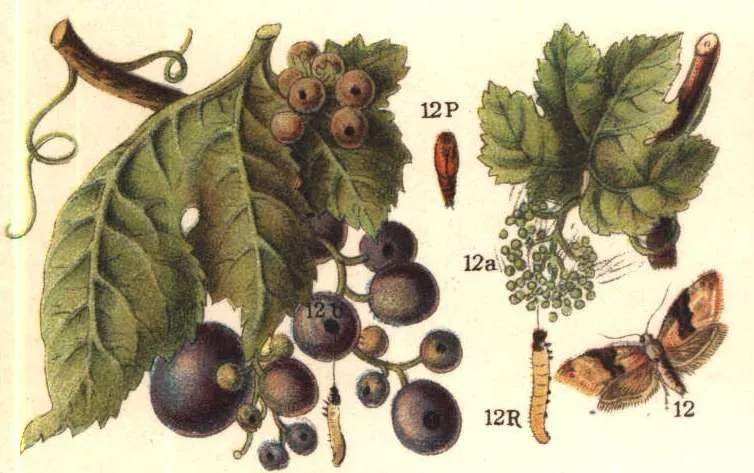
European grapevine moth, Lobesia botrana, is a serious tortrix pest of grape flowers and berries. Larvae web flower clusters, bore into developing grapes, and contaminate bunches with frass, increasing the risk of Botrytis and other fruit rots. Grapevine is the principal crop host, although olives, stone fruit, persimmons, pomegranates and several ornamental or wild plants may support feeding. In the United States, the pest was eradicated from California in 2016 but remains a regulated detection concern.
Typical conditions
Overview
Adults are small moths with cream to tan forewings mottled with gray, brown and black, usually held roof-like over the body. Eggs are laid singly rather than in overlapping masses. Larvae are variable tan, yellow-brown or darker and can resemble other tortricid caterpillars, so field identification of larvae is unreliable without specialist confirmation.
Grapevine, especially Vitis vinifera, is the most important agricultural host. The pest is especially damaging because larvae feed within protected flower clusters and berries, where they are difficult to reach and where damaged fruit can become infected by secondary fungi.
Symptoms and identification
- Early-season larvae web flowers, flower parts and pedicels together, producing silk shelters and feeding injury in grape clusters.
- Damaged flower clusters may dry or fail to set fruit.
- Later larvae enter green or ripening berries, leaving holes, hollowed berries, webbing and visible frass.
- Infested bunches may show berry collapse, leakage and secondary bunch rots, including Botrytis, Aspergillus, Alternaria, Rhizopus, Cladosporium or Penicillium.
- Look for single, flat, lentil-shaped eggs on flower-cluster parts or berries. Fresh eggs are pale and iridescent; developing eggs become yellow and later show a dark head capsule.
Several native or established grape pests can cause similar webbing and berry injury in the United States. Confirmation of L. botrana requires an expert, particularly for larvae.
Causes and spread
Damage is caused by larvae feeding on grape flowers and fruit, not by the adult moth. Adults are most active around dusk and lay eggs singly on suitable plant surfaces. Larvae move into clusters and berries, where silk webbing and concealed feeding protect them from exposure.
Long-distance spread is most commonly associated with infested grape clusters, vine clippings, nursery stock and contaminated grape-production equipment. Local spread can occur from nearby untreated vines, vineyards or alternate hosts. In the United States, regulated import pathways and surveys are intended to prevent reintroduction.
Life cycle and persistence
The species overwinters mainly as a pupa in a silken cocoon under grapevine bark, in soil cracks or other protected locations around the trellis. Adults emerge after sustained spring warmth, with males often appearing before females. Females mate and begin laying eggs within a few days.
The first generation generally coincides with bud break through flowering and attacks flower clusters. The second generation attacks developing green berries, while a third generation in warm regions commonly feeds in ripening bunches and causes the most economically important damage. Two generations occur in cooler areas, three are common in Mediterranean climates, and a partial fourth generation may occur in especially warm regions.
Egg hatch may take about 3–5 days in favorable summer conditions and roughly 10–11 days in cooler spring conditions. Larval development commonly takes 20–30 days, followed by pupation lasting approximately 6–14 days, depending on temperature.
Treatment and control
Begin with monitoring rather than calendar spraying. Inspect a representative sample of clusters, use pheromone traps to establish flight timing, and follow current recommendations from the state extension service or regulatory program. For established populations, management is commonly directed at newly hatched larvae before they enter flowers or berries, because concealed larvae are harder to control.
Use canopy management, removal of infested fruit and careful harvest sanitation as supporting measures. In commercial vineyards, area-wide coordination and mating disruption may be important. If a suspect moth is found in the United States, preserve the specimen and contact plant-health authorities before moving fruit, vines, cuttings or equipment from the site.
Low-impact and biological control
- Use pheromone-based mating disruption where it is registered, locally recommended and economically appropriate; effectiveness depends on adequate dispenser density, block size and immigration pressure.
- Conserve predators and parasitoids by avoiding unnecessary broad-spectrum insecticide applications and by maintaining flowering resources away from harvest-sensitive areas.
- Hand-pick and destroy webbed clusters or infested berries in backyard vines and small plantings.
- Remove fallen fruit, old bunches and pruning debris that can harbor pupae or attract secondary pests.
- Biological insecticides based on products such as Bacillus thuringiensis may be useful against exposed young larvae only when the specific formulation is legally labeled for the crop and pest and applied at the correct timing.
Biological and organic options work best against exposed early larvae and are less reliable after larvae enter berries.
Prevention
- Learn the appearance of grapevine moth injury, but do not rely on visual diagnosis alone; report suspected L. botrana detections in the United States to state plant-health officials or USDA APHIS.
- Use pheromone traps and, where available, an extension or state regulatory monitoring program to detect adult flight periods.
- Inspect grape clusters regularly from flowering through harvest for eggs, silk webbing, entry holes, hollow berries and frass.
- Remove and destroy heavily infested clusters and fallen or mummified fruit where practical; do not compost suspect material unless temperatures and procedures are adequate.
- Prune and train vines to improve cluster visibility and spray or biological-control coverage without causing sunburn.
- Clean harvest bins, tools and equipment before moving between blocks, and obtain nursery stock and grape cuttings from reputable, inspected sources.
- Coordinate management with neighboring vineyards because untreated blocks can contribute to reinfestation.
Interesting facts
- Grapevine is the principal crop host, although the documented host list includes olive, persimmon, pomegranate, kiwifruit, some Prunus species, currants and several wild or ornamental plants.
- European grapevine moth eggs are laid singly, making them different from the overlapping egg masses of some other vineyard tortricids.
- The third generation often causes the greatest grape damage because larvae feed inside ripening bunches and promote bunch rot.
- Lobesia botrana is easily confused with other grape berry moths. In the eastern United States, the native grape berry moth, Endopiza viteana, can cause similar injury but is a different species.
- The United States eradicated the California infestation detected in 2009, but continued surveillance and import safeguards remain important because reintroduction could threaten grapes and other fruit crops.
Use only insecticides legally authorized for European grapevine moth on the specific crop in your state or country. Read and follow the current product label for crop, pest, rate, timing, worker protection, preharvest interval, resistance-management requirements and environmental precautions. Do not use an off-label pesticide program or assume that a product registered for another grape leafroller is authorized for Lobesia botrana. In the United States, suspected detections should be reported before moving or treating regulated plant material.