
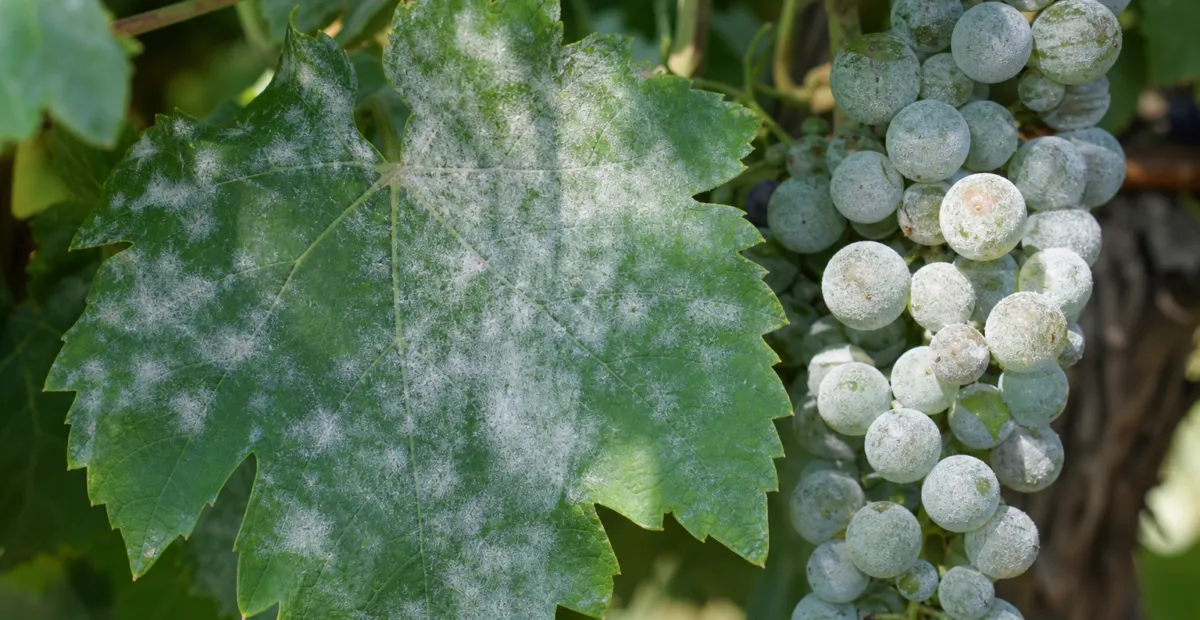
Grape Powdery Mildew
Erysiphe necator Schwein. (synonym: Uncinula necator)Grape Powdery Mildew overview
Grape powdery mildew is a widespread fungal disease of grapevines caused by Erysiphe necator. It produces white to gray powdery colonies on leaves, shoots, rachises and berries, often beginning before symptoms are obvious. Early infections can scar, crack or stop berry development, while severe canopy infection reduces photosynthesis and fruit quality. Prevention depends on early monitoring, airflow, resistant or tolerant cultivars and timely integrated management.
Typical conditions
Overview
Erysiphe necator causes grape powdery mildew, one of the most important diseases of cultivated grapevines in the United States. Unlike downy mildew, it does not require prolonged leaf wetness for active colony growth; free moisture can instead help release primary ascospores from overwintering structures. The fungus forms superficial white to gray mycelium and spores, while feeding through specialized structures inside epidermal cells.
Vitis vinifera cultivars are often highly susceptible, whereas many North American and interspecific grape types show variable partial resistance. A resistant rating is not absolute: cultivar, pathogen population, canopy conditions and regional disease pressure all affect performance.
Symptoms and identification
Early leaf symptoms may appear as faint chlorotic or pale spots, followed by white, web-like growth that becomes dusty or powdery. Colonies may occur on either leaf surface, shoots, petioles, rachises, flowers and young fruit.
- Young shoots can become stunted, distorted or covered with white growth.
- Infected berries may develop a powdery coating, brown or black web-like scars, russeting, cracking or splitting.
- Severely infected clusters may stop expanding, dry, or fail to ripen normally.
- Older infections can leave red-brown blotches on dormant canes.
Do not confuse this disease with downy mildew, which commonly produces yellow oil spots on the upper leaf surface and whitish growth mainly on the underside during humid or wet periods.
Causes and spread
The pathogen survives primarily as dark chasmothecia on infected vine surfaces or as mycelium inside dormant buds. In spring, rain, dew or irrigation wetting can trigger ascospore release. After primary infections become established, large numbers of conidia are produced and spread readily by air currents within and between vines.
Spread is favored by dense canopies, excessive vigor, poor spray penetration, susceptible cultivars and an untreated early-season infection focus. The disease is polycyclic, so repeated secondary infection can rapidly increase severity during periods of suitable temperature.
Life cycle and persistence
Overwintering chasmothecia mature on infected green tissue during late summer and fall and may be washed onto cordons, arms and other permanent vine parts. In spring, moisture and suitable temperatures release ascospores, which infect young green tissue. In some vineyards, infected dormant buds produce diseased shoots known as flag shoots shortly after budbreak.
Conidia commonly begin forming about 5–10 days after infection and continue to initiate new colonies throughout the season. Colony development is favored by moderate temperatures, especially about 70–85°F. Prolonged temperatures above approximately 95°F can slow growth, but heat alone is not a dependable control strategy.
Treatment and control
Management is most effective when started preventively or at the first detected colonies. Remove or suppress isolated early infections where feasible, then maintain thorough coverage of expanding shoots, leaves and clusters according to local extension recommendations and the product label.
For commercial vineyards, base interval and product-group decisions on disease pressure, vine growth, weather and a resistance-management plan. Rotate or alternate fungicides with different FRAC groups, avoid repeated use of a single systemic or single-site product, and do not assume that a product will eradicate established colonies unless its current label specifically supports that use. Improve canopy penetration through shoot positioning and carefully timed leaf removal.
Low-impact and biological control
In US organic production, sulfur products, certain horticultural oils, potassium bicarbonate products and microbial biologicals may be available, but approval depends on the specific formulation, crop, certification program and current label. These materials work best early and with thorough coverage; they are less reliable after heavy colonization.
- Use labeled sulfur products preventively or at early infection, while observing temperature restrictions and crop-safety precautions.
- Potassium bicarbonate and biological products may help suppress colonies when used repeatedly and with good coverage.
- Horticultural oils can suppress or eradicate some colonies, but should not be combined or closely timed with sulfur unless the label specifically permits it.
- Combine organic products with tolerant cultivars, canopy management, sanitation and frequent scouting.
Prevention
Begin scouting at budbreak and continue through fruit development, inspecting shoot tips, basal leaves, undersides of leaves, flowers and clusters. In vineyards, use a locally appropriate disease-risk model such as the UC Davis Powdery Mildew Risk Index together with direct scouting rather than relying on a calendar alone.
- Choose cultivars or breeding lines with documented powdery mildew tolerance where fruit and wine characteristics permit.
- Prune and train vines to create an open canopy; position shoots and remove excess suckers, laterals or leaves when appropriate.
- Improve light and spray penetration around clusters without excessively exposing fruit to sunburn.
- Remove severely infected tissues where practical, especially flag shoots and heavily diseased prunings; dispose of them away from the vine row.
- Avoid excessive nitrogen and unmanaged vigor.
- Protect the crop before disease becomes widespread, particularly from early shoot growth through bloom and berry development.
Interesting facts
Erysiphe necator is an obligate biotroph: it depends on living grape tissue for growth and reproduction. Its former scientific name, Uncinula necator, remains common in older extension literature.
The pathogen is specialized mainly to grapevine relatives in the genus Vitis, so powdery mildew from cucurbits, roses or other unrelated plants is not the same disease and normally does not infect grapes. Susceptibility differs substantially among grape species and cultivars; muscadine grape, Vitis rotundifolia, also shows pathogen specialization that differs from many other Vitis hosts.
Berry infection can have consequences beyond yield: cracked fruit, poor marketability and mildew-associated compounds can affect juice and wine quality.
Use only fungicides legally authorized for grapevines and grape powdery mildew in the United States and in your state, and follow the current product label for rate, timing, reentry interval, preharvest interval, worker protection, temperature restrictions and mixing compatibility. Rotate FRAC groups to reduce resistance risk. Sulfur and oil applications can injure vines or fruit when misused or applied too close together; follow the label and local extension guidance. Pesticide registrations and permitted uses can change.
Affected plants
The plants below are linked to this problem by structured host-plant data. The list updates automatically as new plant profiles are added.
 Tagetes (Tagetes erecta) care guideTagetes erecta
 Boxelder (Acer negundo) care guideAcer negundo
 Arrowwood (Viburnum carlesii) care guideViburnum carlesii
 Arrow-wood (Viburnum dentatum) care guideViburnum dentatum
 Fragrant viburnum (Viburnum farreri) care guideViburnum farreri
 Wayfaring-tree (Viburnum lantana) care guideViburnum lantana
 Okra (Abelmoschus esculentus) care guideAbelmoschus esculentus
 Flossflowe (Ageratum houstonianum) care guideAgeratum houstonianum
 False Acacia (Robinia pseudoacacia) care guideRobinia pseudoacacia
 Apple tree (Malus domestica) care guideMalus domestica
 Lemon verbena (Aloysia citrodora) care guideAloysia citrodora
 Common Garden Peony (Paeonia lactiflora) care guidePaeonia lactiflora