Spotted Asparagus Beetle
Crioceris duodecimpunctataSpotted Asparagus Beetle overview
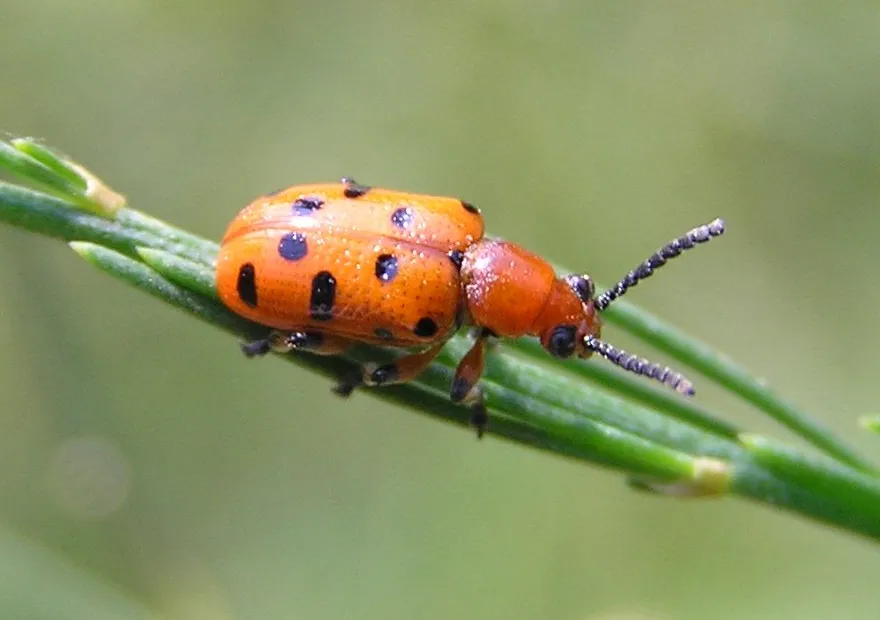
The spotted asparagus beetle, Crioceris duodecimpunctata, is a reddish-orange leaf beetle marked with twelve black spots. Adults chew tender asparagus spears and fern growth, while larvae usually develop inside asparagus berries, making this species less damaging to established crowns than the common asparagus beetle. It can still reduce market quality and become important in asparagus seed-production plantings.
Typical conditions
Overview
Crioceris duodecimpunctata, commonly called the spotted asparagus beetle or twelve-spotted asparagus beetle, is a leaf beetle in the family Chrysomelidae. Adults are typically reddish-orange to tan and about 1/4 to 1/3 inch long, with six black spots on each wing cover.
In the United States it is associated primarily with cultivated asparagus (Asparagus officinalis). The species is often found together with the common asparagus beetle, Crioceris asparagi, but their larval feeding habits differ. Spotted asparagus beetle larvae commonly develop in asparagus berries, while common asparagus beetle larvae are more destructive to fern foliage.
Symptoms and identification
Adult feeding can scar, pit, or chew holes in tender asparagus spears. Damaged spears may become brown, hooked, bent, or misshapen, reducing their marketability and making them less appealing for fresh use.
Adults may also feed on asparagus fern tips and foliage. Eggs attached to harvested spears are objectionable to consumers even though they do not themselves injure the plant. Larvae are commonly found inside developing berries, where they consume berry tissue and seeds. Heavy berry injury is particularly important in seed-production plantings.
Because adults and larvae can resemble those of the common asparagus beetle, confirm the adult’s reddish-orange color and twelve black wing-cover spots before attributing extensive fern defoliation to this species.
Causes and spread
Populations build when adult beetles overwinter in or near asparagus beds, including old fern residue, plant debris, sheltered vegetation, logs, and other protected sites. Adults move onto newly emerging asparagus in spring, feed, and begin laying eggs after approximately one week.
Spread occurs through adult flight into asparagus plantings and through survival of beetles in unmanaged beds and nearby debris. Female plants that produce berries provide the principal larval resource. Volunteer asparagus, neglected seed crops, weeds, and retained dead fern can increase local habitat and overwintering sites.
Life cycle and persistence
Adults overwinter in sheltered locations and emerge as asparagus spears appear, usually later in spring than the common asparagus beetle in much of the northern United States. Adults feed on spears and fern growth, mate, and lay oval eggs singly on asparagus tissue; spotted asparagus beetle eggs are commonly attached by their side rather than standing upright.
Eggs generally hatch within several days to about a week, although timing varies with temperature. Larvae are slug-like and orange, gray-orange, or cream-colored with a brownish head. They most often enter developing asparagus berries and feed for roughly 10–14 days before dropping to the soil to pupate. Adults emerge after pupation, and one or more generations may occur depending on latitude and season; two generations are reported in some Mid-Atlantic locations.
Treatment and control
Use an integrated approach based on confirmed pest presence and crop value. In home gardens, handpick adults into soapy water, brush or remove eggs from spears and fern, and remove localized infested berries or branches. Shake infested fern over a container to dislodge larvae, then remove the collected material.
For commercial or larger plantings, monitor adults, eggs, larvae, spear injury, and berry injury rather than treating by calendar alone. Management thresholds differ by state, crop-use pattern, and whether the planting is harvested for fresh spears or seed. Consult the current recommendations of the state Extension service and consider treatment only when pest pressure threatens market quality, crown vigor, or seed yield.
Do not confuse spotted asparagus beetle with the more damaging common asparagus beetle. Extensive fern defoliation, for example, may indicate C. asparagi or a mixed infestation rather than C. duodecimpunctata alone.
Low-impact and biological control
- Handpick adults and remove eggs, larvae, and infested berries in small plantings.
- Encourage natural enemies by limiting broad-spectrum insecticide use. Lady beetle larvae and parasitoid wasps may attack asparagus beetle stages, although their effectiveness varies by location and season.
- Ducks or chickens may help reduce exposed beetles and larvae around suitable backyard plantings, but protect young asparagus and prevent soil compaction or crop contamination.
- Use sanitation, prompt harvest, weed management, and removal of volunteer asparagus as the foundation of nonchemical control.
- Biological products or organically approved pesticides should be considered only when they are specifically labeled for asparagus and the target pest in the United States; efficacy and availability vary.
Prevention
- Inspect spears and fern growth frequently from emergence through early summer, especially on warm, sunny afternoons when adults are active.
- Harvest marketable spears promptly and regularly; rapid harvest reduces the time available for adult feeding and egg laying on shoots.
- After fern has completely senesced, remove and dispose of old fern and plant debris where permitted. If frost or snow delays fall cleanup, remove dead material as soon as practical in spring.
- Keep the asparagus bed and surrounding margins reasonably free of weeds, volunteer asparagus, and dense unmanaged debris.
- In small plantings, handpick adults and remove eggs before they hatch. Remove and destroy infested berries in seed-production areas.
- Maintain vigorous asparagus growth through appropriate fertility, irrigation, and weed management; healthy fern is better able to support crown replenishment.
Interesting facts
- The species is also known as the twelve-spotted asparagus beetle because each wing cover carries six black spots.
- It is generally less injurious to established asparagus crowns than the common asparagus beetle because its larvae usually feed in berries rather than heavily defoliating fern.
- Berry feeding can nevertheless be economically important in asparagus grown for seed.
- The beetle is native to Europe and became established in North America after introduction in the late nineteenth century.
- Adult spotted asparagus beetles are sometimes mistaken for lady beetles; their more elongated body, reddish-orange color, and six spots per wing cover help distinguish them.
Use insecticides only when monitoring shows that control is justified and only products legally authorized and currently labeled in the United States for asparagus and this pest or crop-use situation. Follow the current label exactly, including rate, personal protective equipment, preharvest interval, reentry interval, application timing, and restrictions protecting pollinators and aquatic organisms. Do not apply a product based solely on an internet list or on a label for a different crop or pest. Contact the state Extension service for current state-specific options.
Affected plants
The plants below are linked to this problem by structured host-plant data. The list updates automatically as new plant profiles are added.