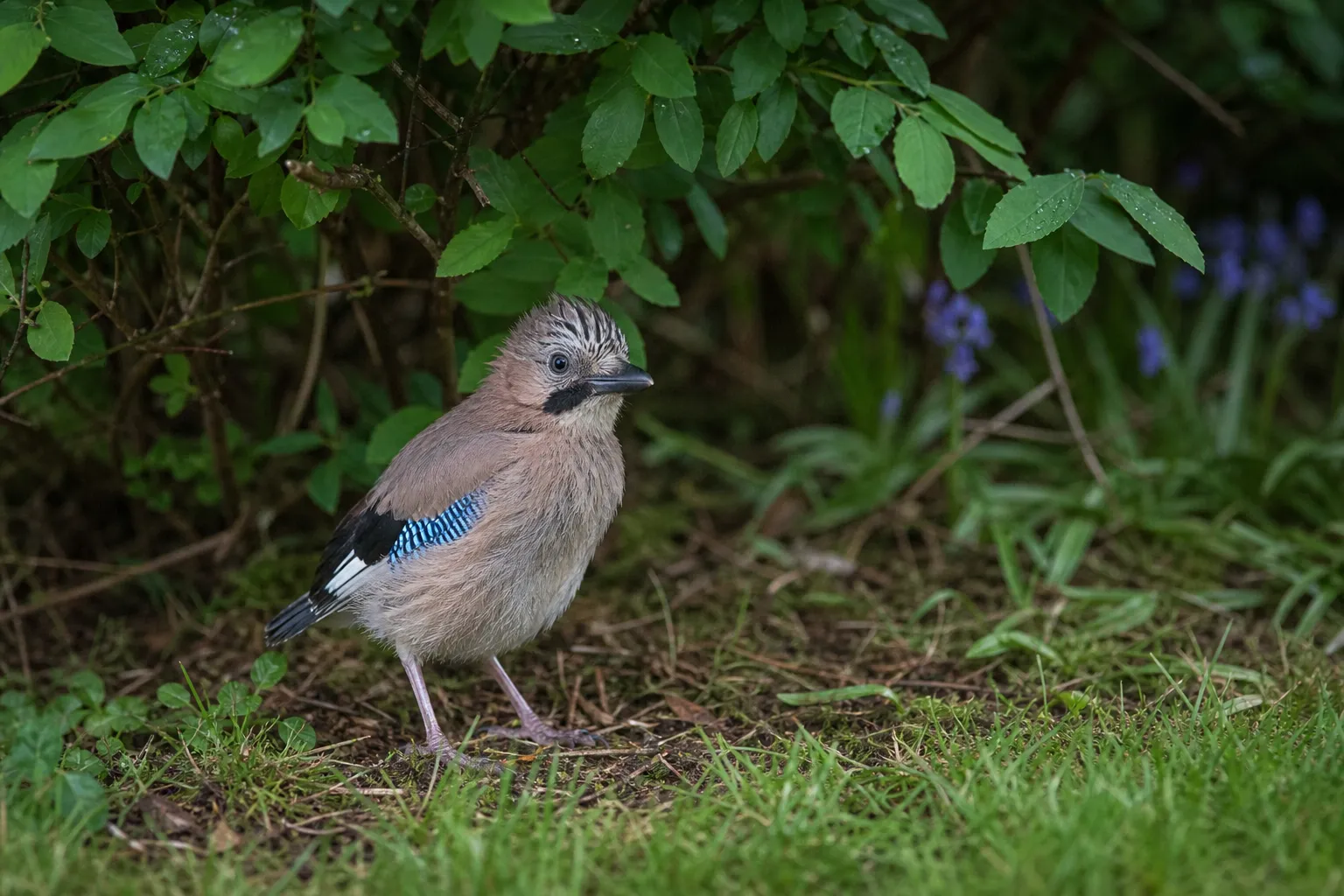
Finding a young jay on the ground can be alarming. Its feathers may look untidy, its flight may be clumsy, and it may sit very still while you approach. But in many cases, that awkward-looking bird is not abandoned at all. It is a fledgling: a young bird that has left the nest and is still learning how to fly, forage and avoid danger.
The most helpful thing you can do is pause before picking it up. Watch from a distance, keep pets away and decide whether the bird is simply growing up—or genuinely needs professional help.
One important detail matters in the United States: a true Eurasian jay (Garrulus glandarius) is not a normal wild resident here. If you are in the U.S. and believe you have found one, the bird may instead be a young blue jay, scrub-jay or another native corvid. Identification can be tricky, so do not rely on appearance alone. If the bird really is a Eurasian jay, contact a licensed wildlife rehabilitator or your state wildlife agency rather than attempting to keep it.
First, work out whether it is a fledgling or a nestling
The bird’s stage of development gives you the clearest clue about what to do next. A nestling is too young to be out of the nest. A fledgling has left the nest normally, even though it may not yet fly well.
A fledgling usually has these features
- Most or all of its body is covered with feathers.
- It can stand, hop, grip a branch or flutter short distances.
- Its tail may look short, and its wing feathers may still seem underdeveloped.
- It may call repeatedly, gape for food or flap when approached.
- It appears alert and reacts to movement nearby.
Fledglings often spend several days on the ground or in low shrubs while their parents continue feeding them. The parents may stay out of sight because a person standing nearby makes them cautious. For that reason, you may not see an adult bird even when one is watching from a tree.
A nestling needs more immediate attention
A nestling has little feathering, bare patches, fluffy down or visible pinfeathers. It may be unable to stand, hop or grip properly. If you find a bird at this stage, look for the nest before doing anything else.
A healthy nestling can usually be placed back in its original nest. Your scent will not cause the parents to reject it. If the nest has fallen or been destroyed, a licensed rehabilitator can advise you about a replacement nest or another safe solution.
When you should leave a young jay alone
If the bird is fully feathered, alert and moving normally, leaving it where you found it is usually the best choice. Keep your distance and give the family space to reunite. Watching from inside your home or from at least 50 to 100 feet away can make it easier for the parents to return.
Try to keep observation brief and discreet. Constant checking can attract predators, frighten the parents or encourage the young bird to move into a more dangerous area.
For the next day or two, take practical steps around your yard:
- Keep cats indoors and dogs leashed.
- Ask children to watch from a distance rather than handle the bird.
- Pause mowing, hedge trimming and other noisy work nearby.
- Remove hazards such as open window wells, buckets and deep containers.
- Do not place food or water beside the bird.
A fledgling that is hopping beneath a tree, calling and occasionally fluttering is often doing exactly what it should. Its parents may be feeding it in short visits that are easy to miss.
Move it only if it is in immediate danger
You can move a healthy fledgling a short distance if it is sitting in a driveway, on a busy walkway, beside a road or in another exposed location. Gently place it under a nearby shrub, behind a low plant or on a low branch. Choose a spot close enough for the parents to hear and find it—usually within a few yards of where you discovered it.
Do not carry it across the neighborhood or release it in a park. The young bird’s parents may not be able to locate it, and the original area is where the family has established its territory.
If a cat or dog has grabbed the bird, treat the situation as urgent even when you cannot see a wound. Punctures can be tiny, and bacteria from a pet’s mouth or claws can cause serious problems. Contact a wildlife rehabilitator promptly and follow the handling instructions you receive.
Signs the bird really needs help
A young jay should be assessed by a professional if you notice clear evidence of injury, illness or true abandonment. Watch for:
- Bleeding, an obvious wound, a broken wing or a leg held at an unusual angle.
- Difficulty breathing, repeated falling over, tremors or extreme weakness.
- Eyes that remain closed, severe swelling or discharge.
- A bird that is cold, unresponsive or unable to sit upright.
- Feathers stuck together with oil, paint, glue or another substance.
- Evidence that a cat or dog has caught the bird.
- A dead parent nearby, when the young bird is too small to survive independently.
Do not assume that a quiet bird is abandoned. Shock, fear and exhaustion can all make a young bird sit motionless. Let a rehabilitator or wildlife veterinarian help you judge the situation.
How long should you watch for the parents?
Parents may leave a fledgling alone while they search for food, so a short absence does not prove abandonment. If the bird is safe, keep monitoring from a distance for a couple of hours, preferably from indoors or behind a window.
Contact a professional sooner if the bird is injured, exposed to immediate danger or becoming weaker. If it is healthy but you never see an adult after extended, discreet observation, call a licensed wildlife rehabilitator for advice. Avoid making your own decision to raise the bird.
Bird parents do not need to be visibly perched beside their young all day. They may approach quickly, feed the fledgling and leave before you notice. Human presence is one of the most common reasons a parent stays away.
If you must contain the bird temporarily
A healthy fledgling is usually safest outdoors with its parents. However, a professional may ask you to contain an injured bird while transport is arranged, or you may need to protect a bird from immediate danger for a short time.
Use a small cardboard box with air holes. Line it with a smooth towel or a piece of fleece so the bird cannot slide around. Close the box and keep it in a warm, dark, quiet room away from children and pets.
- Handle the bird as little as possible.
- Do not put the bird in a wire cage, where it can damage its feathers.
- Do not force the beak open.
- Do not give food or water unless a qualified rehabilitator specifically tells you to.
- Do not attempt home treatment, splinting or cleaning of wounds.
Improper feeding can cause choking or aspiration, and an incorrect diet can harm a young bird. Corvids also have specialized nutritional needs that are difficult to meet without professional equipment and experience.
Finding the right help in the United States
Wild birds are protected by federal and state regulations, and keeping a native bird at home is generally not legal without the required permits. Wildlife rehabilitation is specialized work: professionals assess injuries, provide species-appropriate care and prepare birds for release without making them dependent on people.
Search for a licensed wildlife rehabilitator in your state, or contact your state department of wildlife, natural resources or environmental protection. You can also ask a local nature center, Audubon organization or animal control office for the appropriate referral. Call before transporting the bird, because not every facility accepts every species or has space for nestlings.
When you call, be ready to describe:
- Exactly where you found the bird.
- Whether it is feathered and able to hop or fly.
- Any visible injury or contact with a cat or dog.
- How long you have observed it.
- Weather conditions and nearby hazards.
- Whether you have already moved or handled it.
Could it really be a Eurasian jay?
Eurasian jays are medium-sized woodland birds with a pinkish-brown body, black-and-white wing markings and a distinctive patch of barred blue feathers on the wing. They are common across much of Europe and parts of Asia, but they are not a typical backyard species in the United States.
In American gardens, people may use “jay” for several different native birds, especially blue jays and scrub-jays. A juvenile bird can look surprisingly different from an adult, so a clear photograph can help a rehabilitator or experienced birder identify it. Avoid posting the bird’s exact location publicly if the species may be unusual or captive-origin.
If the bird appears unusually tame, has a leg band, or seems to have escaped from captivity, tell the wildlife agency or rehabilitator. Do not attempt to return a nonnative bird to the wild.
Make your garden safer for young birds
You can reduce emergencies by making a few simple changes during nesting season. Keep cats indoors, especially in spring and early summer, and check areas where fledglings commonly land. Dense native shrubs give young birds cover while allowing their parents to reach them.
- Use window decals or exterior screens where birds regularly strike glass.
- Cover or empty water features with steep sides, open barrels and unused containers.
- Keep pesticides and other garden chemicals away from wildlife, and follow every product label.
- Delay major pruning until after the main nesting season when practical.
- Provide shallow, clean water only in a basin where birds can escape easily.
A wildlife-friendly garden does not need to look untidy. A mix of mature trees, shrubs, ground cover and a few quiet corners can give young birds the shelter they need without turning your yard into a rescue station.
The kindest help is often hands-off
Seeing a young jay on the ground can tug at your heart, but rescue is not always the right response. If the bird is feathered, alert and uninjured, protect the area, keep pets away and give its parents time to do their job.
Step in when there is a clear emergency: injury, exposure, pet attack, severe weakness or confirmed loss of the parents. Then contact a licensed wildlife professional, keep the bird warm and quiet if instructed, and resist the urge to feed or raise it yourself. With a little patience and the right help at the right moment, you give the young bird its best chance to return to the wild.