
Aphanomyces Root Rot
Aphanomyces euteichesAphanomyces Root Rot overview
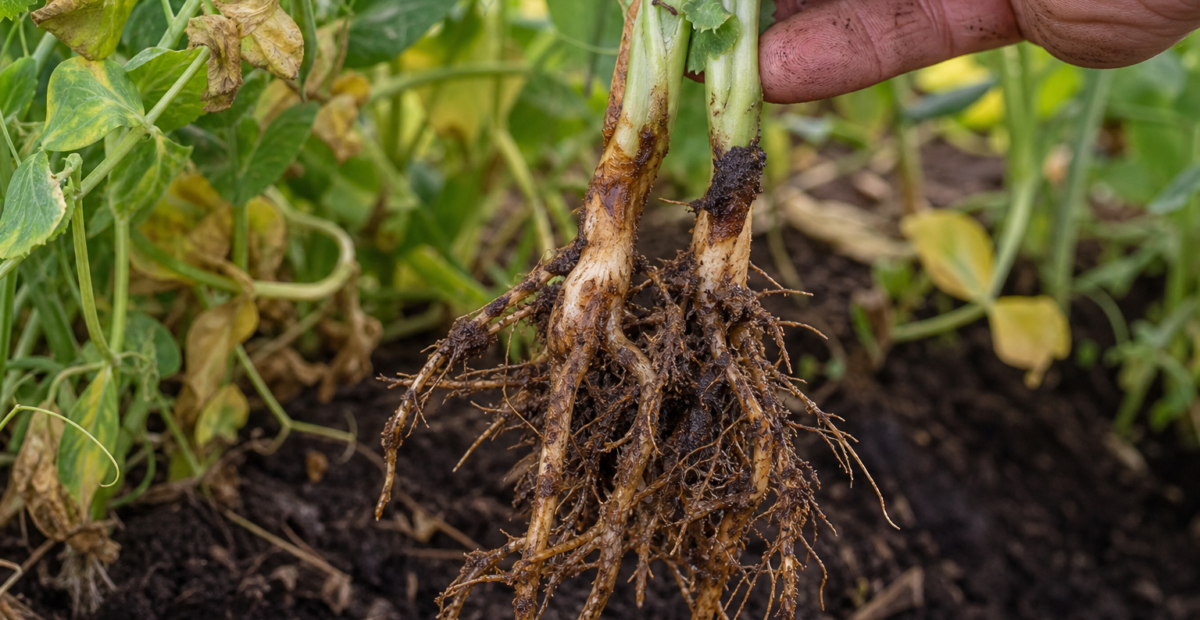
Aphanomyces root rot is a persistent, soilborne disease of peas, alfalfa and several other legumes caused by the water mold Aphanomyces euteiches. It is most damaging when saturated soil, poor drainage and warm spring conditions allow swimming spores to reach roots. Infected plants become stunted and yellow, while roots develop honey-brown decay and may slough away, leaving only vascular strands.
Typical conditions
Overview
Aphanomyces root rot can affect seedlings and older plants, but the most important damage often occurs during establishment or early root development. The pathogen infects root cortex tissue, reducing fine roots and impairing water and nutrient uptake. On peas, infected roots commonly become honey-brown to caramel-brown, water-soaked and soft; the outer tissue may strip away when the plant is gently pulled from the ground.
Above-ground symptoms usually develop after substantial root damage. Plants may be stunted, pale or yellow, wilt during stress and produce fewer pods or seeds. In severe cases, plants die prematurely. Because several soilborne pathogens can occur together, laboratory or extension diagnostic testing is advisable when management decisions are important.
Symptoms and identification
- Roots show water-soaked, honey-brown, caramel-brown or darkening decay.
- Fine feeder roots are reduced or absent.
- The outer root and below-ground stem tissue may slough off, exposing long, string-like vascular tissue.
- Decay can extend slightly above the soil line.
- Lower leaves turn yellow first, followed by progressive chlorosis, stunting, wilting and sometimes plant death.
- Pea plants may form fewer pods and smaller seeds.
- Alfalfa seedlings may have yellow cotyledons, short internodes and severely stunted roots without immediately collapsing.
Symptoms alone cannot reliably distinguish Aphanomyces root rot from other root rots, damping-off, flooding injury or nutrient stress. Dig plants carefully, wash the roots gently and submit representative roots and soil for diagnosis when possible.
Causes and spread
Aphanomyces euteiches survives mainly as thick-walled oospores in infected roots, crop residue and soil. Saturated soil allows motile zoospores to move short distances toward susceptible roots. The pathogen is favored by excessive moisture, poor drainage, compacted or heavy soil, low-lying areas and repeated production of susceptible legumes.
Long-distance movement can occur with contaminated soil, surface drainage, irrigation or splash water, infected plant material and, in some situations, contaminated seed. Disease commonly appears in patches or is more severe where water collects. Root injury from compaction, flooding or other soilborne pathogens can increase disease severity.
Life cycle and persistence
The disease is generally considered monocyclic, with one major infection cycle during a growing season. Dormant oospores germinate when moisture and host-root signals are favorable. They produce sporangia that release biflagellate zoospores. Zoospores swim through free water in soil, encyst on susceptible roots, germinate and penetrate the root cortex.
The pathogen then grows through root tissues and produces new sexual structures and oospores within infected tissue. As roots decay, oospores return to the soil and can remain viable for many years, making short rotations unreliable in heavily infested ground.
Treatment and control
There is no reliable way to cure roots after systemic infection has become established. In gardens, remove and discard severely affected plants, improve drainage and avoid replanting peas or other susceptible legumes immediately in the same wet soil. Do not move infested soil to clean beds.
For commercial peas, lentils or forage legumes, confirm the diagnosis and consider soil testing or a validated bioassay before selecting the next crop. In alfalfa, cultivar resistance matched to the local pathogen race or population is an important management option. Seed treatments may provide limited early protection in some crop systems, but they do not correct saturated soil or protect mature roots from established disease.
Low-impact and biological control
Use an integrated, nonchemical approach centered on drainage, sanitation, crop selection and rotation. Grow peas and other susceptible legumes in raised beds or well-drained soil, reduce compaction, avoid excessive irrigation and remove diseased plants before soil is transported elsewhere. Rotate to nonhost crops where space permits and use resistant or tolerant varieties when documented for the crop and local pathogen population.
Commercial biological products and microbial inoculants should not be assumed to control Aphanomyces root rot. Evidence and performance vary by crop, strain, soil and formulation; use them only when supported by reliable local recommendations and a product label that permits the intended use.
Prevention
- Improve drainage before planting by correcting compaction, using raised beds where practical and managing surface water or subsurface drainage.
- Avoid planting susceptible legumes in fields that remain saturated after rain or irrigation.
- Use certified, high-quality seed and clean soil from tools, boots, transplanters and equipment before moving between beds or fields.
- Choose cultivars with documented resistance or tolerance to the relevant A. euteiches population when such ratings are available, particularly for alfalfa.
- Use rotations that include nonhost crops such as corn or small grains. Rotation can reduce inoculum pressure, but it may not eliminate disease because oospores persist for many years.
- Remove severely diseased garden plants and avoid incorporating heavily infected root systems into small beds where the disease has not previously occurred.
- Prevent runoff from infested areas from entering clean beds or planting rows.
Interesting facts
- Aphanomyces euteiches is an oomycete, or water mold, rather than a true fungus.
- Its swimming zoospores explain why standing water, saturated soil and runoff are especially important in disease spread.
- Pea roots may be reduced to a central string of vascular tissue after the outer cortex decays.
- Oospores can persist in soil for roughly a decade or longer; some agricultural references report survival of 20 years or more under suitable conditions.
- Pea and lentil fields can remain at risk in rotation because both crops are susceptible hosts.
- Root disease may be present well before obvious leaf symptoms appear.
No pesticide program should be assumed to control established Aphanomyces root rot. Use only products legally authorized for the specific crop and problem in the United States, and follow the current product label exactly. Foliar fungicides generally do not reach infected roots, and products effective against other oomycetes may not be effective against Aphanomyces. Consult your state Extension service or a licensed crop adviser before making a treatment decision.