
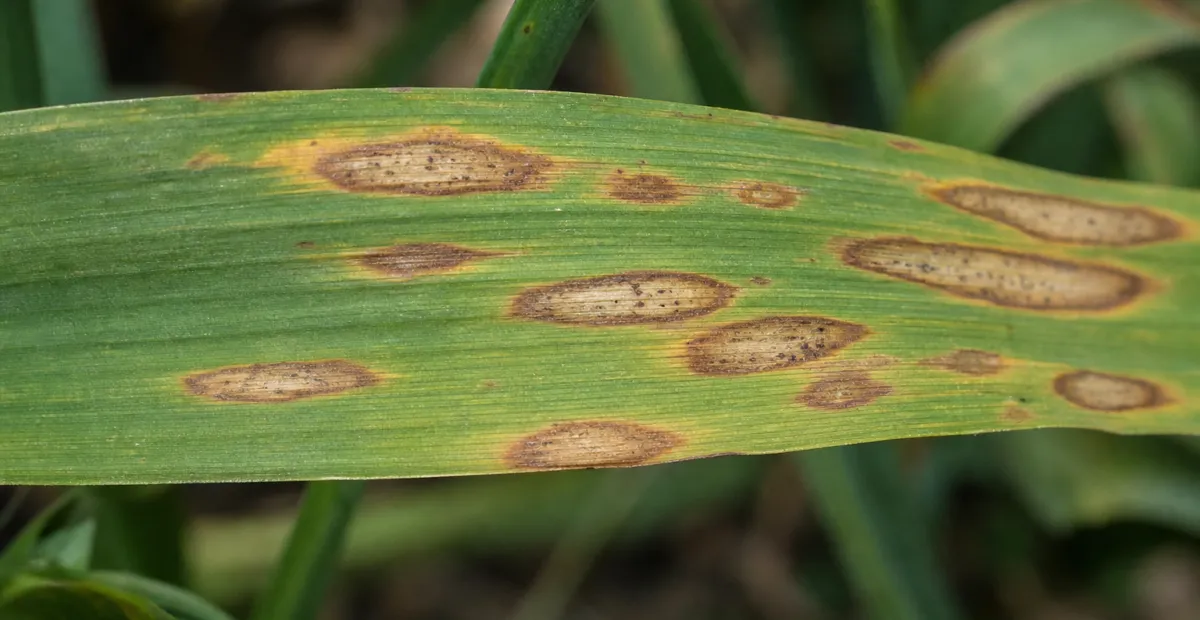
Bipolaris Leaf Spot, Spot Blotch and Common Root Rot
Bipolaris sorokinianaBipolaris Leaf Spot, Spot Blotch and Common Root Rot overview
Bipolaris sorokiniana is a seed- and residue-associated fungal pathogen of grasses that causes spot blotch and common root rot in wheat and barley, black point on grain, and leaf spot or melting-out symptoms in turfgrass. Disease risk rises when susceptible grass is stressed and foliage remains wet, while warm conditions can intensify crown and root injury. Diagnosis may require laboratory confirmation because several dark-spored fungi produce similar lesions.
Typical conditions
Overview
Bipolaris sorokiniana infects grasses, especially small grains and turfgrass. On wheat and barley, the disease complex may appear as spot blotch on foliage, common root rot on roots and crowns, seedling blight, and black point on mature grain. On turf, leaf spots may progress into sheath, crown, root, rhizome, or stolon injury and cause thinning or irregular dead patches.
Field diagnosis is based on lesion pattern, affected plant parts, crop history, and weather, but confirmation by an extension diagnostic laboratory is recommended because symptom-based identification is not specific.
Symptoms and identification
On wheat and barley, seedlings may show poor emergence, stunting, dark brown lesions on lower sheaths, crown discoloration, and brown or blackened roots. Foliar spot blotch produces oval to elongated light- or dark-brown lesions that may enlarge and merge. Mature grain can develop black point, a dark discoloration concentrated near the embryo end.
On turfgrass, lesions are circular to elongated and brown, purple-brown, or dark-edged, often with tan centers or yellow halos. Severe infections can affect sheaths and crowns, producing thinning, scattered dead areas, root decay, and melting-out. Symptoms can be subtle or confused with drought, traffic, nutrient imbalance, or other leaf-spot diseases.
Causes and spread
Primary sources include infected or contaminated seed, surviving cereal and turfgrass residue, thatch, volunteer grasses, and susceptible weeds. Windborne conidia, rain splash, irrigation, mowing, equipment, workers, and movement of wet clippings can spread inoculum locally.
Dense stands, frequent close mowing, prolonged leaf wetness, poor drainage, high humidity, excessive nitrogen, warm soil, drought stress, and other forms of plant stress increase the likelihood that latent or new infections become damaging. The pathogen may persist unnoticed in residue or seed until favorable weather and a susceptible host are present.
Life cycle and persistence
The fungus survives between crops or mowing cycles as mycelium and conidia in infected plants, seed, thatch, and crop residue. Seedborne inoculum can cause seedling blight and establish infection in new stands. Conidia are dispersed primarily by wind, rain splash, irrigation, equipment, and contaminated plant material.
Under suitable moisture, spores germinate and penetrate leaves or young tissues. Foliar lesions produce additional spores, allowing secondary spread through a crop or turf stand. When plants are stressed or temperatures become favorable, infections may extend from leaves and sheaths into crowns and roots. The relative importance of leaf spot versus root and crown injury depends on host, isolate, temperature, moisture, and management.
Treatment and control
There is no curative treatment that restores dead leaf, crown, root, or grain tissue. Remove or manage severely affected turf areas, correct drainage and moisture problems, reduce stress, and reseed or renovate only after the underlying conditions are corrected. In cereal fields, prioritize resistant varieties, crop rotation, clean seed, residue management, and timely harvest planning for future crops.
Where disease risk and crop value justify intervention, a labeled seed treatment or foliar fungicide may be considered only after diagnosis and review of the current U.S. label. Product performance depends on crop, disease stage, resistance status, timing, and local conditions; repeated use of one fungicide class can select resistant fungal populations. Follow label directions and local extension recommendations.
Low-impact and biological control
Use an integrated, low-residue approach rather than relying on a single treatment. Start with pathogen-free or tested seed and avoid planting visibly damaged seed lots. Rotate wheat and barley with non-host crops where practical, manage volunteer cereals and grassy weeds, and incorporate or encourage decomposition of infected residue according to local soil-conservation requirements.
For turfgrass, reduce prolonged leaf wetness, improve drainage and air movement, reduce shade where feasible, avoid excessive nitrogen, and mow at the highest suitable height. Irrigate deeply and infrequently when appropriate, preferably early enough for foliage to dry. Remove heavily diseased clippings when practical, clean mower decks between affected and healthy areas, and avoid moving wet plant debris.
Commercial biological seed or soil products may have inconsistent results and should be selected only when they are labeled for the intended crop and disease. Use them as part of sanitation, host resistance, moisture management, and crop rotation—not as a substitute for those measures.
Prevention
- Plant certified, tested, or appropriately treated seed and avoid carrying contaminated seed between fields.
- Rotate cereal crops with non-host crops when feasible; control volunteer wheat, barley, and grassy weeds.
- Select locally adapted cultivars with documented resistance or improved tolerance where available.
- Manage residue and harvest losses so infected straw and volunteer plants do not remain as a continuous inoculum source.
- Maintain balanced fertility and avoid excessive nitrogen, especially in turfgrass.
- Improve drainage, reduce shade and canopy humidity, and avoid irrigation practices that keep foliage wet overnight.
- For lawns and sports turf, maintain an appropriate mowing height, clean equipment, and avoid mowing or transporting wet clippings from diseased areas.
- Submit representative plants, roots, seed, or grain to a U.S. university or state diagnostic laboratory when disease identity will affect treatment decisions.
Interesting facts
- The organism is associated with several disease names because it can attack different tissues: spot blotch, common root rot, seedling blight, black point, and turfgrass leaf spot or melting-out.
- It has been documented on both cool-season and warm-season grasses, but susceptibility and disease expression vary considerably among hosts and isolates.
- Some U.S. wheat isolates carry the ToxA gene, and wheat sensitivity genes such as Tsn1 can influence disease severity.
- Switchgrass seed and plants have been documented as hosts in the United States, showing that perennial grasses can carry or support the pathogen.
Use fungicides, seed treatments, or other chemical products only when they are legally authorized and specifically labeled for the crop, site, disease, and application in the United States. Follow the current product label exactly, including personal protective equipment, rate, timing, reentry, preharvest, and resistance-management requirements. Do not treat an unidentified turf or cereal disease solely on the basis of leaf spots.