Wheat leaf rust
Puccinia triticina Eriks.Wheat leaf rust overview
Wheat leaf rust is a wind-dispersed fungal disease caused by Puccinia triticina. It produces orange-brown powdery pustules, mainly on wheat leaves, and can reduce photosynthetic area, kernel number, and grain weight when infection reaches the upper canopy before flowering. In the United States, disease pressure is greatest where susceptible cultivars, volunteer wheat, mild temperatures, and prolonged leaf wetness allow repeated spore production.
Typical conditions
Overview
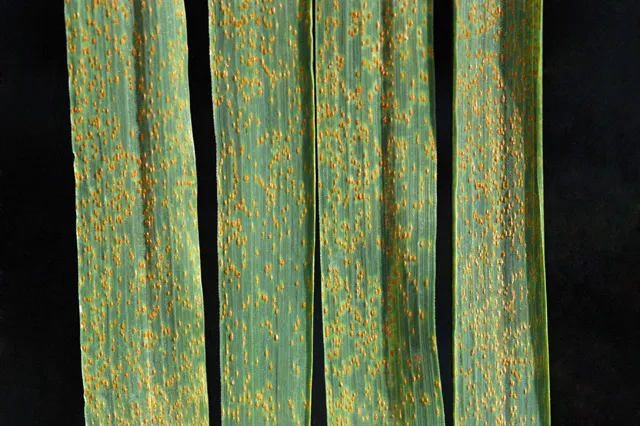
Wheat leaf rust, also called brown rust, is caused by Puccinia triticina. It is one of the most common rust diseases of wheat in the United States and worldwide. The disease is usually recognized by small, round to oval, orange-brown pustules scattered across leaf surfaces.
On susceptible wheat, pustules may occur on both sides of the leaf and produce abundant powdery spores. Infection of the flag leaf and the leaf immediately below it is more damaging than infection confined to older lower leaves because these leaves contribute substantially to grain filling.
The pathogen population is genetically variable, and cultivar resistance can differ by region and by pathogen race. A diagnosis based only on pustule color is therefore not sufficient when leaf rust must be distinguished from stripe rust, stem rust, or non-rust leaf spots.
Symptoms and identification
Typical symptoms include:
- Small, scattered, orange, reddish-brown, or cinnamon-colored pustules on wheat leaves.
- Powdery urediniospores that rub off readily when foliage is touched.
- Pustules concentrated on the upper leaf surface but also possible on the lower surface and leaf sheaths.
- Little surrounding discoloration on highly susceptible plants; resistant reactions may appear as tiny flecks or small pustules bordered by yellow or brown tissue.
- Premature loss of green leaf area, reduced kernel weight, and fewer kernels per head when severe disease develops before or around flowering.
Leaf rust pustules are generally smaller and more randomly scattered than the yellow, linear stripes of stripe rust. Stem rust usually produces larger pustules on stems, leaf sheaths, and leaf surfaces, often with more conspicuous tissue tearing.
Causes and spread
Puccinia triticina is an obligate fungal parasite that obtains nutrients from living host tissue. The main source of disease spread in the United States is repeated production and wind dispersal of urediniospores from infected wheat and related cereal hosts.
Infection is favored when susceptible foliage remains wet from dew or light rain and temperatures are mild. Spores can travel long distances on air currents, allowing disease to move from infected winter wheat in the southern states and southern Great Plains toward later-developing wheat farther north.
Volunteer wheat, early-sown wheat, late-maturing crops, and susceptible cultivars can maintain living green tissue between crop cycles. The pathogen is not primarily spread through contaminated soil or ordinary handling of harvested grain.
Life cycle and persistence
The pathogen has a macrocyclic life cycle with five recognized spore stages and is heteroecious, meaning its complete sexual cycle involves two unrelated hosts. Wheat and related grasses are the main telial and uredinial hosts.
- Urediniospores land on wet wheat foliage, germinate, and penetrate through stomata.
- After colonizing living leaf tissue, the fungus forms uredinia that release new orange-brown urediniospores.
- Several repeating uredinial cycles can occur during one season, rapidly increasing disease.
- Telia form later as wheat matures; teliospores produce basidiospores.
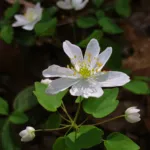
- In regions where suitable alternate hosts occur, the sexual stages can develop on species such as Thalictrum speciosissimum or Isopyrum fumaroides.
In North America, the alternate-host phase is considered rare or epidemiologically minor. Survival between crops is mainly associated with living infected wheat, volunteer wheat, and other green cereal hosts.
Treatment and control
Once pustules are present, remove or isolate infected plants in a garden or small demonstration planting when practical, but understand that windborne spores can arrive from outside the site. In commercial wheat, treatment decisions should consider cultivar resistance, disease severity and growth stage, yield potential, weather, crop value, and the expected time before maturity.
Foliar fungicides can protect green upper leaves and may reduce yield loss when applied at an economically justified stage. They work best as part of an integrated program and generally protect new tissue better than they reverse already extensive damage. Follow current university extension recommendations for the state and crop-use directions on the product label.
Leaf rust is not corrected by fertilizer, irrigation changes, or insect control. Confirm the diagnosis when symptoms are atypical or when stripe rust, stem rust, tan spot, Septoria, or physiological leaf injury are possible alternatives.
Low-impact and biological control
No reliably curative, broadly effective organic treatment is established for field-scale wheat leaf rust. The most practical nonchemical measures are planting resistant cultivars, removing volunteer wheat and unmanaged cereal regrowth, improving crop rotation and planting-date decisions, and monitoring early enough to prevent severe upper-canopy infection.
In small plantings, remove heavily infected leaves or plants where feasible and dispose of them away from living wheat. Do not compost diseased material unless the composting process is reliably hot and complete. Products marketed for organic production should not be assumed effective or legal for this disease; verify both organic certification status and the current label.
Prevention
Use an integrated program built around host resistance and field monitoring:
- Select cultivars with effective, locally appropriate leaf-rust resistance and consult current state or USDA cultivar disease ratings where available.
- Scout lower and middle leaves first, then protect the flag leaf and upper canopy if disease is increasing before grain filling.
- Control volunteer wheat and unmanaged cereal regrowth that can carry the pathogen between crops, while following local conservation and erosion-control requirements.
- Avoid unnecessarily early planting or excessive nitrogen that produces a dense, lush canopy when these practices conflict with local agronomic recommendations.
- Use regional disease alerts, extension scouting reports, and weather information to time decisions rather than treating automatically.
- Rotate cultivars and avoid relying indefinitely on a single race-specific resistance gene because P. triticina populations change over time.
Interesting facts
Puccinia triticina is highly variable for virulence, and different races can overcome different wheat leaf-rust resistance genes. The USDA-ARS Cereal Disease Laboratory characterizes US populations because regional race frequencies influence cultivar performance.
Unlike wheat stem rust, wheat leaf rust does not depend on barberry for its usual North American disease cycle. Its alternate hosts are uncommon or poorly suitable in much of North America, so repeated urediniospore infection on living wheat is usually more important than sexual reproduction.
The pathogen is specialized: documented primary hosts include several wheat species, goatgrass, and triticale, while reported alternate hosts belong mainly to Thalictrum and Isopyrum. Race and host-form differences mean that susceptibility should not be generalized across all wheat relatives.
Use only fungicide products legally authorized for wheat leaf rust or the specific crop and use site in the United States. Follow the current EPA-approved label for rate, timing, reentry interval, preharvest interval, worker protection, resistance-management requirements, and application restrictions. Product registrations and labels can change; consult your state Extension service and pesticide regulator before application. Do not use an off-label or unverified pesticide program.
Affected plants
The plants below are linked to this problem by structured host-plant data. The list updates automatically as new plant profiles are added.