
Tan Spot of Wheat
Pyrenophora tritici-repentisTan Spot of Wheat overview
Tan spot, also called yellow leaf spot, is a fungal disease of wheat caused by Pyrenophora tritici-repentis. It produces tan to brown, lens-shaped or diamond-shaped leaf lesions with yellow margins and can severely reduce photosynthetic area and yield when the upper leaves are infected. Risk is greatest in wheat-after-wheat systems with abundant surface residue and prolonged leaf wetness.
Typical conditions
Overview
Tan spot, also known as yellow leaf spot, is caused by the ascomycete fungus Pyrenophora tritici-repentis. It affects common bread wheat and durum wheat and occurs in wheat-growing regions worldwide, including the U.S. Great Plains and northern wheat-producing states.
The disease is usually most damaging where wheat follows wheat, infected residue remains on the soil surface, and spring or early-summer weather provides extended periods of leaf wetness. Disease severity depends on cultivar susceptibility, pathogen race, residue level, rainfall, and the timing of infection.
Symptoms and identification
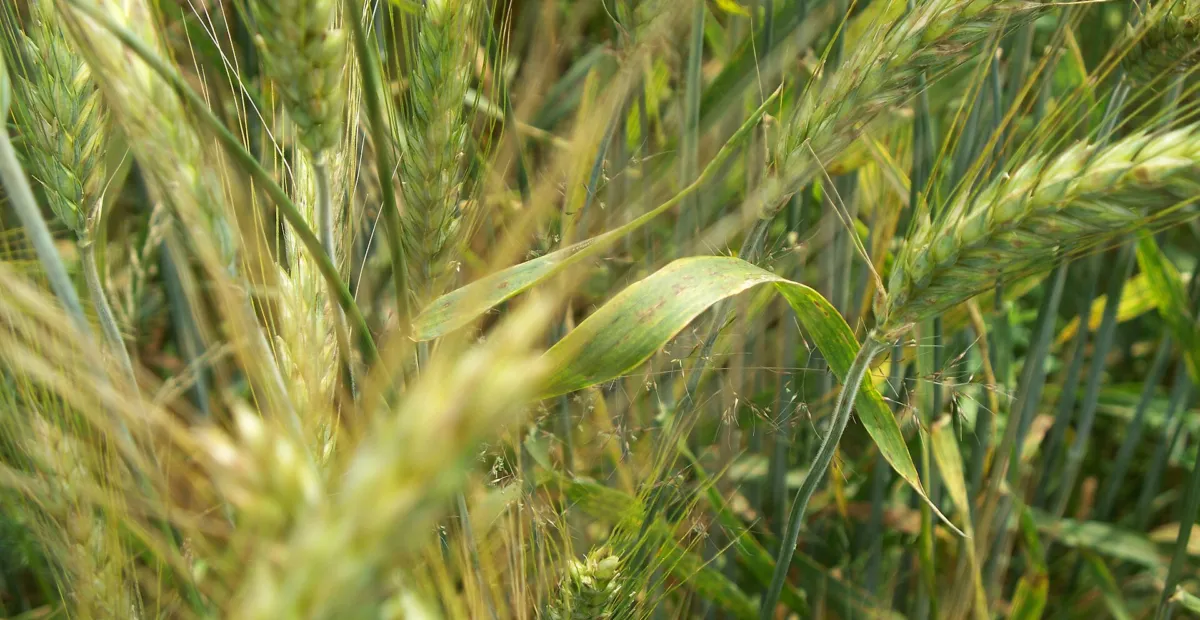
Early symptoms are small tan to brown flecks on wheat leaves. Lesions enlarge into elliptical, lens-shaped, or diamond-shaped blotches, commonly with a yellow halo and sometimes a darker brown or black central fleck.
As lesions expand and merge, leaves develop larger dead areas, turn yellow-brown, and may die prematurely. Lower leaves are often affected first, but infections that reach the flag leaf and flag-leaf-minus-one leaf can cause the greatest yield loss. Tan spot lesions should be distinguished from Septoria or Stagonospora blotches, rusts, and abiotic leaf injury; dark raised fruiting bodies in the leaf lesion are not typical of tan spot.
Causes and spread
The primary inoculum commonly comes from infected wheat straw left in the field. The fungus forms pseudothecia on residue, which produce wind-dispersed ascospores. Lesions can then produce conidia that spread shorter distances by wind and rain splash, driving secondary disease cycles within the crop.
Risk increases with continuous wheat, wheat planted into heavily infected residue, susceptible cultivars, frequent rainfall, irrigation that prolongs wet foliage, and moderate temperatures. Seed infection or contamination may contribute to introduction in some situations, but crop residue is generally the most important field source of inoculum.
Life cycle and persistence
Pyrenophora tritici-repentis survives between crops in infected wheat debris. During fall, winter, and spring, pseudothecia mature on straw and release ascospores during favorable wet periods. These spores infect susceptible wheat leaves when sufficient moisture is present.
After infection, lesions develop and may produce conidia. Repeated cycles of conidial production and dispersal spread the disease upward and across the canopy during the growing season. Infection periods may require several hours of continuous or intermittent wetness, with exact requirements varying with temperature, cultivar, and isolate.
Treatment and control
Management is most effective when based on integrated disease-risk assessment rather than on symptoms alone. Confirm the diagnosis with an extension plant pathologist or diagnostic laboratory when lesions are atypical or when Septoria/Stagonospora blotch is also suspected.
Foliar fungicides may be considered when a susceptible crop has significant disease risk and the upper leaves are still protectable, particularly when weather favors continued spread and yield potential justifies the cost. Product performance, timing, cultivar response, disease pressure, and local extension recommendations should guide the decision. Fungicides cannot restore dead tissue, so late applications after extensive flag-leaf injury are less likely to provide economic benefit.
Low-impact and biological control
For certified-organic or low-input production, emphasize crop rotation, residue decomposition, resistant cultivars, clean seed, balanced fertility, and canopy management that reduces prolonged leaf wetness. Incorporating or otherwise accelerating decomposition of infected straw can lower the amount of primary inoculum, although intensive tillage must be weighed against erosion and soil-health risks.
No biological control product should be assumed effective unless it is specifically registered or approved for the crop and disease in the United States and supported by local evidence. Remove volunteer wheat and manage susceptible cereal or grass hosts where they materially contribute to disease carryover.
Prevention
- Rotate at least one year away from wheat where practical; longer rotations can provide greater residue decomposition and inoculum reduction.
- Use wheat cultivars with documented tan-spot resistance or improved tolerance for the target production region.
- Manage infected residue through tillage, residue incorporation, chopping, or other practices that promote decomposition, while balancing erosion and soil-conservation goals.
- Avoid planting wheat into heavily infected wheat residue when disease risk is high.
- Use high-quality, commercially tested or certified seed and clean equipment when moving between fields.
- Scout lower leaves during late winter and spring, then monitor disease movement toward the flag leaf and flag-leaf-minus-one leaf.
Interesting facts
- The older name yellow leaf spot reflects the yellow halos that often surround tan lesions.
- The pathogen has multiple races and produces host-selective toxins that contribute to chlorosis and necrosis in susceptible wheat.
- Race behavior can differ among common wheat, durum wheat, and other grasses, so host resistance is not uniform across all wheat classes.
- Tan spot is often part of a broader wheat foliar-disease complex, making accurate diagnosis important before selecting a treatment.
Use only fungicides legally authorized in the United States for tan spot on the specific wheat crop and production system. Follow the current EPA-approved product label for crop, rate, timing, preharvest interval, worker protection, resistance-management requirements, and application restrictions. Consult current state extension recommendations and rotate fungicide modes of action when treatment is justified; never use an off-label pesticide program.