
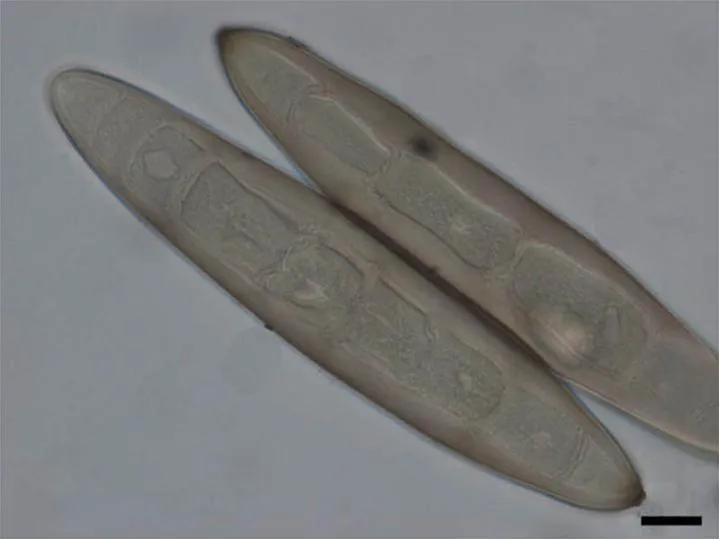
 Source:
 Northern corn leaf blight
Exserohilum turcicumNorthern corn leaf blight overview
Northern corn leaf blight is a fungal leaf disease caused by Exserohilum turcicum, most important on susceptible field, sweet and popcorn hybrids. It produces distinctive gray-green to tan, cigar-shaped lesions that begin on lower leaves and may move upward during cool-to-moderate, wet weather. Early, severe infection can reduce photosynthesis, grain fill and stalk strength.
Typical conditions
Overview
Northern corn leaf blight is caused by the fungus Exserohilum turcicum (synonyms include Setosphaeria turcica and the older name Helminthosporium turcicum). In the United States it is most often encountered in field corn, sweet corn and popcorn, especially where susceptible hybrids are grown.
Symptoms usually start on lower leaves and progress upward. Disease is most damaging when substantial leaf area is lost before or around tasseling and silking, because reduced photosynthesis can impair grain fill. Severe leaf blighting may also increase susceptibility to stalk lodging and stalk-rot problems.
Symptoms and identification
- Elongated, elliptical or cigar-shaped lesions, commonly about 1–6 inches long, develop parallel to the leaf margin or veins.
- Early lesions are gray-green; older lesions become tan to brown or gray, often with a distinct boundary between diseased and healthy tissue.
- Under humid conditions, lesions may appear dirty or dark because the fungus produces conidia on the dead tissue.
- Lesions begin on lower leaves and can coalesce, causing extensive blighting of the upper canopy.
- On susceptible plants, early severe infection can reduce ear fill and may contribute to weakened stalks.
Several diseases can resemble it, including gray leaf spot, southern corn leaf blight, Goss’s wilt or leaf blight, and Stewart’s wilt. A laboratory diagnosis may be needed when management decisions or seed production are involved.
Causes and spread
The pathogen survives primarily as mycelium and spores in infected corn residue. When moisture and temperature are favorable, spores are produced on lesions or residue and are moved short distances by wind, rain splash and field operations. Repeated cycles of spore production can carry disease from lower leaves into the upper canopy.
In the United States, disease development is favored by moderate temperatures of roughly 64–80°F, frequent dew, rainfall or irrigation that keeps leaves wet for extended periods, and dense canopies with limited air movement. Corn planted repeatedly in the same field and volunteer corn left in or near the crop can increase the local source of inoculum.
Life cycle and persistence
The fungus overwinters in infected maize residue. In spring and early summer, moisture stimulates sporulation, and airborne conidia land on wet leaves. After germination and penetration, lesions develop following an incubation period that varies with temperature, host resistance and isolate.
New lesions produce additional conidia during humid or wet periods, creating secondary infection cycles. Disease often becomes visible around or after silking, although infections occurring earlier generally have greater potential to reduce yield. E. turcicum populations are not uniform: host-specific interactions and physiological races can affect which resistance genes remain effective.
Treatment and control
Remove or isolate badly affected ornamental or garden corn when practical, and do not save seed from severely diseased plants. In commercial plantings, base intervention on hybrid susceptibility, disease distribution, crop value, expected weather, growth stage and the amount of healthy leaf area remaining.
Fungicides are most likely to provide value when a susceptible crop is threatened by active disease before or around tasseling and sufficient green leaf area remains to protect. They are less useful after extensive canopy blighting. Confirm the diagnosis before treatment, rotate fungicide modes of action where products are used, and follow resistance-management guidance.
Low-impact and biological control
- Use resistant or more tolerant corn varieties as the primary nonchemical control.
- Rotate out of corn when feasible and incorporate, chop or otherwise manage infected residue according to local conservation and production recommendations.
- Control volunteer corn and evaluate susceptible sorghum, sudangrass and johnsongrass near the planting.
- Improve canopy drying by avoiding overhead irrigation when possible and watering early enough for foliage to dry.
- Use sanitation and scouting to prevent movement of infected debris between plantings. No broadly reliable home-organic treatment eradicates established infections from corn leaves.
Prevention
- Choose hybrids with strong quantitative resistance and, where appropriate, documented resistance genes suited to the local pathogen population. Resistance ratings can differ among field, sweet and popcorn types.
- Use crop rotation and residue management to reduce the amount of infected corn debris carrying the pathogen into the next crop. Rotation is most useful when volunteer corn and nearby susceptible hosts are also controlled.
- Manage volunteer corn and consider the disease implications of sorghum, sudangrass or johnsongrass in rotations where these hosts are present and documented as susceptible.
- Scout from lower leaves upward, particularly before tasseling through grain fill, after periods of cool, wet or persistently humid weather.
- Maintain balanced fertility and avoid unnecessary irrigation or practices that prolong leaf wetness. Fertility correction will not cure the disease but can reduce additional plant stress.
Interesting facts
- The characteristic lesions are often described as cigar-shaped, making this disease relatively distinctive on corn when symptoms are well developed.
- Different E. turcicum races or host-specific populations can interact differently with maize resistance genes, so a hybrid that performs well in one region may not have the same level of protection elsewhere.
- The same fungal species is associated with northern corn leaf blight on maize and leaf blight on sorghum, but maize- and sorghum-adapted isolates are generally host-specific rather than interchangeable.
- Early infection before or near silking is usually more consequential than infection late in grain development.
Use only fungicide products legally authorized for the specific crop and disease in the United States and in your state. Follow the current EPA-approved label for crop, rate, timing, personal protective equipment, reentry interval, preharvest interval and application restrictions. Do not assume that a product labeled for field corn is legal for sweet corn, popcorn, sorghum or home garden use. Because fungicide sensitivity can vary, use integrated management and follow current regional extension recommendations.