
 Source:
 Rose rust
Phragmidium mucronatumRose rust overview
Rose rust is a fungal disease of roses caused by Phragmidium mucronatum, producing yellow to reddish leaf spots and conspicuous orange, red, or black spore pustules, usually on leaf undersides. Cool, wet weather favors infection, and severe disease can cause premature defoliation, distorted canes, and reduced plant vigor. Accurate diagnosis is important because several Phragmidium species can cause similar symptoms.
Typical conditions
Overview
Rose rust affects cultivated and wild roses, with symptoms most often developing on leaves and sometimes on canes, petioles, sepals, or other green tissues. Yellow to reddish spots appear on upper leaf surfaces, while raised orange, red, brown, or black pustules develop mainly on the undersides. Severe infections may produce extensive defoliation and weaken the plant.
The disease is favored by cool, moist conditions and prolonged leaf wetness. It is generally more noticeable in spring and fall, although infections can occur during wet summer periods. Unlike rusts that alternate between unrelated host plants, rose rust is restricted to the rose host genus and does not require an alternate host.
Symptoms and identification
- Small yellow, orange, reddish, or brown spots on upper leaf surfaces.
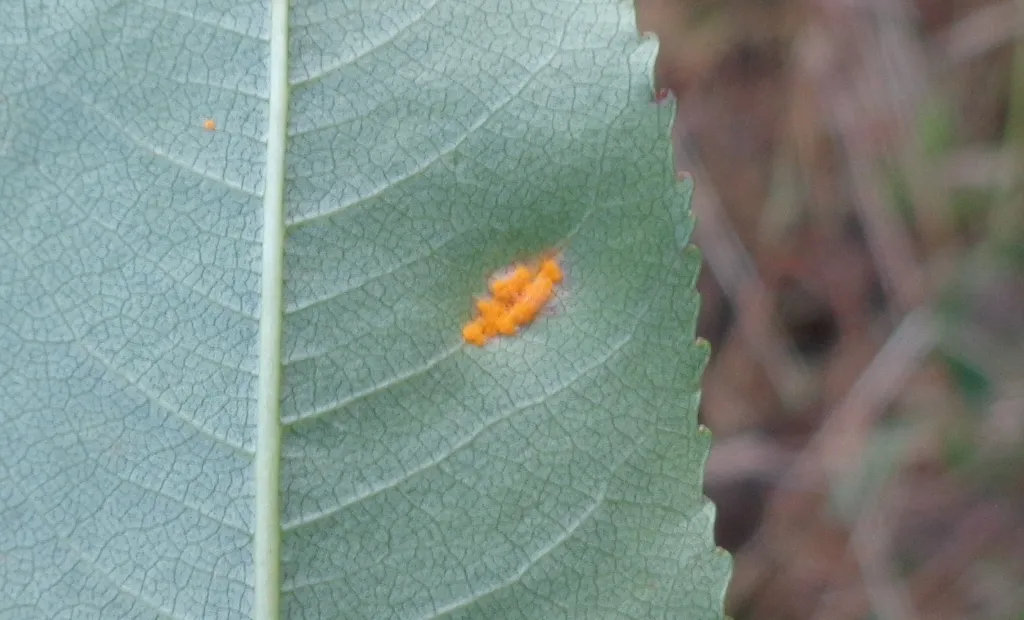
- Raised, powdery orange pustules on leaf undersides, often directly beneath upper-surface spots.
- Later dark brown or black spore-producing structures as the infection matures.
- Yellowing, premature leaf death, curling, distortion, or partial defoliation when disease is severe.
- Occasional pustules or elongated lesions on green canes, petioles, sepals, or other young tissues.
Rust can be confused with insect eggs, spray injury, or other rose leaf-spot diseases. The powdery spore masses on the lower leaf surface are a particularly useful diagnostic feature.
Causes and spread
The causal fungus produces airborne spores that are carried from infected roses to susceptible rose tissue. Infection requires a wet leaf surface; heavy dew, rain, overhead irrigation, and dense foliage can provide sufficient moisture. New infections are more likely when temperatures are mild and leaves remain wet for several hours.
Rust may be introduced on infected nursery stock or cuttings. After establishment, spores from active pustules spread locally between roses. Infected fallen leaves and diseased canes can help maintain the pathogen through the dormant season, depending on local conditions and the Phragmidium species involved.
Life cycle and persistence
Phragmidium mucronatum has a complex rust life cycle with several spore stages, but its known infection cycle is completed on roses rather than by alternating to a different plant family. Repeating urediniospores are produced in orange or yellow pustules and can cause successive infections during favorable weather.
Later in the season, darker teliospores may form in infected tissues or fallen leaves. These thick-walled resting spores can survive unfavorable periods and germinate to produce basidiospores, contributing to the next infection cycle. The exact timing and prominence of stages vary with climate, host cultivar, and the Phragmidium species present.
Treatment and control
Remove and discard heavily infected leaves as soon as practical, especially when pustules are actively releasing spores. Prune infected cane sections well below visible lesions and dispose of the material rather than placing it in home compost. Rake and remove fallen leaves, then apply a fresh layer of mulch to reduce splash and contact with contaminated debris.
Improve airflow by thinning congested growth and correct irrigation practices. Fungicides are most useful preventively or at the earliest stages of disease; they cannot restore leaves that are already damaged. If the diagnosis is uncertain, submit a representative sample to a U.S. university or state plant disease diagnostic laboratory, particularly because multiple Phragmidium species and other rose diseases can look similar.
Low-impact and biological control
Use an integrated, low-input approach centered on sanitation, resistant or tolerant cultivars, dry foliage, and good air circulation. Hand-pick or prune infected tissues, remove debris from the soil surface, and avoid moving wet foliage or contaminated tools between roses.
Products marketed as organic, such as certain copper or sulfur formulations, may have activity against fungal diseases, but effectiveness and crop safety vary by product, cultivar, weather, and disease pressure. Use them only when the current U.S. label allows the product for roses and rose rust, and follow all label directions and precautions.
Prevention
- Buy vigorous, disease-free roses from reputable nurseries and inspect leaves and canes before planting.
- Select cultivars with documented resistance or tolerance where available; resistance is not uniform across all rose types or Phragmidium species.
- Space shrubs to permit air movement and prune selectively to open congested growth.
- Water at the soil line, preferably in the morning, rather than wetting foliage with overhead irrigation.
- Inspect plants regularly during cool, wet periods and remove newly infected leaves promptly.
- Collect fallen rose leaves and remove them from the planting area; do not leave diseased debris beneath shrubs.
- Disinfect pruning tools between plants when cutting visibly infected canes.
Interesting facts
- Rose rust is one of the rust diseases restricted to the rose host genus rather than requiring an unrelated alternate host.
- The orange pustules are masses of spores, not insect eggs.
- Symptoms may become less obvious during hot, dry weather but can resume when cool, wet conditions return.
- Several Phragmidium species infect roses, so the name P. mucronatum should not be assigned from symptoms alone when species confirmation matters.
- Severe infections can cause serious defoliation even though rose rust is relatively uncommon in many U.S. home landscapes.
Use fungicides only when the product is legally authorized for roses and this disease in your state and country. Follow the current product label exactly, including application interval, personal protective equipment, re-entry interval, and disposal requirements. Do not assume that a product labeled for black spot or another rose disease is labeled for rose rust. Cultural and sanitation measures should remain the foundation of management.