
Nickel deficiency
Nickel deficiency overview
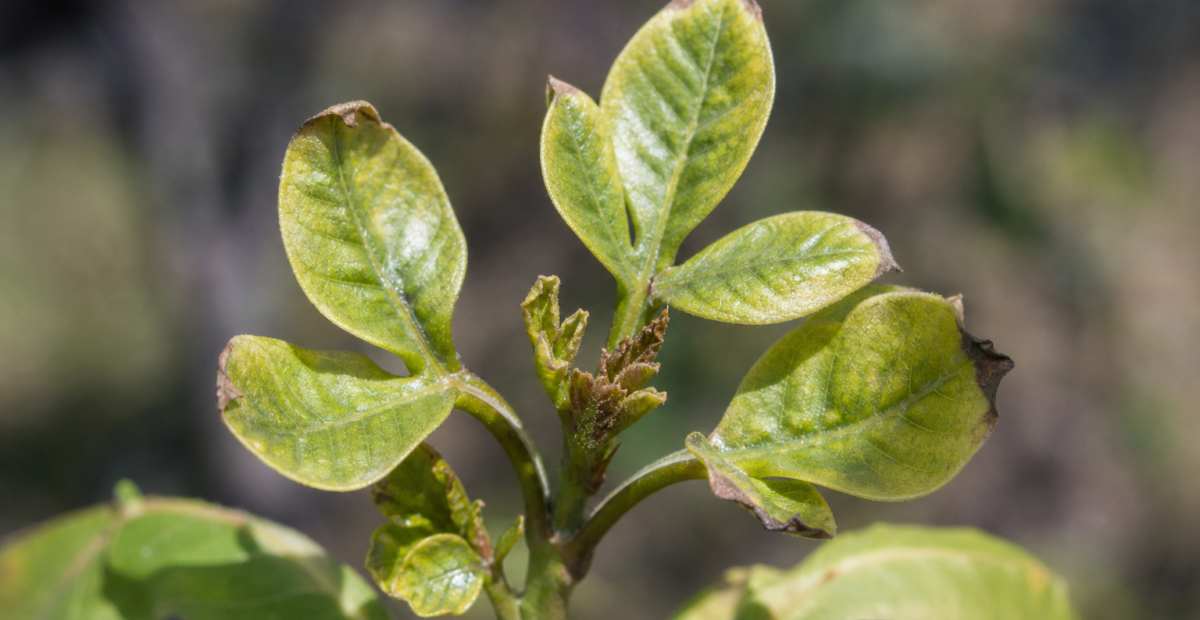
Nickel deficiency is a rare plant nutritional disorder involving impaired urease activity and nitrogen metabolism. The clearest signs are necrotic leaf tips, yellowing, stunted growth, delayed nodulation, and the distinctive “mouse-ear” foliage of pecan. Diagnosis is difficult because symptoms can resemble nitrogen, zinc, iron, or other nutrient disorders, so tissue and soil testing should precede correction.
Typical conditions
Overview
Nickel is an essential plant micronutrient, although plants need it at extremely low concentrations. It activates urease, the enzyme that breaks down urea, and contributes to nitrogen metabolism and biological nitrogen fixation.
When nickel is inadequate, urea or ureide-derived nitrogen compounds can accumulate, especially in plants dependent on urea nutrition or symbiotic nitrogen fixation. Pecan “mouse-ear” is the best-known field expression in the United States. Nickel deficiency is uncommon and should not be diagnosed solely from leaf appearance.
Symptoms and identification
- Leaflet-tip chlorosis followed by brown necrosis or death, sometimes progressing along the margins.
- Young leaves may be small, rounded, thickened, distorted or closely spaced.
- Pecan may develop characteristic “mouse-ear” leaves with shortened leaflets and compact shoots.
- Legumes may show chlorosis, stunting, delayed or reduced nodulation, impaired nitrogen fixation and poor growth.
- Urea-fed plants can accumulate toxic urea in leaf tips, producing necrosis that may resemble nitrogen or zinc disorders.
Symptoms vary by species, cultivar, nitrogen source and severity. Iron, zinc, nitrogen and environmental stresses can look similar.
Causes and spread
This is not an infectious disease and does not spread between plants. It results from inadequate plant-available nickel or restricted uptake. Reported risk factors include high soil pH, intensively oxidized or sandy low-organic-matter soils, very low extractable nickel, and competition from unusually high levels of zinc or other metal nutrients. Heavy reliance on urea nutrition or biological nitrogen fixation can make symptoms more visible.
In U.S. landscapes and orchards, true deficiency is rare; localized problems are more plausible than a uniform deficiency across an entire property. Excess nickel is toxic, so indiscriminate supplementation is unsafe.
Life cycle and persistence
Nickel deficiency has no pest or pathogen lifecycle. Its expression changes with plant growth, nitrogen metabolism and soil availability. Symptoms may become more apparent during rapid vegetative growth, reproductive development, or periods when plants depend heavily on urea hydrolysis or symbiotic nitrogen fixation. In pecan, newly formed shoots can repeatedly produce mouse-ear foliage when the underlying availability problem remains.
Treatment and control
Confirm the diagnosis with plant-tissue and soil testing, while ruling out nitrogen, zinc, iron, molybdenum, root, drought and herbicide injury. If deficiency is documented, use a properly formulated, water-soluble nickel fertilizer only at a crop-appropriate, label-supported rate. Low-rate foliar correction has been used for acute deficiency, while soil correction may be considered in persistent orchard or field situations under professional guidance.
Do not estimate rates from general internet recommendations: nickel has a narrow margin between nutritional benefit and toxicity. Recheck new growth and tissue results after treatment. Avoid treating edible crops close to harvest unless the product label and applicable U.S. requirements specifically allow it.
Low-impact and biological control
There is no biological control because nickel deficiency is not caused by an organism. Organic and cultural management should focus on diagnosis, balanced fertility, improved soil structure and careful pH management. Mature compost or other permitted organic amendments may improve rooting and nutrient buffering, but they should not be assumed to supply a predictable nickel dose. Use only inputs allowed under the intended production system and supported by testing; never apply industrial metal waste or uncharacterized amendments.
Prevention
- Use a representative soil test and, where appropriate, accredited plant-tissue analysis before applying nickel.
- Maintain crop-appropriate soil pH rather than raising pH unnecessarily; correct pH gradually and according to a soil-test recommendation.
- Use balanced fertilization and avoid repeated, high-rate applications of zinc, copper, manganese, iron, calcium or magnesium without documented need.
- Improve soil organic matter, rooting conditions and moisture management without adding untested industrial or metal-containing materials.
- For pecans and legumes, monitor new growth, nodulation, yield and tissue nutrient results rather than relying on a single visual symptom.
- Keep fertilizer records and prevent runoff or overspray into adjoining beds and waterways.
Interesting facts
- Nickel is recognized as an essential plant nutrient even though the required concentration is lower than for any other essential mineral element.
- The classic pecan symptom is called “mouse-ear” because the small, rounded leaflets resemble mouse ears.
- Nickel deficiency was first demonstrated prominently in controlled soybean studies, where urea accumulated and caused leaflet-tip necrosis.
- Nickel is also associated with hydrogenase activity in nitrogen-fixing systems, helping explain why legumes can be particularly sensitive under certain conditions.
- Because the symptoms overlap with several common disorders, confirmed nickel deficiency is much less common than suspected nickel deficiency.
Nickel fertilizers are micronutrient products, not pesticides. In the United States, use only a nickel-containing fertilizer or soil amendment legally authorized for the crop, site and intended use in your state, and follow the current product label exactly. Do not use nickel salts or improvised foliar mixtures without professional rate guidance; excessive nickel can injure plants and contaminate soil or edible plant tissue.