
Strawberry blossom weevil
Anthonomus rubiStrawberry blossom weevil overview
The strawberry blossom weevil (Anthonomus rubi) is a small Eurasian weevil that attacks berry crops by feeding on young foliage and unopened flower buds. Females commonly lay an egg in a closed bud, then partially sever its stalk, causing the bud to wilt, hang or drop. The pest is established in Washington State and is an important U.S. plant-health concern, although local identification should be confirmed before action.
Typical conditions
Overview
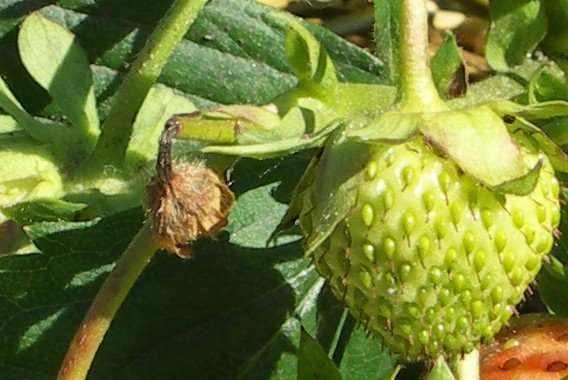
Strawberry blossom weevil is a small, dark weevil whose most damaging activity is concentrated around flowering. The female punctures a closed flower bud, deposits an egg, and chews through the pedicel below the bud. The clipped bud may remain partly attached, hang downward, wilt or fall to the ground. Larvae develop inside the severed bud and consume its reproductive tissues.
Strawberry and raspberry are the principal documented crop hosts. Blackberry and rose can also be attacked, and records from North America include wild Rubus hosts. Damage can be confused with the native strawberry clipper, Anthonomus signatus; adult or damaged-bud identification is therefore important, especially in regions outside the known U.S. distribution.
Symptoms and identification
- Unopened green flower buds are cut through their stalks and hang, wilt or drop.
- Some clipped buds contain a pale, legless larva, pupa or developing adult.
- Adults chew small, round holes or pits in young strawberry, raspberry and blackberry leaves and may feed on petals or pollen.
- Flower loss appears as fewer open flowers and reduced fruit set; severe injury can substantially reduce berry yield.
- Not every clipped bud contains an egg: newly emerged adults may sometimes sever buds without ovipositing.
Causes and spread
The pest spreads locally through adult movement between cultivated berries, wild Rubus and ornamental roses. Long-distance movement is most strongly associated with infested plants for planting, especially plants carrying closed buds that contain eggs, larvae or pupae. Unmanaged Himalayan blackberry hedges and nearby woodland margins may provide feeding or overwintering sites.
Life cycle and persistence
Anthonomus rubi generally completes one generation per year. Adults overwinter in dry leaves, plant debris and sheltered vegetation near host plants. They become active in spring during warm weather, first feeding on young foliage and floral tissues. After mating, females lay eggs in closed flower buds, commonly one or two per bud, and sever the pedicel.
The egg, larva and pupa develop inside the clipped bud. A new adult emerges from the dried bud, feeds during the growing season and may survive for many months before overwintering. Adults can move between cultivated berries and wild or ornamental Rosaceae, so the pest may persist outside the crop.
Treatment and control
Confirm the pest before treating. In a home garden, promptly remove clipped buds, hand-pick adults when practical, and use exclusion netting on small plantings. In commercial or larger plantings, base any intervention on scouting records, the number of clipped buds, crop value and local extension recommendations. Protect pollinators by avoiding unnecessary insecticide exposure during bloom.
Because U.S. registrations and labels differ by crop and state, there is no universal chemical program presented here. Consult your state extension service and the current label for any legally authorized product, and observe resistance-management, worker-protection and preharvest requirements.
Low-impact and biological control
Begin with monitoring rather than routine spraying. From early bud formation until flowering, inspect plants at least weekly for clipped buds and adults. Shake foliage over a white tray during warm, sunny conditions to dislodge adults, and use a beat sheet or hand collection in small plantings.
- Remove and destroy clipped buds before adults emerge; do not compost suspect buds unless the pile reliably reaches pathogen- and insect-killing temperatures.
- Remove heavily infested wild blackberry or other unmanaged host vegetation where lawful and practical, while avoiding unnecessary removal of beneficial habitat.
- Use fine insect-exclusion mesh over small plantings before adults enter, removing or managing it according to pollination needs.
- Maintain clean beds and reduce sheltered debris immediately around susceptible plantings, recognizing that adults may overwinter beyond the cultivated bed.
- Yellow sticky traps or approved monitoring traps may help detect adults, but trap performance and lures vary and should not be treated as a stand-alone control.
Prevention
- Purchase clean, inspected nursery stock from reputable suppliers and follow all federal and state plant-import requirements.
- Quarantine and inspect new strawberry, raspberry, blackberry and rose plants before placing them beside established beds.
- During spring scouting, mark hotspots and remove clipped buds promptly.
- Monitor wild blackberry and other nearby Rosaceae hosts, particularly along field edges and property boundaries.
- Coordinate monitoring across neighboring gardens or farms because adults can move between host patches.
- Report a suspected detection outside the known U.S. distribution to the state department of agriculture or USDA APHIS, preserving adults and damaged buds for identification.
Interesting facts
- The female's distinctive bud-clipping behavior both shelters the immature stages and destroys the flower's fruiting potential.
- USDA APHIS modified Canadian import requirements for Fragaria, Rubus and Rosa plants in 2021 because buds can contain eggs, larvae or pupae.
- Himalayan blackberry has been a commonly recorded host in the Pacific Northwest, including wild hedges.
- The pest is native to Eurasia and North Africa and was first reported in North America in British Columbia in 2019 before detection in Washington State.
- Small clipped buds alone are not a definitive identification because other bud weevils can produce similar damage.
Use insecticides only when the pest has been correctly identified and only when a product is legally authorized and currently labeled for Anthonomus rubi or the relevant weevil on the specific crop in your state and country. Follow the current label exactly, including crop, rate, preharvest interval, pollinator precautions and application timing. Do not spray open flowers when bees or other pollinators are foraging unless the label explicitly permits it.