
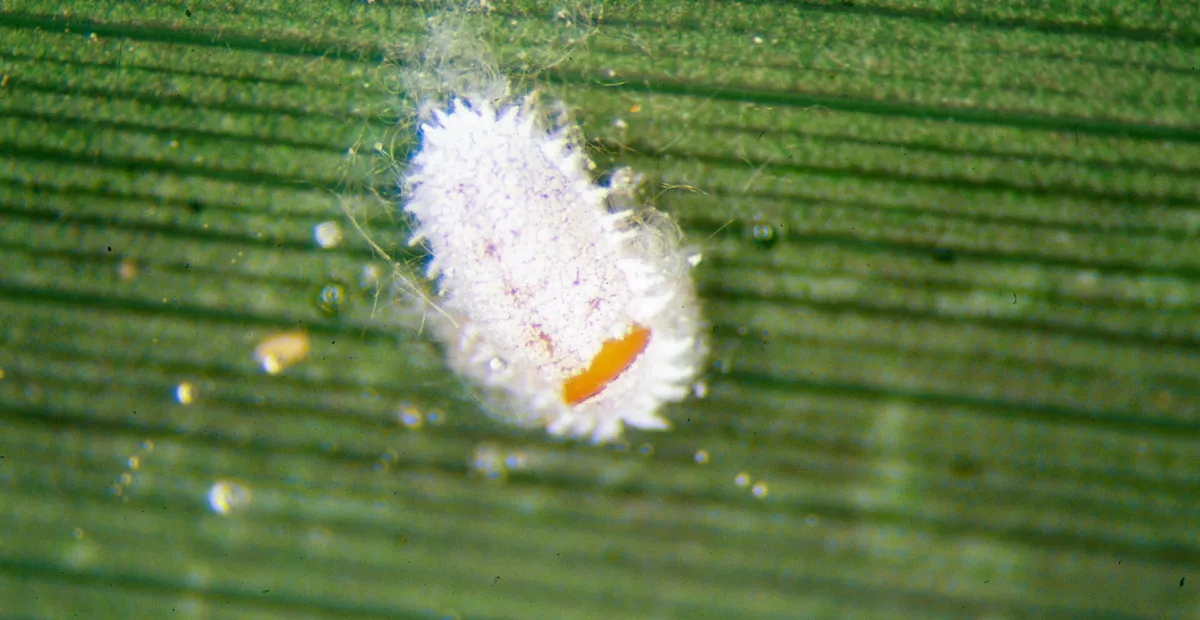
Citrus mealybug
Planococcus citriCitrus mealybug overview
Citrus mealybug, Planococcus citri, is a sap-feeding pest of citrus, greenhouse crops, houseplants, ornamentals, fruits and vegetables. Colonies hide in leaf axils, branch crotches, fruit clusters and beneath citrus calyxes. Feeding weakens plants and produces honeydew that supports black sooty mold. Early detection, ant management, sanitation and conservation of natural enemies are central to control.
Typical conditions
Overview
Planococcus citri, commonly called citrus mealybug or greenhouse mealybug, feeds by inserting its mouthparts into phloem tissue. Adult females are oval, wingless and usually about 0.12 inch long, with short, relatively even wax filaments and sometimes a faint dark dorsal stripe. Colonies are often concealed in leaf axils, branch crotches, bark crevices, fruit clusters and beneath citrus calyxes.
It is a broad host-range pest, but the importance of a particular host varies by climate, cultivar, crop system and mealybug species present. Low outdoor populations may be tolerated when predators and parasitoids are active; greenhouse and indoor populations can increase continuously.
Symptoms and identification
- White, powdery-waxy insects or cottony egg sacs on stems, leaves, fruit, leaf axils and protected crevices.
- Sticky honeydew on foliage and fruit, followed by black sooty mold.
- Yellowing, curling, wilting, distorted leaves, reduced vigor, stunted shoots and premature leaf or fruit drop when infestations are heavy.
- On citrus, feeding near fruit stems or between fruit can reduce appearance and may contribute to fruit drop; fruit may develop blemishes or hardened areas.
- Ant activity around colonies is a useful warning sign because ants harvest honeydew and may protect the pest.
Do not identify solely from white wax: long-tailed, vine, obscure and other mealybugs can look similar. Confirm characteristic body shape, filament pattern and host location when species-level identification matters.
Causes and spread
Infestations commonly enter on contaminated nursery stock, houseplants, cuttings, containers, stakes, tools, clothing or harvest equipment. First-instar crawlers disperse readily over plant surfaces and may be moved by wind, workers, machinery and animals. Adult females crawl short distances, while winged males can fly. Ants may transport colonies between plants and interfere with predators and parasitoids.
Dense canopies, touching plant parts, excessive nitrogen fertilizer and lush irrigated growth create favorable shelter and feeding sites. In greenhouses and interiorscapes, continuous mild temperatures can permit year-round development.
Life cycle and persistence
Females produce several hundred eggs in a white cottony ovisac. Eggs may hatch in roughly 6–10 days under favorable conditions or take several weeks in less favorable conditions. Crawlers disperse, then settle to feed and develop through nymphal stages. Females retain a wingless nymph-like form; males pass through additional stages and a pupal period before emerging as short-lived winged adults.
Development rate depends strongly on host plant, temperature and growing system. Outdoor citrus commonly has multiple, sometimes overlapping generations; greenhouse populations may be continuous. Crawlers and young nymphs are generally more exposed and easier to target than wax-covered adults or eggs protected inside ovisacs.
Treatment and control
Use an integrated sequence rather than relying on a single spray. Isolate affected houseplants or greenhouse plants. On sturdy plants, wash exposed colonies from foliage and stems with a firm water spray, repeating as needed. Hand-remove visible colonies with a cotton swab or soft cloth; on small infestations, a tested spot treatment with 70% or weaker isopropyl alcohol may help, but first test the plant because leaf burn is possible.
Prune and dispose of badly infested plant parts. Improve coverage by opening dense growth and target newly hatched crawlers before they settle into protected crevices. For citrus, inspect the canopy interior, fruit clusters, stems and calyxes rather than treating only visible outer foliage. Recheck plants after treatment because eggs and concealed colonies can survive.
When biological control is feasible, conserve resident natural enemies or use commercially available agents suited to the crop and environment. The mealybug destroyer, Cryptolaemus montrouzieri, is particularly relevant where egg sacs are present; the parasitoid Leptomastix dactylopii is specialized for citrus mealybug and may be used in protected production where available.
Low-impact and biological control
- Use exclusion, quarantine, sanitation, pruning and physical removal as the foundation of control.
- Wash colonies from sturdy plants with repeated forceful water sprays.
- Conserve predators and parasitoids by avoiding disruptive broad-spectrum insecticides and controlling ants.
- Where appropriate and locally available, use Cryptolaemus montrouzieri and citrus-mealybug parasitoids such as Leptomastix dactylopii.
- Some formulations of narrow-range horticultural oil, neem or azadirachtin, and Beauveria bassiana are allowed in some organic production systems, but crop, site and formulation eligibility must be checked before use. Thorough coverage and repeat monitoring are essential because wax, egg sacs and concealed colonies reduce efficacy.
Prevention
- Inspect all new plants, especially citrus, orchids, succulents, ficus, palms, gardenia, coleus and other susceptible ornamentals, before purchase and again after a quarantine period.
- Keep incoming plants isolated until repeated inspections show no insects, wax or honeydew.
- Remove heavily infested leaves, shoots or plants in sealed bags; clean pots, benches, tools and equipment before reuse.
- Prune to improve airflow and visibility, but avoid excessive nitrogen that promotes tender growth.
- Manage ants with exclusion, sanitation and appropriately placed ant controls so they cannot protect mealybug colonies.
- Scout hidden sites weekly, including leaf axils, branch crotches, undersides of leaves, fruit clusters and citrus calyxes. Use sticky tape around twigs or stems to detect crawler activity.
- Protect parasitoids, lady beetles, lacewings, syrphid larvae and spiders by minimizing unnecessary broad-spectrum insecticides and dust.
Interesting facts
- The white material is wax produced by the insect, not fungal growth; the cottony masses are egg sacs called ovisacs.
- Female citrus mealybugs cannot fly, but crawlers can disperse passively and ants can actively move colonies.
- Adult male citrus mealybugs are winged, do not feed and live only briefly after emergence.
- Honeydew can support black sooty mold, which is usually a secondary surface growth rather than the primary cause of plant decline.
- The mealybug destroyer larva resembles a large mealybug, so beneficial larvae can be mistakenly killed during cleanup.
- Species identification is important because similar-looking mealybugs differ in host range, biology and response to biological control.
Use only products legally authorized for citrus mealybug on the specific crop and site in the United States, and follow the current EPA-approved label. Confirm crop registration, application timing, reentry interval, preharvest interval, pollinator precautions, phytotoxicity warnings and compatibility with biological control agents. Do not use a pesticide merely because it is labeled for another mealybug, another crop or another state. Treat crawler stages when monitoring indicates activity, and avoid unnecessary broad-spectrum applications that can trigger secondary outbreaks by killing natural enemies.
Affected plants
The plants below are linked to this problem by structured host-plant data. The list updates automatically as new plant profiles are added.
 Pineapple (Ananas comosus) care guideAnanas comosus
 Asparagus (Asparagus officinalis) care guideAsparagus officinalis
 Polka Dot Begonia (Begonia maculata) care guideBegonia maculata
 King begonia (Begonia rex) care guideBegonia rex
 Begonia ‘Cocktail’Begonia 'Cocktail'
 Begonia ‘Double Red’Begonia 'Double Red'
 Begonia ‘Escargot’Begonia 'Escargot'
 Begonia ‘Gryphon’Begonia 'Gryphon'
 Begonia ‘Lucerna’Begonia 'Lucerna'
 Begonia ‘Obliqua’Begonia 'Obliqua'
 Begonia ‘Olympia’Begonia 'Olympia'
 Begonia ‘Tuberhybrida’Begonia 'Tuberhybrida'