
Chestnut blight
Cryphonectria parasitica (Murrill) M.E. BarrChestnut blight overview
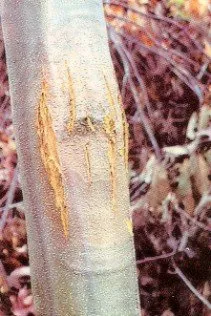
Chestnut blight is a destructive fungal canker disease caused by Cryphonectria parasitica. It attacks the inner bark and cambium of chestnut stems and branches, producing sunken orange-brown cankers, bark cracking, branch dieback, and often epicormic shoots below the lesion. American chestnut is highly susceptible; Asian chestnuts are generally more resistant but can still become infected. Early confirmation and sanitation help limit spread.
Typical conditions
Overview
Cryphonectria parasitica infects chestnut bark, inner bark and vascular cambium. Expanding cankers girdle stems and branches, interrupting water and carbohydrate movement. The disease can kill young trees and above-ground portions of older trees. American chestnut (Castanea dentata) is exceptionally susceptible, while Chinese and Japanese chestnuts are generally more resistant rather than immune.
Diagnosis should be based on the combination of host, canker appearance and laboratory or expert confirmation when valuable trees, restoration plantings or regulatory concerns are involved. Other canker fungi, winter injury and physical bark damage can look similar.
Symptoms and identification
- Early lesions may appear as slightly sunken, reddish-brown or orange-brown areas on stems and branches.
- Cankers enlarge longitudinally, causing bark cracking, swelling, sunken margins and exposed dead inner bark.
- Orange to yellow-orange fungal fruiting structures may develop on the canker surface during moist conditions.
- Leaves beyond a girdled canker wilt, turn brown and remain attached; affected branches die back.
- Epicormic shoots commonly arise below active cankers, especially on American chestnut.
- Hypovirulent infections may produce shallow, callusing or slowly expanding cankers that become inactive, so appearance can vary.
Causes and spread
The pathogen enters through wounds, branch scars, cracks, graft unions and other breaks in the bark. It produces asexual spores in pycnidia and sexual spores in perithecia; wet weather and rain splash help release and move spores to susceptible tissue. Spores can also be transported on contaminated tools, equipment, animals, nursery material and infected chestnut wood.
In the United States, movement of infected logs, branches, bark and firewood is an important avoidable pathway. Disease severity depends on chestnut species and genotype, wound availability, moisture, temperature, tree stress and the genetic compatibility of fungal strains with naturally occurring hypoviruses.
Life cycle and persistence
Cryphonectria parasitica survives in active cankers and infected or recently dead chestnut wood. Under moist conditions, pycnidia and perithecia produce spores that are dispersed primarily by rain splash and short-range movement. After landing on susceptible bark, spores germinate and the fungus colonizes the inner bark and cambium, forming an expanding canker.
When the canker girdles the stem or branch, tissues above it die. The fungus can continue to sporulate from dead wood. Some fungal strains become hypovirulent after infection with Cryphonectria hypoviruses, which can reduce fungal growth, sporulation and canker expansion; transmission is not uniform because vegetative incompatibility limits movement between many fungal strains.
Treatment and control
There is no dependable curative treatment that restores a girdled chestnut stem. On high-value trees, an experienced arborist or plant pathologist may evaluate whether an early, localized canker can be removed by therapeutic bark excision. The procedure must remove all visibly infected bark and a margin of healthy tissue without unnecessarily girdling the stem, and results are variable.
Remove dead or actively cankered branches where feasible, cutting back to healthy wood and avoiding spread of contaminated chips and tools. In forest and restoration settings, management generally emphasizes resistant genetic material, sanitation, monitoring and research-supported biological control rather than routine fungicide spraying. Suspected cases on regulated nursery stock should be reported according to current state or federal guidance.
Low-impact and biological control
The most practical nonchemical measures are sanitation, limiting movement of infected wood, careful pruning, tool hygiene and use of blight-resistant chestnut species or selections. Hypovirulence caused by Cryphonectria hypoviruses is a genuine biological-control phenomenon: the virus can weaken the blight fungus and allow cankers to become passive. However, effectiveness varies by fungal strain, vegetative compatibility type, chestnut genotype and site, and natural or introduced hypovirus transmission is much less consistently successful in many areas of eastern North America than in parts of Europe.
Hypovirus treatments should be undertaken only through qualified chestnut-restoration, forestry or plant-pathology programs using appropriately characterized material. Do not assume that a pale or inactive canker is automatically controlled or that an unverified homemade inoculum will be effective.
Prevention
- Plant chestnut species and cultivars selected for the greatest locally appropriate blight resistance; treat American chestnut restoration material as highly susceptible.
- Buy plants from reputable sources and inspect stems, graft unions and branches for cankers before planting.
- Prune during dry weather, avoid unnecessary wounds and disinfect tools between trees when working in a diseased stand.
- Remove and destroy or properly dispose of infected branches and severely diseased small trees where practical; do not move suspect chestnut wood or firewood.
- Reduce additional stress through appropriate planting depth, drainage, mulch management and irrigation during establishment.
- Contact a state forestry or plant-disease diagnostic service for confirmation when a rare, valuable or restoration chestnut is affected.
Interesting facts
- Chestnut blight was first recognized in the United States in 1904 and contributed to the near-elimination of mature American chestnut from eastern forests.
- The pathogen was formerly known as Endothia parasitica.
- All recognized Castanea species can be infected, but susceptibility differs greatly; American chestnut is generally the most susceptible, while Chinese and Japanese chestnuts are usually more resistant.
- Oaks, including several Quercus species, have been documented as occasional or secondary hosts, but chestnuts are the principal hosts of practical concern.
- Cryphonectria hypoviruses are fungal viruses, not plant viruses; they reduce the virulence of some pathogen strains and helped establish one of the best-known examples of mycovirus-based biological control.
No routine pesticide program is recommended here. Fungicides generally do not provide reliable control once the fungus has colonized a stem canker. Use only products legally authorized for chestnut and this disease in the United States, and follow the current label exactly; label directions, crop/site registration, reentry intervals, protective-equipment requirements and application restrictions control all pesticide use.
Affected plants
The plants below are linked to this problem by structured host-plant data. The list updates automatically as new plant profiles are added.
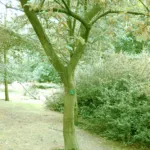 Castanea ‘Pumila’Castanea 'Pumila'
 Castanea ‘Sativa’Castanea 'Sativa'
 Japanese Chestnut (Castanea crenata) care guideCastanea crenata
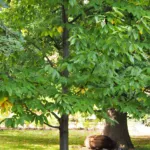 Castanea dentata care guideCastanea dentata
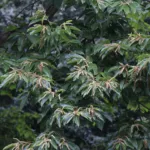 He Chinese chestnu (Castanea mollissima) care guideCastanea mollissima
 Ruby red horse-chestnut (Aesculus ‘Carnea Briotii’)Aesculus 'Carnea Briotii'
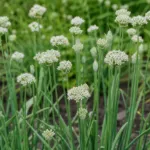 Bunching onion (Allium fistulosum) care guideAllium fistulosum
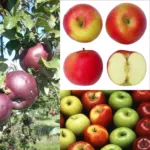 Apple tree (Malus domestica) care guideMalus domestica
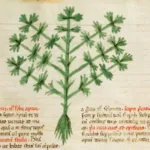 Wild Celery (Apium graveolens) care guideApium graveolens
 Border Forsythia (Forsythia intermedia) care guideForsythia intermedia
 Common Garden Peony (Paeonia lactiflora) care guidePaeonia lactiflora
 Paeonia mlokosewitschii care guidePaeonia mlokosewitschii