
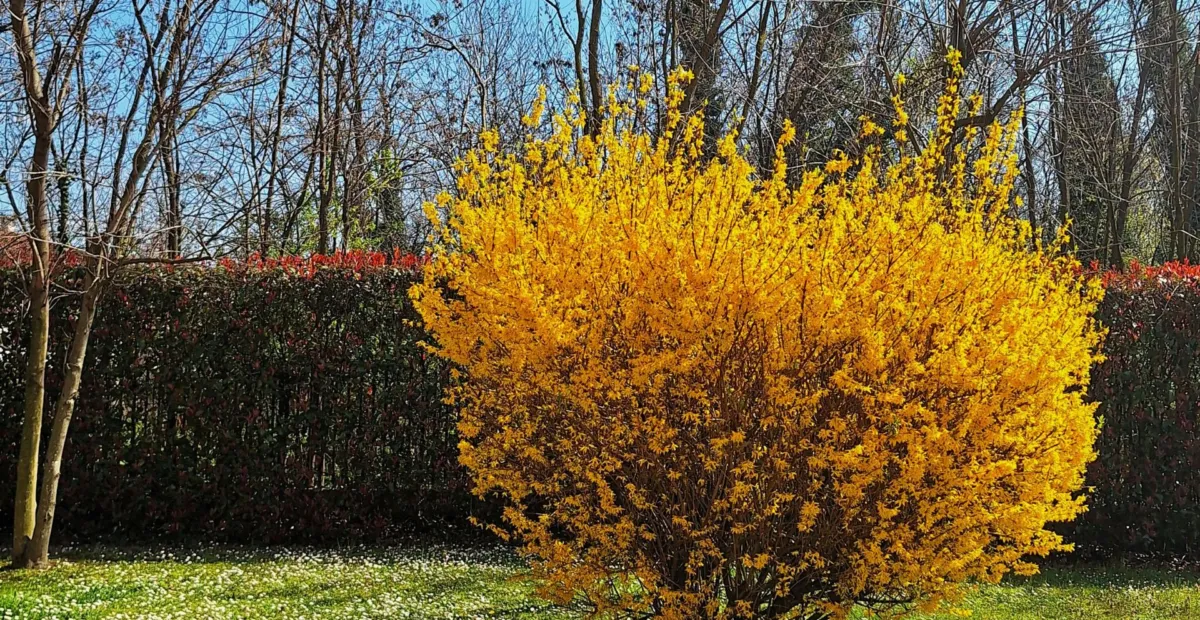
Border Forsythia (Forsythia intermedia) short overview
Border Forsythia is a fast-growing, deciduous hybrid shrub prized for its arching branches and vivid yellow, bell-shaped flowers that open in early spring before the leaves. It is adaptable and forgiving, growing in full sun or partial shade and in many well-drained soils, but flowering is strongest with abundant sunlight. Regular renewal pruning after bloom keeps the shrub from becoming rangy and preserves next year’s flower buds.
Taxonomic classification
Border Forsythia (Forsythia intermedia) care guide
Light and placement
Choose full sun for the heaviest and earliest flowering; morning-to-afternoon sun is ideal. Partial shade is tolerated, but deep shade produces weak growth and noticeably fewer flowers. Excessive shade causes sparse, elongated stems, while intense reflected heat may increase drought stress and leaf scorch if roots are dry.
Watering and humidity
Water deeply when the upper few inches of soil begin to dry during the first growing season, then extend the interval as roots establish. Mature plants tolerate short dry periods but flower and grow better with moderate moisture. Water at the soil line rather than wetting foliage repeatedly, and reduce irrigation in cool fall weather unless conditions are unusually dry.
Soil and growing medium
Use ordinary garden soil that drains freely but does not become excessively dry. Border Forsythia tolerates a broad pH range, approximately 5.0–8.0, including mildly alkaline conditions. Improve compact clay with organic matter and avoid permanently saturated planting sites, where root stress can increase.
Feeding
Usually needs little fertilizer once established. Apply a thin layer of compost or a balanced slow-release shrub fertilizer in early spring as growth begins, following the product label. Avoid heavy nitrogen feeding, which can promote rank shoots and foliage at the expense of a manageable form. Do not fertilize drought-stressed or newly transplanted plants until they are recovering.
Growth and habit
This is a vigorous, arching shrub that can become loose and rangy if left unmanaged. Long shoots often form a fountain-like outline, and stems may root where they contact moist soil. Renewal pruning is more effective than repeated light shearing because it preserves the shrub’s natural form while controlling age and density.
Planting and repotting
Plant in spring or fall, setting the root ball level with the surrounding soil and watering deeply to settle air pockets. Space standard plants about 10–12 feet apart for a full mature spread; closer spacing is possible for a managed hedge. Mulch lightly over the root zone, keeping mulch away from stems, and water consistently during establishment.
Container-grown plants can be transplanted readily. For container culture, move the shrub into a larger pot when roots fill the current container, preferably in early spring or fall. Because mature plants become large and rangy, in-ground planting is generally more suitable than long-term container growing.
Propagation and pruning
Propagation
Propagate selected plants from semi-hardwood or hardwood cuttings. Layering is also practical because flexible arching stems can root where they contact moist soil. Take cuttings from healthy, true-to-type stock; seed is less useful for preserving cultivar characteristics and hybrid offspring may vary.
Pruning
Prune immediately after flowering, removing several of the oldest stems at or near ground level and shortening badly placed branches as needed. Avoid major pruning after mid-July because flower buds for the following spring develop on the current season’s growth. Rejuvenate overgrown plants gradually or cut them back hard when appropriate.
Overwintering
No routine winter protection is needed in suitable USDA zones. In colder sites, protect young plants from drying winds with a loose windbreak and maintain an even soil moisture level before ground freeze. Expect flower-bud loss after severe cold or late freezes even when stems remain alive.
Uses
Primarily an ornamental shrub for early-season color, informal hedging, mass planting, banks, borders, and cut branches for indoor forcing. It is not a reliable pollinator-support plant when represented by sterile hybrid selections, and no culinary or medicinal use is recommended here.
Appearance
Opposite, simple leaves are ovate-oblong to lance-shaped and commonly toothed toward the upper half. Young branches are brown and distinctly four-ridged, with visible lenticels and chambered pith. The loose, arching framework carries flowers directly along bare stems before the foliage expands. A small brown capsule may form but is not ornamental.
Flowering
The shrub flowers on older wood, producing numerous four-lobed, yellow, bell-shaped flowers along bare stems in early spring. Bloom is often strongest in full sun. Late freezes can damage unopened flower buds even when the vegetative framework survives, so flowering may be less reliable in colder or exposed sites.
Pollination and visitors
Although the bright flowers may visually suggest pollinator value, extension guidance reports that the commonly grown Forsythia × intermedia hybrid is sterile and produces neither nectar nor pollen. It should therefore not be selected as a primary food plant for bees or other flower visitors.
Diseases and pests
Diseases
Usually trouble-free, but leaf spot, crown gall, bacterial blight or canker, Phomopsis gall, and dieback may occur. Improve air circulation, avoid chronic wetness, remove visibly diseased wood, sanitize pruning tools, and avoid unnecessary wounding. Correct planting stress is usually more useful than routine spraying.
Pests
Possible pests include aphids, spider mites, four-lined plant bug, Japanese weevil, and northern root-knot nematode. Inspect new growth and leaf undersides, especially during hot or dry weather. Start with water sprays, pruning of localized damage, improved plant vigor, and targeted treatment only when damage is significant.
Related diseases and pests
Only Plant Doctor profiles whose host data indicate this plant may be affected are shown here.
 DiseaseRose powdery mildewPodosphaera pannosa
 DiseaseApple Proliferation Disease‘Candidatus Phytoplasma mali’
 PestNorthern root-knot nematodeMeloidogyne hapla
 DiseaseCrown gallAgrobacterium tumefaciens (現在 commonly classified as Rhizobium radiobacter)
 DiseaseBacterial blight and cankerPseudomonas syringae pv. syringae
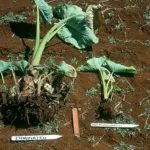 PestJavanese Root-Knot NematodeMeloidogyne javanica
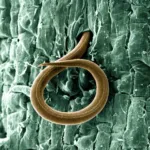 PestSouthern root-knot nematodeMeloidogyne incognita
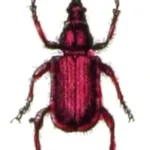 PestPeach weevilRhynchites bacchus
Toxicity and pollen
Reliable evidence specific to the exact hybrid is limited. The available extension and veterinary references reviewed do not establish a significant human or pet poisoning risk, but absence of a record is not proof of complete safety. Discourage ingestion, avoid treating the plant as edible, and seek medical or veterinary advice after a concerning exposure.
- Pollination / pollen
- No meaningful pollen release documented for the commonly grown sterile hybrid
The reviewed sources do not identify meaningful airborne pollen exposure from the commonly grown sterile hybrid. Because cultivar fertility can vary and allergy responses are individual, people with severe pollen sensitivity should still avoid assuming zero risk from every forsythia selection.
Native habitat
Forsythia intermedia is a horticultural hybrid developed in Europe from Asian parentage rather than a native North American shrub. In cultivation it tolerates urban conditions, air pollution, some drought, and a broad range of garden soils, provided drainage is adequate. It is not native to the United States.
Interesting fact
This plant is a garden-origin hybrid rather than a naturally occurring wild species.
Its flowers appear on bare stems before the leaves emerge.
The stems are characteristically four-sided or four-ridged.
Flower buds are more vulnerable to cold than the vegetative framework.
Frequently asked questions (FAQ)
The most relevant questions about this plant, with short and direct answers.
🌱Quick care
How much sun does Border Forsythia need?⌄
Border Forsythia grows best in full sun, although it tolerates partial shade. More direct sunlight generally produces heavier and earlier spring flowering.
How often should I water Forsythia intermedia?⌄
Water Border Forsythia moderately, keeping the soil evenly moist while it establishes. Once established, it usually tolerates short dry periods, but water during prolonged summer drought.
Is Border Forsythia easy to grow?⌄
Yes, Border Forsythia is an adaptable, fast-growing shrub that is generally easy to grow. It performs in ordinary well-drained garden soil and tolerates urban conditions, salt, and some drought.
🌤️Environment and placement
What USDA hardiness zones are suitable for Forsythia intermedia?⌄
Border Forsythia is generally suitable for USDA Zones 4 through 8, although reliable flowering can be less consistent in colder locations. Winter cold and late freezes may damage flower buds even when the stems survive.
How large does Border Forsythia get?⌄
A typical Border Forsythia grows about 8 to 10 feet tall and 10 to 12 feet wide. Cultivars vary considerably, so check the mature size before planting near buildings, paths, or property lines.
What type of soil is best for Border Forsythia?⌄
Use well-drained, moderately moist garden soil for the best growth. Forsythia intermedia tolerates a wide range of soils, including average or somewhat poor soil, but does not perform well in persistently waterlogged ground.
Can Border Forsythia grow in partial shade?⌄
Yes, Border Forsythia can grow in partial shade, but it usually flowers less heavily than plants grown in full sun. Avoid dense shade if abundant yellow spring blooms are the main goal.
Is Border Forsythia drought tolerant?⌄
Established Border Forsythia has moderate drought tolerance and can handle short dry periods. Water deeply during extended drought, especially when the plant is young or growing in sandy soil.
Can Border Forsythia be used as a hedge or screen?⌄
Yes, Border Forsythia can be planted as an informal hedge, screen, border, or mass planting. Its naturally arching, fountain-like growth is usually better suited to an informal hedge than a tightly clipped formal hedge.
💧Care and problems
Why is my Border Forsythia not flowering?⌄
The most common causes are insufficient sunlight, winter or late-freeze damage to flower buds, and pruning at the wrong time. Because flowers form on older wood, pruning from mid-summer through early spring can remove the next season’s blooms.
When should I prune Forsythia intermedia?⌄
Prune Border Forsythia immediately after it finishes flowering in spring. This timing allows new shoots to develop flower buds for the following year.
How do I prune an overgrown Border Forsythia?⌄
Thin an overgrown Border Forsythia by removing some of the oldest stems at ground level rather than shearing the entire shrub. Severe rejuvenation pruning can also be used on a healthy plant, but flowering may be reduced temporarily.
Can I shear Border Forsythia into a neat shape?⌄
You can shear Border Forsythia, but regular shearing often works against its natural arching form and can reduce flowering. Selective thinning and removal of older stems usually produces a healthier, more attractive shrub.
What pests and diseases affect Border Forsythia?⌄
Border Forsythia is relatively pest- and disease-free, but it can develop leaf spot, crown gall, dieback, or occasional infestations of aphids, spider mites, and other minor pests. Poor drainage, drought stress, and damaged stems can increase problems.
Does Border Forsythia spread or sucker?⌄
Border Forsythia may produce suckers and can root where arching stems touch the soil. Remove unwanted suckers at their origin and keep naturally layering branches pruned if you want to limit spread.
🪴Planting and repotting
When is the best time to plant Border Forsythia?⌄
Plant Border Forsythia in spring or fall when temperatures are mild and soil moisture is available. Avoid planting into frozen, waterlogged, or excessively hot, dry soil.
How far apart should Border Forsythia be planted?⌄
Space standard Border Forsythia plants about 8 to 12 feet apart, depending on the cultivar and whether you want the shrubs to merge. Use the plant’s expected mature width as the primary spacing guide.
Can Border Forsythia be transplanted?⌄
Yes, Border Forsythia is generally easy to transplant. Move it during dormancy or mild weather, preserve as much of the root system as practical, and keep the soil consistently moist while it reestablishes.
✂️Propagation and pruning
How do you propagate Forsythia intermedia from cuttings?⌄
Propagate Border Forsythia from softwood cuttings taken from current-season growth in late spring or early summer. Use 4- to 6-inch cuttings, remove the lower leaves, place them in a moist, well-drained rooting medium, and keep them in bright indirect light.
How long do Border Forsythia cuttings take to root?⌄
Border Forsythia softwood cuttings commonly root in about six to eight weeks under suitable conditions. Transplant them after a well-developed root system has formed.
Can Border Forsythia be propagated by layering?⌄
Yes, Border Forsythia layers readily because stems can root where they contact moist soil. Pin a flexible stem to the ground, wait for roots to form, then sever and transplant the rooted section.
Can I grow Border Forsythia from a branch in water?⌄
Dormant Border Forsythia branches can be forced to flower indoors in water, but flowering branches are not a dependable way to produce a permanent new plant. For new shrubs, use softwood cuttings or simple layering instead.
⚠️Toxicity and safety
Is Border Forsythia toxic to dogs and cats?⌄
The ASPCA lists Forsythia, commonly called Golden Bells, as non-toxic to dogs, cats, and horses. Even non-toxic plant material can cause mild stomach upset if eaten in large quantities.
Is Border Forsythia poisonous to people?⌄
There is no established serious human-toxicity classification for Border Forsythia, but evidence about human consumption is limited. Do not eat the plant, and contact a medical professional or poison center if a child has ingested an unknown amount.
🌸Flowering and special interest
When does Border Forsythia bloom?⌄
Border Forsythia blooms in early spring, often before its leaves emerge. Exact timing varies with climate, cultivar, winter conditions, and spring temperatures.
What color are Border Forsythia flowers?⌄
Border Forsythia produces bright yellow, bell-shaped flowers with four lobes. The flowers are most abundant on branches that developed during the previous growing season.
Why did a late freeze kill the flowers but not the Border Forsythia shrub?⌄
Late freezes can injure exposed flower buds while leaving the older stems and roots alive. The shrub should usually recover and flower again the following spring if new growth develops normally.
Can you force Border Forsythia branches indoors?⌄
Yes, cut dormant branches in late winter or very early spring and place them in water indoors to force an earlier display of yellow flowers. Keep the branches in bright, indirect light and change the water regularly.
Does Border Forsythia have good fall color?⌄
Border Forsythia has limited ornamental interest after flowering, and its fall color is usually modest, sometimes showing green with a slight purple tinge. Its main landscape value is the abundant early-spring bloom.
Similar plants
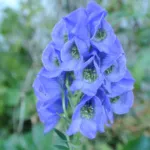 Azure Monkshood (Aconitum carmichaelii) care guideAconitum carmichaelii
 Monkshood (Aconitum ‘Stainless Steel’)Aconitum 'Stainless Steel'
 Monkshood (Aconitum ‘Bressingham Spire’)Aconitum 'Bressingham Spire'
 Golden full moon maple (Acer shirasawanum ‘Aureum’)Acer shirasawanum 'Aureum'
 Globosum (Acer platanoides ‘Globosum’)Acer platanoides 'Globosum'
 Striped maple (Acer pensylvanicum) care guideAcer pensylvanicum