
 Source:
 Lion’s head maple (Acer palmatum ‘Shishigashira’) short overview
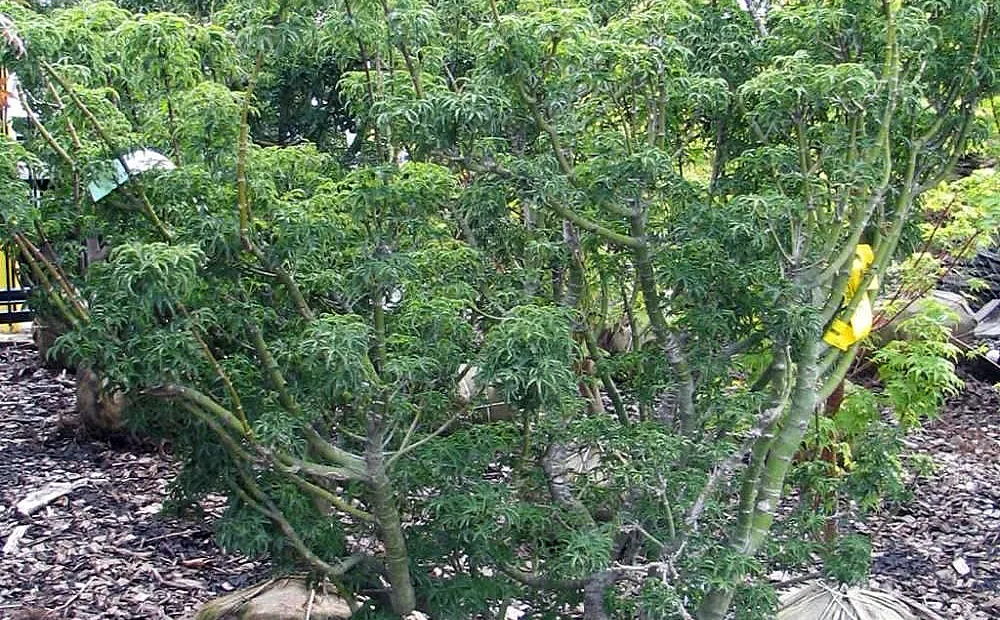
Acer palmatum 'Shishigashira' is a distinctive Japanese maple with an upright, compact habit and dense tufts of small, crinkled, deeply lobed green leaves. Its sculptural form works well as a specimen, patio tree, bonsai subject, or woodland-garden accent. Foliage often holds its summer color well before turning gold, orange, and crimson in fall. Grow it in moist, well-drained soil with protection from hot, drying winds.
Taxonomic classification
Lion’s head maple (Acer palmatum ‘Shishigashira’) care guide
Light and placement
Give morning sun, dappled light, or partial shade, especially in hot-summer areas. A sheltered east or north exposure is often useful; filtered afternoon light reduces scorch. Full sun can work in cooler climates if moisture is reliable. Brown leaf edges, bleached foliage, or premature leaf drop suggest excessive heat, wind, or drought, while weak, elongated growth and sparse foliage suggest insufficient light.
Watering and humidity
Water deeply when the upper few inches of soil begin to dry, then allow excess water to drain. Keep young trees evenly moist through establishment and increase attention during hot, windy weather. Reduce irrigation after leaf fall but do not allow containers or recently planted trees to dry completely. Mulch helps moderate root temperature and moisture.
Soil and growing medium
Use a loose, moisture-retentive but well-drained soil rich in organic matter. A loam amended with compost or leaf mold is suitable. Slightly acidic to neutral conditions are preferred; high-pH soils can induce chlorosis, especially where roots are stressed or drainage is poor.
Feeding
Apply a balanced, slow-release fertilizer or a light organic feed in early spring before leaves fully emerge. Avoid heavy nitrogen, late-season feeding, and fertilizing drought-stressed or newly transplanted trees. A thin compost mulch can support soil structure without forcing soft, late growth.
Growth and habit
This is a slow-growing cultivar that develops a compact, upright, strongly structured crown with dense foliage tufts along the branches. Young plants can look sparse before branching fills in. Keep pruning restrained so the characteristic architecture is not lost, and prioritize shelter from desiccating wind.
Planting and repotting
Plant in spring or fall when soil moisture can be maintained. Set the root flare level with or slightly above the surrounding soil, never deeply buried. Water thoroughly after planting and mulch broadly but keep mulch away from the trunk. Allow enough room for the eventual upright crown and avoid exposed, windy sites.
Repot container-grown specimens in late winter or early spring before bud break, moving up only one container size. Refresh part of the substrate without aggressively disturbing the root ball. Ensure excellent drainage and protect newly repotted plants from drying wind while roots re-establish.
Propagation and pruning
Propagation
Usually propagated by grafting onto compatible Acer rootstock, which preserves the cultivar. Grafting is best left to skilled propagators and is commonly performed during the dormant season or as appropriate for the chosen grafting method. Seed does not reliably reproduce the cultivar.
Pruning
Prune sparingly. Remove dead, damaged, crossing, or poorly placed branches during late fall through midwinter. Avoid routine spring and summer pruning because Japanese maples can bleed sap heavily and fresh cuts may be stressed by heat or disease. Preserve the cultivar's layered, tufted structure.
Overwintering
Outdoor plants generally overwinter in the ground within their hardiness range. Protect young trees from drying winter winds and sudden temperature swings with mulch over the root zone, kept away from the trunk. Containers are more vulnerable: place them in a sheltered location, insulate the pot, and prevent repeated freeze-thaw exposure.
Uses
A high-value ornamental for specimen planting, Japanese-style gardens, woodland edges, courtyards, patio containers, and bonsai. Its compact upright architecture and unusual foliage provide interest beyond the fall display. It is not treated here as a culinary or medicinal plant.
Appearance
The cultivar is recognized by its upright, compact form and small five- to seven-lobed leaves that are thick, deeply divided, crinkled, and gathered in dense tufts along short shoots. The foliage gives the crown a sculptural, lion-mane appearance. Young plants may look sparse, while mature branches develop bold trunks and a strong architectural outline.
Flowering
Small reddish-purple flowers appear in spring, usually around April in much of the United States. They occur in compact clusters and are attractive close up but not showy from a distance. Paired winged samaras develop afterward and mature from late summer into fall.
Pollination and visitors
The small spring flowers can be visited by bees and other insects, but this cultivar is primarily valued for foliage and form rather than as a major pollinator plant. Visitor activity is likely to be modest because the flowers are small and inconspicuous.
Acer palmatum 'Shishigashira' photos
Click any photo for a larger view. Source, author and license are shown separately.
Diseases and pests
Diseases
Avoid prolonged root saturation, trunk injuries, and overhead irrigation where possible. Potential problems include anthracnose, leaf spot, canker, verticillium wilt, fusarium, botrytis, and root rot. Improve drainage, remove badly affected material, and sanitize pruning tools; diagnose wilt or canker before applying treatments.
Pests
Watch for aphids, scale, borers, bagworms, root weevils, and mites. Inspect new growth and the undersides of leaves, maintain plant vigor, and avoid unnecessary broad-spectrum insecticides. Remove heavily infested material and use targeted controls only when monitoring shows a persistent problem.
Toxicity and pollen
No cultivar-specific poisonous principle was identified in the reviewed sources. Japanese maple is generally grown as an ornamental rather than an edible plant. Discourage intentional ingestion and contact a medical or veterinary professional if a large amount is eaten or symptoms occur.
- Typical season
- Spring, typically April–May
- Pollination / pollen
- Low-volume, insect-associated pollen
Japanese maple produces relatively little airborne pollen compared with large, strongly wind-pollinated maples. Its small stature and low pollen output make it a comparatively lower-concern ornamental, but individual sensitivity is still possible and risk is not zero.
Native habitat
The species is native to woodland and mountain environments of Japan, Korea, China, eastern Mongolia, and southeastern Russia. It is associated with moist, well-drained, organic soils and filtered or partial light, although established plants can tolerate more sun when roots remain cool and evenly moist.
Interesting fact
The cultivar name refers to a lion's head, reflecting the dense, curled foliage tufts. It is also known under the synonym 'Ribesifolium'. The cultivar has been cultivated in Japan since at least the late nineteenth century and is valued for bonsai and specimen use.
Frequently asked questions (FAQ)
The most relevant questions about this plant, with short and direct answers.
🌱Quick care
What is Acer palmatum 'Shishigashira' commonly called?⌄
Acer palmatum 'Shishigashira' is commonly called lion’s head maple or lion’s head Japanese maple. It is an upright, compact Japanese maple known for dense branching and small, curled leaves.
How big does Acer palmatum 'Shishigashira' get?⌄
Acer palmatum 'Shishigashira' typically grows about 7–15 feet tall and 5–12 feet wide in the landscape. Its mature size depends on climate, soil, pruning, and whether it is grown in a container.
Is Acer palmatum 'Shishigashira' a slow-growing maple?⌄
Yes, Acer palmatum 'Shishigashira' is generally slow to moderate growing, especially in containers. Young trees may take years to develop a substantial trunk, while established landscape plants can make steadier growth.
🌤️Environment and placement
How much sun does Acer palmatum 'Shishigashira' need?⌄
Grow Acer palmatum 'Shishigashira' in full sun to partial shade. Morning sun with afternoon protection is often best in hot climates, while northern locations may support more direct sun.
Can Acer palmatum 'Shishigashira' grow in full sun?⌄
Yes, it can grow in full sun if the soil remains evenly moist and the site is not excessively hot or windy. In hot summer regions, afternoon shade helps reduce leaf scorch.
Where should I plant Acer palmatum 'Shishigashira' in my yard?⌄
Plant it in a sheltered location with well-drained, organic-rich soil and protection from harsh afternoon heat and drying winds. Avoid exposed sites where reflected heat or drought can damage the foliage.
What USDA hardiness zones are suitable for Acer palmatum 'Shishigashira'?⌄
Acer palmatum 'Shishigashira' is generally suited to USDA Zones 5–8. Cold protection is especially useful for container-grown trees and for plants exposed to drying winter winds.
What type of soil does Acer palmatum 'Shishigashira' prefer?⌄
It prefers moist, organically rich, slightly acidic to neutral, well-drained loam. Improve compacted or sandy soil with organic matter, but do not plant it where water remains stagnant around the roots.
💧Care and problems
How often should I water Acer palmatum 'Shishigashira'?⌄
Water deeply whenever the soil surface begins to dry, keeping the root zone evenly moist but not waterlogged. Newly planted trees may need watering several times per week during hot, dry weather.
Why are the leaves of my Acer palmatum 'Shishigashira' turning brown?⌄
Brown leaf edges or patches are commonly caused by heat, drought, wind, salt buildup, or intense afternoon sun. Keep the soil evenly moist, apply mulch without touching the trunk, and improve protection from harsh exposure.
How do I prevent leaf scorch on Acer palmatum 'Shishigashira'?⌄
Prevent leaf scorch by maintaining consistent soil moisture, mulching the root zone, and providing afternoon shade in hot climates. Avoid fertilizer overuse and protect the tree from strong, drying winds.
Should I fertilize Acer palmatum 'Shishigashira'?⌄
Fertilize only when the tree shows weak growth or the soil is deficient, using a balanced, slow-release fertilizer in early spring. Avoid heavy nitrogen applications, which can produce soft growth and increase stress.
Why is my Acer palmatum 'Shishigashira' losing leaves early?⌄
Early leaf loss can result from drought, heat stress, root damage, transplant shock, disease, or autumn dormancy. Check soil moisture and drainage first, then inspect the trunk and branches for injury or dieback.
Does Acer palmatum 'Shishigashira' need mulch?⌄
Yes, a 2–3 inch layer of organic mulch helps conserve moisture and moderate root temperatures. Keep mulch several inches away from the trunk to prevent prolonged wetness and decay.
🪴Planting and repotting
When is the best time to plant Acer palmatum 'Shishigashira'?⌄
Plant it in early spring or fall when temperatures are moderate and soil moisture is reliable. Avoid planting during extreme summer heat unless the tree can be watered and shaded consistently.
How do I plant Acer palmatum 'Shishigashira' in the ground?⌄
Dig a hole about twice as wide as the root ball and no deeper than its original soil level, then backfill with the excavated soil amended modestly with organic matter. Water thoroughly and mulch the root zone without covering the trunk flare.
Can Acer palmatum 'Shishigashira' be grown in a container?⌄
Yes, Acer palmatum 'Shishigashira' performs well in a large container with drainage holes and a porous, well-drained potting mix. Container plants dry out and freeze more quickly than plants in the ground, so they require closer monitoring.
When should I repot Acer palmatum 'Shishigashira'?⌄
Repot it in late winter or very early spring, just before active growth begins, when the root ball is crowded or water drains unusually quickly. Move it into only a moderately larger container to reduce the risk of persistently wet soil.
Can Acer palmatum 'Shishigashira' be used for bonsai?⌄
Yes, Acer palmatum 'Shishigashira' is valued for bonsai because of its dense branching, compact habit, and small textured leaves. Its relatively slow thickening means development requires patience and careful root management.
✂️Propagation and pruning
Can Acer palmatum 'Shishigashira' be grown from seed?⌄
Seed-grown plants will not reliably reproduce the named 'Shishigashira' characteristics because seedlings are genetically variable. Seed propagation is useful for growing Japanese maple seedlings, but the cultivar is normally maintained by vegetative propagation.
Can Acer palmatum 'Shishigashira' be propagated from cuttings?⌄
It can sometimes be propagated from cuttings, but rooting success is variable and often low for named Japanese maple cultivars. High humidity, a sterile porous medium, bottom heat, and careful moisture control improve the chances.
Can Acer palmatum 'Shishigashira' be air-layered?⌄
Air-layering may work on suitable branches, although results vary with timing, branch age, and aftercare. The new layer should remain protected from drying until a strong root system has formed.
Is Acer palmatum 'Shishigashira' usually grafted?⌄
Many nursery-grown named Japanese maples are grafted onto compatible Japanese maple rootstock. Remove rootstock shoots that emerge below the graft because they can outgrow and weaken the desired cultivar.
Can I prune Acer palmatum 'Shishigashira' in spring?⌄
Light structural pruning is usually best in late winter, while the tree is dormant but severe freezing has passed. Spring and summer cuts may bleed sap and can expose the tree to unnecessary stress, so avoid heavy pruning then.
How should I prune Acer palmatum 'Shishigashira'?⌄
Prune selectively to remove dead, crossing, damaged, or poorly placed branches and to preserve its naturally dense upright form. Avoid shearing the canopy, which can create congested growth and spoil the plant’s architectural structure.
⚠️Toxicity and safety
Is Acer palmatum 'Shishigashira' toxic to dogs, cats, or people?⌄
No specific toxicity is documented for Acer palmatum 'Shishigashira', but it is an ornamental plant and should not be intentionally eaten. Prevent pets and children from chewing large quantities of leaves, stems, or seeds.
🌸Flowering and special interest
Does Acer palmatum 'Shishigashira' flower?⌄
Yes, it produces small reddish-purple flowers in spring, usually around April in temperate climates. The flowers are ornamental but relatively inconspicuous compared with the foliage and fall color.
What color does Acer palmatum 'Shishigashira' turn in fall?⌄
Its foliage can develop a vivid blend of yellow-gold, orange, and red in fall. Color intensity depends on cultivar expression, sunlight, temperature, moisture, and local growing conditions.
Does Acer palmatum 'Shishigashira' produce samaras?⌄
Yes, like other Japanese maples, it can produce paired winged fruits called samaras after flowering. Seedlings from those samaras may differ from the parent plant and will not necessarily be true to 'Shishigashira'.
Similar plants
 Sugar maple (Acer saccharum) care guideAcer saccharum
 Shirazz (Acer palmatum ‘Shirazz’)Acer palmatum 'Shirazz'
 Atropurpureum (Acer palmatum ‘Atropurpureum’)Acer palmatum 'Atropurpureum'
 Bloodgood (Acer palmatum ‘Bloodgood’)Acer palmatum 'Bloodgood'
 Tatar Maple (Acer tataricum) care guideAcer tataricum
 Osakazuki (Acer palmatum ‘Osakazuki’)Acer palmatum 'Osakazuki'