
 Source:
He California fan palm (Washingtonia filifera) short overview
he California fan palm, Washingtonia filifera, is a striking evergreen palm native to desert oases of southern California, Arizona, and northwestern Mexico. Its stout trunk supports a crown of large, gray-green fan leaves edged with threadlike fibers. White flower clusters appear in late spring and early summer, followed by black fruits. Give it full sun, sharply drained soil, careful irrigation, and protection from prolonged hard freezes.
Taxonomic classification
He California fan palm (Washingtonia filifera) care guide
Light and placement
Give full sun with open exposure and strong overhead light. A south- or west-facing position is suitable where summer heat is beneficial. Young plants may tolerate brief light shade, but mature palms become less tolerant of shade. Weak growth, stretched leaves, or a sparse crown suggest insufficient light; scorched foliage more often indicates drought, transplant stress, or extreme heat than excessive sun.
Watering and humidity
Water deeply and thoroughly during establishment, then let the upper soil dry before watering again. Once established, irrigate infrequently but deeply, adjusting for rainfall, season, soil, and container size. Reduce watering in cool weather and avoid frequent shallow irrigation. Excellent drainage is essential because overwatering and wet soil can cause root or trunk rot.
Soil and growing medium
Use sharply drained sandy, rocky, or gritty soil. The species tolerates alkaline and calcareous conditions and is poorly suited to persistently wet substrates. In containers, use a coarse palm or cactus-style mix with added mineral drainage material. Avoid compacted clay and standing water around the trunk.
Feeding
Feed established landscape palms in spring and again during the warm growing season with a slow-release palm fertilizer containing potassium and magnesium. Apply according to the product label and water it in. Do not fertilize newly planted, drought-stressed, cold-damaged, or waterlogged palms until they recover.
Growth and habit
A robust, upright palm develops a single columnar trunk and a crown of large fan leaves. It grows quickly in heat with adequate establishment, but growth slows in cool or poorly drained conditions. Young plants tolerate some shade, while older palms perform best in unobstructed sun. Retained dead fronds require planned maintenance.
Planting and repotting
Plant in spring or early summer after severe frost risk has passed. Set the root ball at its original depth, never burying the trunk base. Water deeply during establishment, then allow the surrounding soil to dry between irrigations. Leave generous clearance for the mature crown and spiny leaf stalks.
Repot container plants in spring only when roots have filled the pot. Move up one pot size, preserve the root ball, and use a fast-draining mineral-rich mix. Large palms are difficult to transplant; establish young plants before they become oversized.
Propagation and pruning
Propagation
Propagate from fresh or properly stored seed. Remove fruit pulp, sow in a warm, well-drained medium, and keep evenly moist but not saturated. Germination can be uneven. Reliable vegetative propagation is not generally used for this species.
Pruning
Remove dead or hazardous fronds only when necessary, using clean equipment and appropriate protective clothing. Do not routinely remove green fronds or cut into the trunk. The natural dead-frond skirt is characteristic but can be a fire hazard and may be regulated in some jurisdictions.
Overwintering
Protect young palms from prolonged freezes, especially when temperatures approach the mid-20s °F. Keep the crown dry during cold spells, tie foliage loosely if needed, and use breathable frost protection rather than sealed plastic against the leaves. Container specimens can be moved to a bright, cool, frost-free site. Mature plants tolerate brief cold better than prolonged freezing.
Uses
Used as a drought-tolerant ornamental specimen, street or avenue palm, desert-garden accent, and habitat-forming tree in warm regions. Natural groves provide structure and nesting opportunities for wildlife. Retained dead fronds are highly flammable and may harbor rodents, so local maintenance and fire regulations should be followed.
Appearance
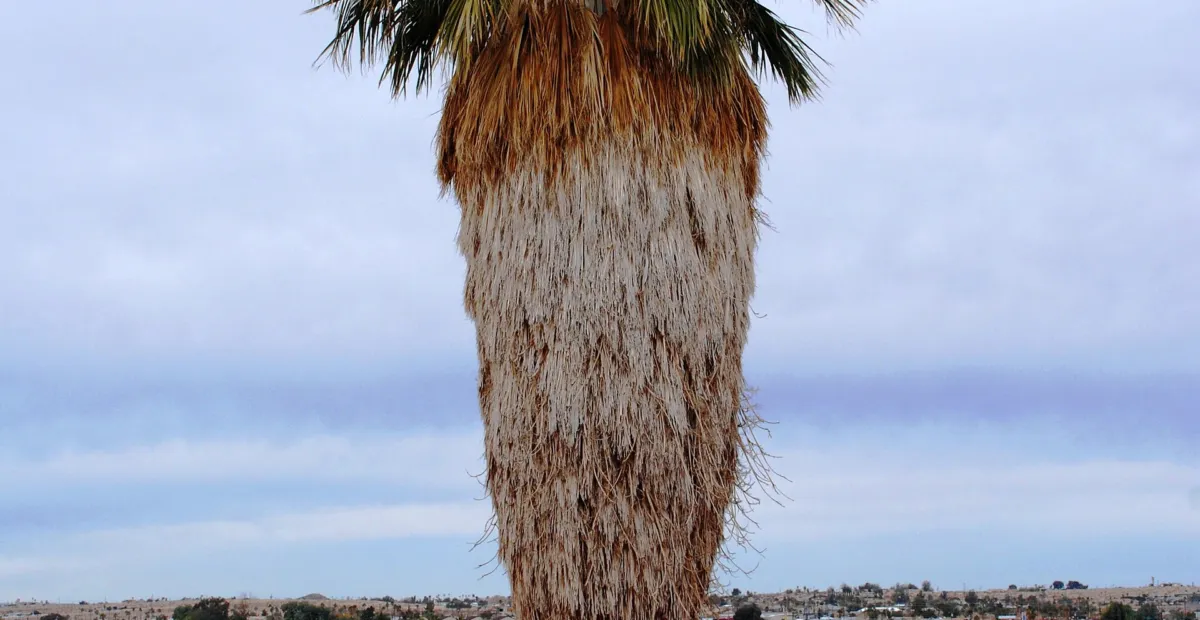
The species is recognized by its thick, gray-brown, columnar trunk and large, pleated, fan-shaped leaves. Leaf blades are divided into segments with conspicuous white threadlike filaments, while the long petioles may bear teeth or spines. Dead leaves can remain attached, forming a shaggy skirt around the trunk.
Flowering
Mature palms produce branched, arching inflorescences extending beyond the leaf crown. The small cream-white flowers are borne in dense clusters in late spring and early summer, commonly May and June in the southwestern United States. Flowers are followed by small dark fruits.
Pollination and visitors
The flowers are predominantly insect-mediated and may be visited by bees and other small insects. Self-pollination can also occur, so animal visitation is not the only reproductive pathway.
Washingtonia filifera photos
Click any photo for a larger view. Source, author and license are shown separately.
Diseases and pests
Diseases
The main risk is trunk or root rot caused by persistently wet soil or over-irrigation. Improve drainage, avoid burying the trunk base, and reduce irrigation during cool or rainy periods. Remove severely affected material only when necessary and maintain clean pruning tools.
Pests
Scale insects, palm leaf skeletonizer, and palm weevil may occur. Inspect young foliage and older trunks regularly. Manage light infestations with washing or horticultural oil when appropriate; follow product labels and avoid spraying stressed plants in extreme heat. Remove heavily infested debris and correct overwatering.
Toxicity and pollen
No well-established human or companion-animal poisoning syndrome was identified in the authoritative horticultural sources reviewed. The fruits are not recommended as a household food crop without proper identification and preparation. Handle spiny leaf stalks and fibrous dead fronds carefully; avoid ingestion by pets or children.
- Typical season
- Late spring to early summer
- Pollination / pollen
- Flower-produced pollen; airborne relevance not well quantified
This is a flowering palm that releases pollen from its inflorescences, but reliable U.S.-specific airborne pollen and allergy-risk ratings were not located. People with known palm-pollen sensitivity should limit exposure during flowering and avoid handling flowering structures unnecessarily.
Native habitat
In its native range, the species occupies desert oases, seeps, springs, stream margins, canyon bottoms, and sites where groundwater is accessible. Natural soils may be sandy, rocky, saline, or alkaline, but successful palms are associated with dependable subsurface or surface moisture despite the surrounding arid climate.
Interesting fact
This is the only palm native to California.
Its natural groves commonly mark springs, seeps, and groundwater.
Dead leaves can form a dense skirt around the trunk.
Coyote movement helps disperse its fruit and seeds.
Mature palms may live for roughly a century or more.
Frequently asked questions (FAQ)
The most relevant questions about this plant, with short and direct answers.
🌱Quick care
What is Washingtonia filifera commonly called in the United States?⌄
The verified common name is he California fan palm, and Washingtonia filifera is also widely documented as California fan palm or desert fan palm. It belongs to the palm family, Arecaceae. ([research.fs.usda.gov](https://research.fs.usda.gov/feis/species-reviews/wasfil?utm_source=openai))
How much sunlight does he California fan palm need?⌄
He California fan palm needs full sun for strong growth and a well-formed crown. Choose an open location without persistent shade from buildings or larger trees. ([landscapeplants.oregonstate.edu](https://landscapeplants.oregonstate.edu/plants/washingtonia-filifera?utm_source=openai))
How often should I water Washingtonia filifera?⌄
Water Washingtonia filifera deeply while it is establishing, then reduce irrigation once the root system is established. Mature trees tolerate dry conditions, but occasional deep watering may still be useful during prolonged extreme heat or drought. ([animals.sandiegozoo.org](https://animals.sandiegozoo.org/plants/california-fan-palm?utm_source=openai))
Is Washingtonia filifera drought tolerant?⌄
Yes, Washingtonia filifera is drought tolerant once established. It performs best when excess water drains quickly rather than remaining around the trunk or roots. ([animals.sandiegozoo.org](https://animals.sandiegozoo.org/plants/california-fan-palm?utm_source=openai))
🌤️Environment and placement
What USDA hardiness zone is Washingtonia filifera suitable for?⌄
Washingtonia filifera is generally listed for USDA Zones 9A through 11. Cold tolerance varies with plant age, exposure, duration of freezing temperatures, and winter moisture. ([landscapeplants.oregonstate.edu](https://landscapeplants.oregonstate.edu/plants/washingtonia-filifera?utm_source=openai))
Can Washingtonia filifera survive frost?⌄
Established Washingtonia filifera can tolerate some freezing weather, but frost protection is advisable for young palms and during severe or prolonged freezes. Cold, wet soil can increase the risk of root and trunk problems. ([animals.sandiegozoo.org](https://animals.sandiegozoo.org/plants/california-fan-palm?utm_source=openai))
What soil is best for Washingtonia filifera?⌄
Use sandy, rocky, sharply drained soil; Washingtonia filifera also tolerates alkaline and calcareous conditions. Avoid heavy, poorly drained sites because persistent wetness can contribute to root or trunk rot. ([animals.sandiegozoo.org](https://animals.sandiegozoo.org/plants/california-fan-palm?utm_source=openai))
Can Washingtonia filifera grow in clay soil?⌄
Washingtonia filifera can grow in clay only when drainage is improved substantially. Amend the planting area or choose a raised, fast-draining site so water does not remain around the root zone. ([ask.ifas.ufl.edu](https://ask.ifas.ufl.edu/publication/ST669?utm_source=openai))
How large does Washingtonia filifera get?⌄
Washingtonia filifera commonly grows about 30 to 50 feet tall, although mature specimens can reach approximately 60 feet. Its broad crown and large trunk require substantial clearance from buildings, utilities, and pavement. ([landscapeplants.oregonstate.edu](https://landscapeplants.oregonstate.edu/plants/washingtonia-filifera?utm_source=openai))
Where is Washingtonia filifera native?⌄
Washingtonia filifera is native to the deserts of southeastern California, southwestern Arizona, and northwestern Mexico, where it naturally occurs near springs, seeps, and other dependable water sources. ([research.fs.usda.gov](https://research.fs.usda.gov/feis/species-reviews/wasfil?utm_source=openai))
💧Care and problems
Why are Washingtonia filifera leaves turning brown?⌄
Brown leaves can result from normal aging, drought stress, transplant shock, cold damage, or excessive soil moisture. Check irrigation and drainage first, and do not remove green fronds unless they are damaged or unsafe. ([ask.ifas.ufl.edu](https://ask.ifas.ufl.edu/publication/ST669?utm_source=openai))
Why is my Washingtonia filifera not growing?⌄
Slow growth is commonly linked to insufficient sunlight, cold conditions, root disturbance, poor drainage, or inadequate water during establishment. Confirm that the palm is planted in full sun and that the root zone drains rapidly. ([landscapeplants.oregonstate.edu](https://landscapeplants.oregonstate.edu/plants/washingtonia-filifera?utm_source=openai))
Does Washingtonia filifera need fertilizer?⌄
Washingtonia filifera can benefit from a palm fertilizer when soil nutrients are low, especially during active growth. Apply according to the product label and avoid fertilizing stressed, newly transplanted, or cold-damaged palms until they recover.
Should I remove the dead fronds from Washingtonia filifera?⌄
Remove completely dead fronds when they can be cut safely, particularly where the dry skirt creates a fire or access hazard. Use professional palm pruning for tall trees, because the trunk and leaf stalks can be difficult and dangerous to handle. ([landscapeplants.oregonstate.edu](https://landscapeplants.oregonstate.edu/plants/washingtonia-filifera?utm_source=openai))
Is the skirt of dead leaves on Washingtonia filifera dangerous?⌄
The hanging skirt can accumulate dry material and may create a fire hazard, especially in hot, dry landscapes. Removal should be performed carefully by trained professionals on tall palms because the fronds and trunk can present serious hazards. ([landscapeplants.oregonstate.edu](https://landscapeplants.oregonstate.edu/plants/washingtonia-filifera?utm_source=openai))
How can I tell Washingtonia filifera from Washingtonia robusta?⌄
Washingtonia filifera generally has a thicker trunk, a broader and less compact crown, and more conspicuous threadlike fibers on the leaf segments than Washingtonia robusta. Landscape palms may be difficult to identify because hybrids and variable forms occur. ([selectree.calpoly.edu](https://selectree.calpoly.edu/tree-detail/washingtonia-filifera?utm_source=openai))
🪴Planting and repotting
When is the best time to plant Washingtonia filifera?⌄
Plant Washingtonia filifera during the warm growing season after the risk of hard freezes has passed. Warm soil supports root establishment, while very hot or freezing weather can increase transplant stress.
How should I plant Washingtonia filifera in the ground?⌄
Plant it at the same depth as it grew in its container, in full sun and sharply drained soil. Water deeply after planting, keep the root zone evenly supported during establishment, and avoid burying the trunk base. ([animals.sandiegozoo.org](https://animals.sandiegozoo.org/plants/california-fan-palm?utm_source=openai))
Can Washingtonia filifera be grown in a container?⌄
Young Washingtonia filifera can be grown in a deep container temporarily, but it eventually becomes a very large landscape palm. Use a container with drainage holes and move the plant outdoors gradually so it receives strong light without sudden sun stress.
✂️Propagation and pruning
How do you propagate Washingtonia filifera?⌄
Washingtonia filifera is propagated by seed. Clean ripe seeds, sow them in a sterile, well-drained medium, and keep them warm and lightly moist until germination; exact timing varies with seed freshness and temperature. ([ask.ifas.ufl.edu](https://ask.ifas.ufl.edu/publication/ST669?utm_source=openai))
How long do Washingtonia filifera seeds take to germinate?⌄
Washingtonia filifera seeds may germinate in several weeks to a few months, depending on freshness, warmth, moisture, and sowing conditions. Keep the medium moist but never waterlogged while waiting.
Can Washingtonia filifera be propagated from cuttings?⌄
No, Washingtonia filifera is not normally propagated from stem or leaf cuttings. Seed propagation is the standard method because palms generally do not regenerate new plants from ordinary cuttings. ([ask.ifas.ufl.edu](https://ask.ifas.ufl.edu/publication/ST669?utm_source=openai))
⚠️Toxicity and safety
Are Washingtonia filifera berries poisonous?⌄
There is no established specific toxicity commonly documented for Washingtonia filifera, but the fruits should not be treated as food unless properly identified and prepared. Keep fallen fruit away from children and pets if ingestion is a concern.
Do Washingtonia filifera leaves have spines?⌄
Yes, the leaf stalks can have sharp teeth or spines, especially near the base. Wear gloves and protective clothing when handling fronds, and keep the palm away from narrow walkways and frequently used play areas. ([landscapeplants.oregonstate.edu](https://landscapeplants.oregonstate.edu/plants/washingtonia-filifera?utm_source=openai))
Is Washingtonia filifera safe to plant near a house?⌄
It can be planted near a house only when sufficient space is allowed for its tall trunk, wide crown, falling fronds, and professional pruning access. Avoid locations beneath utility lines or where mature fronds could obstruct roofs, sidewalks, or driveways.
Is Washingtonia filifera invasive in the United States?⌄
Washingtonia filifera is native to parts of the southwestern United States and is generally classified as noninvasive in its native range. However, seedlings can appear where birds disperse fruit, so remove unwanted volunteers before they become difficult to manage. ([research.fs.usda.gov](https://research.fs.usda.gov/feis/species-reviews/wasfil?utm_source=openai))
🌸Flowering and special interest
When does Washingtonia filifera flower?⌄
Washingtonia filifera typically flowers in spring, with white or pale flowers carried on long branched structures. Flowering is usually more noticeable on mature palms growing in warm, sunny conditions. ([research.fs.usda.gov](https://research.fs.usda.gov/feis/species-reviews/wasfil?utm_source=openai))
Does Washingtonia filifera produce fruit?⌄
Yes, mature Washingtonia filifera produces small dark fruits after flowering. The fruits can drop around the landscape and may be dispersed by wildlife, so remove developing flower or fruit stalks if cleanup is a concern. ([research.fs.usda.gov](https://research.fs.usda.gov/feis/species-reviews/wasfil?utm_source=openai))
Similar plants
 Trachycarpus latisectus care guideTrachycarpus latisectus
 Dwarf Palmetto (Sabal minor) care guideSabal minor
 He Florida cherry palm or buccaneer palm (Pseudophoenix sargentii) care guidePseudophoenix sargentii
 Veitchia arecina care guideVeitchia arecina
 He Macarthur palm (Ptychosperma macarthurii) care guidePtychosperma macarthurii
 He Chusan palm (Trachycarpus fortunei) care guideTrachycarpus fortunei
Sources and data reliability
Wikipedia-en exact taxon intro (Wikidata P225 verified) – local common name
iNaturalist – localized genus name
Washingtonia filifera, California palm | US Forest Service Research and Development
Washingtonia filifera | Landscape Plants | Oregon State University
California Fan Palm | San Diego Zoo Animals & Plants