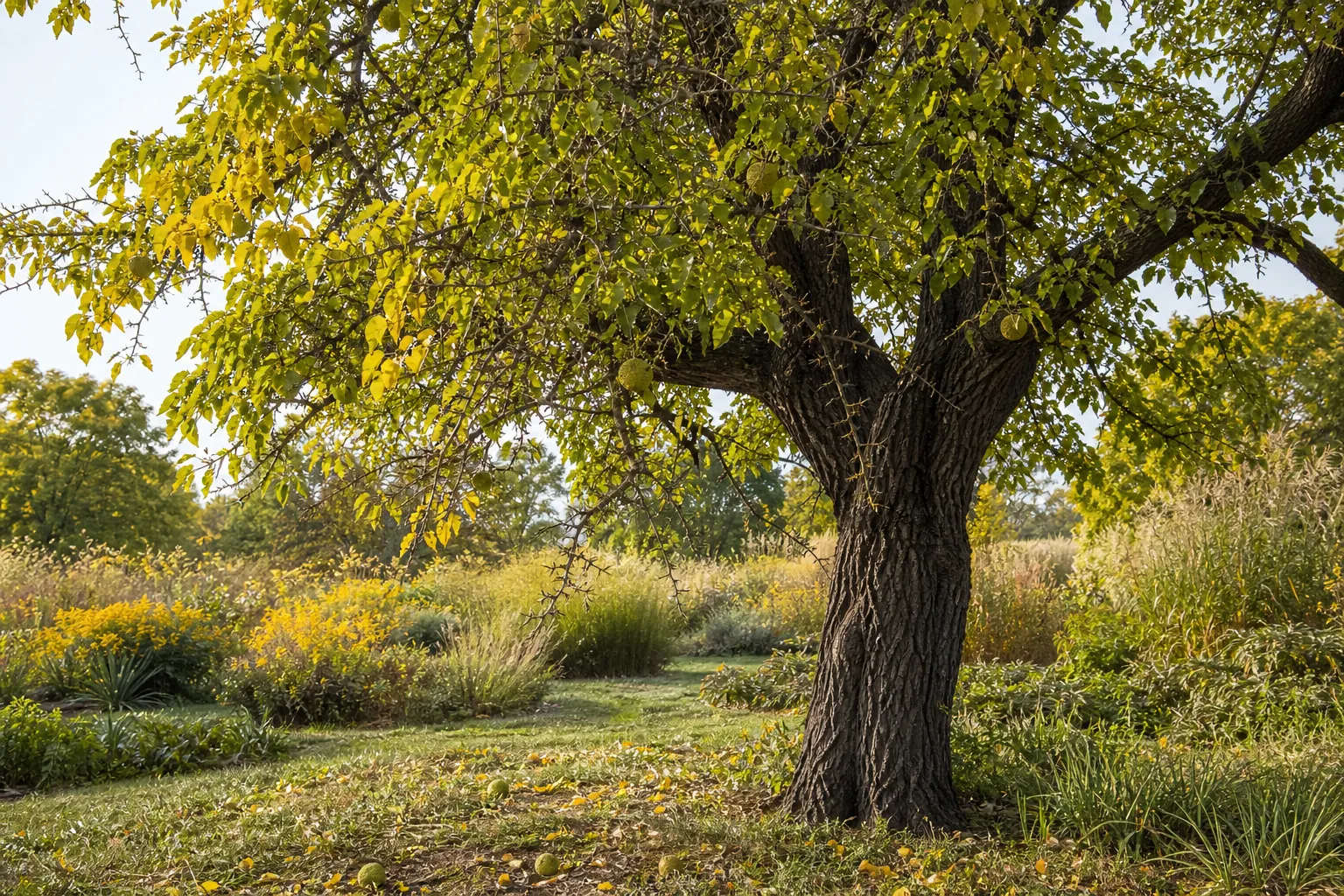
Few trees attract attention like Osage orange. Its glossy green leaves, thorny branches and bright yellow-green fruit make it look almost familiar—until you pick up one of its heavy, wrinkled “hedge apples.” The fruit resembles an oversized orange, but it is not a citrus fruit and is not grown as a conventional edible crop.
Maclura pomifera is a tough North American tree with a remarkable history. Farmers once planted it as a living fence across the Great Plains, while Indigenous peoples valued its strong, durable wood for bows. Today, gardeners grow it as a specimen tree, privacy screen, windbreak plant or living reminder of the American prairie.
If you have room for a large, sometimes thorny tree, Osage orange can be rewarding. The key is to understand its mature size, choose the right sex and form, and give it enough sunlight and space to develop without becoming a maintenance problem.
What is Osage orange?
Osage orange belongs to the mulberry family, Moraceae. Despite its common name, it is not related to oranges, lemons or other citrus trees. Other names include hedge apple, hedge, bodark, bois d’arc and bowwood.
In its native range, the tree comes from a relatively small area around the Red River drainage in parts of Texas, Oklahoma, Arkansas and Louisiana. People later planted it widely across the Great Plains and eastern United States, especially for thorny hedgerows and windbreaks. It now grows naturally or semi-naturally in many regions beyond its original range.
A mature tree commonly reaches about 25 to 60 feet tall, although exceptionally favorable trees may grow taller. It often develops a short trunk, several major limbs and a broad, rounded crown. Lower branches may droop toward the ground and remain attached for years, creating a dense, somewhat untidy silhouette.
Why the fruit looks so unusual
The Osage orange fruit is a multiple fruit. Instead of developing from a single flower with one ovary, it forms from many small flower parts that grow together. The result is a round, lumpy fruit usually about 3 to 5 inches across, with a yellow-green color that becomes more vivid as it ripens.
Inside are many small seeds embedded in the fleshy fruit. When bruised or cut, the fruit may release a sticky, milky sap. The odor and texture are not especially appealing, and the fruit is generally treated as inedible rather than as a food for people. Avoid experimenting with eating it, particularly because individual sensitivities and older descriptions of its use vary.
Although people sometimes place the fruits indoors in hopes of discouraging insects, results are inconsistent and the practice is not a dependable pest-control method. The fruit can also become messy when it drops, so consider its position carefully before planting a female tree near paths, patios or driveways.
Male and female trees
Osage orange is dioecious, meaning male and female flowers occur on separate trees. Only female trees produce fruit, and they need pollen from a male tree nearby for the fruit to contain viable seeds.
- Male trees: Do not produce the large hedge apples and are often the better choice for a tidy ornamental planting.
- Female trees: Produce the characteristic fruit, but fallen fruits can be heavy, slippery and messy.
- Seed-grown trees: May be male or female, so their eventual sex is uncertain until maturity or flowering.
- Thornless male forms: Are available through some specialty nurseries and are useful where sharp branches would be a concern.
Choose the right location
Give Osage orange full sun—ideally at least six hours of direct sunlight each day. The tree grows most vigorously in open conditions and tends to become less thorny on shaded interior branches, but shade is not a good substitute for a sunny planting site.
Osage orange tolerates a wide range of soils, including clay, sandy soil and relatively poor ground. It performs best in deep, reasonably fertile, well-drained soil, especially where moisture is available during establishment. Avoid sites that stay waterlogged for long periods or have severely compacted soil.
Before planting, look up the mature spread and inspect the site for overhead wires, septic systems, underground utilities, sidewalks and property lines. The roots can explore a large area, and the branches may eventually create a dense, spreading canopy.
Climate and cold tolerance
Osage orange is best suited to much of the central and eastern United States, particularly areas with hot summers and a reasonably long growing season. It can tolerate drought once established, but young trees need regular moisture while their root systems develop.
In the northern Great Plains and other exposed cold regions, winter injury can limit success. A sheltered site, adequate summer growth and a locally adapted nursery tree can improve establishment. Check your local nursery recommendations rather than relying on a single national hardiness assumption.
Planting Osage orange step by step
- Choose a healthy tree. Look for a straight, vigorous plant with no severe trunk damage, circling roots or signs of dieback.
- Prepare the planting hole. Make it about twice as wide as the root ball but no deeper than the root system. The trunk flare should sit level with or slightly above the surrounding soil.
- Backfill with native soil. Avoid creating a rich pocket that encourages roots to remain in the hole instead of moving outward.
- Water slowly. Apply enough water to moisten the full root zone, then allow excess water to drain.
- Add mulch. Spread a 2- to 3-inch layer of wood mulch over the root area, keeping it several inches away from the trunk.
- Protect the young tree. A trunk guard or temporary fence can help prevent rubbing, animal damage and accidental injury from lawn equipment.
Planting in fall or early spring is usually easier on a young tree than planting during hot, dry weather. If you plant in summer, monitor soil moisture particularly closely during the first several weeks.
How much water does it need?
Osage orange is often described as drought tolerant, but that reputation applies mainly to established trees. A recently planted tree should not be expected to thrive on occasional rainfall alone.
For a practical home-garden watering plan, measure the water rather than guessing. During the first growing season, apply about 10 gallons of water once or twice a week when rainfall is limited, adjusting for soil type and heat. On sandy soil, smaller applications may be needed more often; on heavy clay, water more slowly and allow the soil surface to dry somewhat between applications.
One simple measurement method is to place a 1-gallon bucket beneath the hose and time how long it takes to fill. If the bucket fills in two minutes, running the hose for ten minutes delivers approximately 5 gallons. Two such measured applications equal about 10 gallons.
After the first year, taper irrigation as the tree roots extend. During a prolonged summer drought, a deep watering that moistens the soil several inches down is more useful than a light daily sprinkle. To check, push a trowel or screwdriver into the soil near—but not against—the root zone. If the soil is dry several inches below the surface, it is time to water.
A small growing experiment worth trying
If you are unsure how your site behaves, run a simple first-season comparison. Choose two similar young trees or divide one planting area into two zones. Give one zone 10 gallons once weekly and the other 5 gallons twice weekly, keeping rainfall records and checking soil moisture at the same depth.
Record new growth, leaf color, wilting and the time it takes the soil to dry. The goal is not to force rapid growth but to discover whether your soil drains quickly or holds moisture. If leaves wilt repeatedly, the soil stays saturated or growth stops, adjust the schedule rather than automatically adding more water.
Pruning and managing the thorns
Young Osage orange trees benefit from early structural pruning. Select one main trunk if you want a conventional tree, or retain several well-spaced trunks for a more natural form. Remove crossing, damaged or dangerously low branches while they are small.
Thorns can be ½ to 1 inch long on vigorous, sun-grown branches. Wear sturdy gloves, eye protection and long sleeves when pruning. Keep the tree away from play areas, narrow walkways and places where children or pets may brush against the branches.
If you are growing a hedge, regular pruning can maintain a dense barrier. However, a neglected hedge can become difficult to manage because the tree resprouts strongly after cutting. Plan for ongoing maintenance rather than treating it as a plant-and-forget screen.
Comparing common planting choices
- Seed-grown Osage orange: Affordable and genetically diverse, but the tree’s sex, thorniness and final shape are unpredictable.
- Named thornless male selections: A practical choice for ornamental landscapes where fruit and sharp branches are unwanted. Availability may be limited.
- Female specimen trees: Best for gardeners who specifically want the unusual fruit and have room to manage fallen hedge apples.
- Hedge plantings: Historically valuable for livestock barriers, but they require repeated pruning and can spread into unmanaged ground.
When shopping, ask the nursery whether the plant is male or female, whether it is a thornless selection and what mature size is expected. Do not assume that a small container plant will remain shrub-sized.
Growing from seed
Propagation from seed is possible, although cleaning the fruit is unpleasant. Collect ripe fruits in fall and allow them to soften in a protected outdoor location. Once the fruit has broken down, separate the seeds, rinse away the pulp and let them dry briefly.
Fresh seeds can be sown in fall. For spring sowing, a period of cold, moist treatment can improve germination. One established method is to keep the seeds in moist sand or another suitable medium at about 41 degrees Fahrenheit for roughly 30 days before planting.
Sow seeds about ¼ to ½ inch deep in firm, well-drained soil. Keep the bed evenly moist and provide full sun after germination. Seedlings grow best where competing weeds are controlled, but remember that the resulting trees will not reliably reproduce the qualities of a thornless or male parent.
Wildlife, history and practical uses
Osage orange has a long relationship with people. Its exceptionally durable wood has been used for fence posts, tool handles and bows. Historic hedgerows helped farmers enclose livestock before woven wire and barbed wire became widely available.
The dense branches can provide cover for birds and small animals, although the tree is not necessarily the best all-purpose wildlife plant. If wildlife value is your main goal, consider pairing it with native trees, shrubs and flowers that offer a broader range of fruits, seeds and nesting habitat.
Osage orange can also work in windbreaks, erosion-control plantings and difficult open sites. Because it can colonize disturbed ground and resprout after cutting, do not plant it where escape into natural areas or unmanaged pasture would create a problem. Check local guidance if you live near prairie remnants, conservation land or other sensitive habitats.
Common problems to watch for
- Weak establishment: Usually linked to drought, grass competition, poor planting depth or root damage.
- Dieback in cold regions: Young growth may suffer winter injury in exposed northern locations.
- Messy fruit: Plant female trees away from traffic areas and mowable lawn edges.
- Unwanted suckers or regrowth: Remove young shoots early, before they become thorny and difficult to handle.
- Compacted soil: Improve the planting site and avoid repeated vehicle or foot traffic over the root zone.
Serious pest problems are not usually the main challenge for home gardeners. Site selection, thorn management and long-term size are more important than routine spraying. Avoid applying any pesticide unless you have identified a specific problem and the product label permits that use.
Is Osage orange right for your garden?
Choose Osage orange if you appreciate unusual trees, have plenty of space and want a hardy plant with a strong American history. A thornless male selection may suit a landscape near a lawn or garden better than a seed-grown female tree.
Before you plant, answer three questions: Can you provide full sun? Can you accommodate a mature tree and its roots? Are you prepared for thorns, pruning and—if you choose a female—the annual fruit drop?
With those decisions made in advance, Maclura pomifera becomes much easier to grow. Give it sunlight, measured water during establishment and room to mature, and this strange, durable tree can become one of the most memorable plants in your landscape.