Finding a small gray moth fluttering around your kitchen can be unsettling, especially when you store flour, grains, birdseed or homegrown seeds. The Mediterranean flour moth is a stored-food pest, not a garden insect that attacks living plants. Its caterpillars can contaminate dry foods with silk, droppings and shed skins, so the most effective solution is to find the infested package, remove it and improve the way you store pantry goods.
Fortunately, you do not need a complicated pesticide program. A careful inspection, thorough cleaning and a few sensible storage habits usually provide the best long-term control. Here is how to recognize this moth, avoid confusing it with the more common Indianmeal moth, and stop an infestation from returning.
What is the Mediterranean flour moth?
The Mediterranean flour moth, Anagasta kuehniella, is a small moth whose larval stage feeds on stored dry foods. Despite its name, it is not limited to flour and it is not restricted to Mediterranean climates. It can occur wherever dry grain products and suitable indoor conditions are available, including homes, bakeries, mills, food warehouses and animal-feed storage areas.
The adult moth is mainly a nuisance. The damaging stage is the caterpillar, which feeds inside or around stored food and produces silken webbing as it moves and develops. That webbing may bind flour or meal into clumps and can spread contamination beyond the portion the larvae actually eat.
In a home, the original source is often a forgotten or lightly used package. Common possibilities include whole-wheat flour, cornmeal, pancake mix, cereal, dry pet food, birdseed, nuts, dried fruit, pasta, baking ingredients and saved garden seeds.
How to identify it
The adult moth
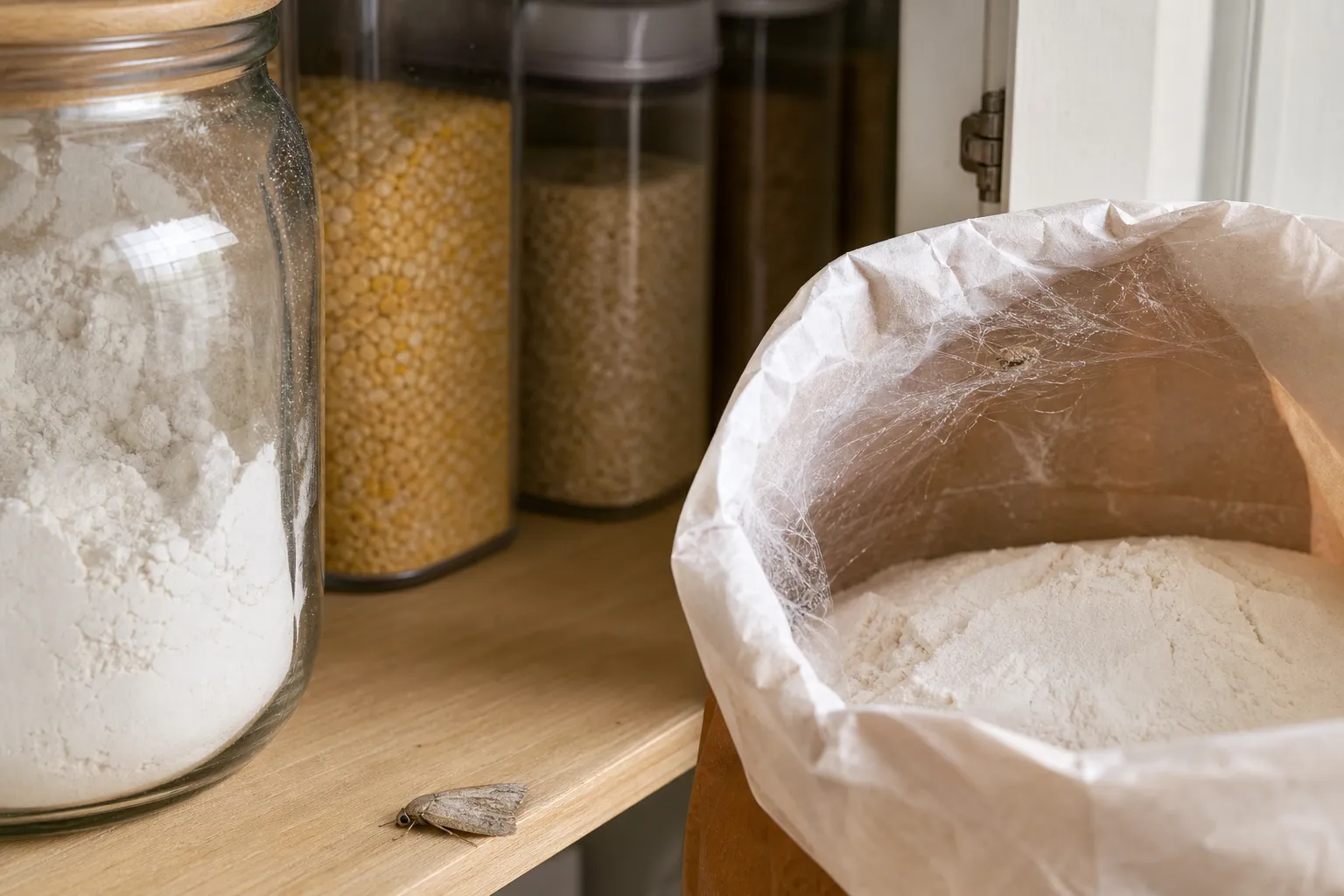
An adult Mediterranean flour moth has pale gray forewings marked by darker, wavy bands. The hind wings are dirty white or grayish white. Its wingspan is roughly three-quarters to four-fifths of an inch, although the moth may look smaller when resting with its wings folded over its body.
Adults may appear on pantry shelves, window screens, walls or ceilings. They often become noticeable only after the larvae have left their food source to find a protected place for pupation. Seeing a moth in a room does not necessarily mean the infestation began there.
These moths are not strong, purposeful fliers. They may flutter awkwardly, settle on nearby surfaces or become active when lights are switched on. Appearance alone is not always enough for a confident identification, so inspect the food products as well.
The larva and its clues
The larva is a pale caterpillar with a darker head. As it grows, it may reach about five-eighths of an inch long. Its most useful identifying clue is the silk it produces.
- Fine threads or mats of silk inside flour, meal or cereal
- Food that looks clumped, dusty or unusually compacted
- Larvae crawling on shelves, walls or ceilings near stored food
- Small cocoons or pupation sites in cracks, corners and behind containers
- Unexplained larvae in pet food, birdseed or packets of saved seed
Do not rely only on finding adult moths. The larvae may be hidden deep inside packaging, and an apparently clean shelf can still contain the source of the problem.
Mediterranean flour moth or Indianmeal moth?
Indianmeal moths are more commonly encountered in household pantries, and the two species can be confused. Indianmeal moth adults usually have a pale gray or tan inner portion of the forewing and a reddish-brown to copper-colored outer portion. Mediterranean flour moths look more uniformly pale gray, with darker wavy lines rather than a strong copper band.
Both species can infest flour, grain products, pet food, nuts, dried fruit and seeds. Their control is also broadly similar, so do not delay action while trying to make a perfect identification. If you need a precise diagnosis, collect the insect or take a close photograph and ask your county extension office, a university insect diagnostician or a licensed pest professional.
Clothes moths are another common source of confusion. They are associated with wool, fur, feathers and other animal-based materials, not flour and grain. If you find silk in a food package, treat it as a stored-food pest until proven otherwise.
Where to look first
Begin with the foods you use infrequently. Pantry pests can remain unnoticed in a bag of flour or a box of cereal for weeks, especially when the package sits undisturbed in the back of a cabinet.
Inspect every dry product in the same cupboard, then expand your search to nearby storage areas. Include materials that are not normally thought of as food for people.
- Flour, cornmeal, whole grains and baking mixes
- Cereal, crackers, pasta and dry soup mixes
- Rice, beans, popcorn and other dried seeds
- Nuts, dried fruit, chocolate and powdered ingredients
- Dry dog food, cat food, chicken feed and other animal feeds
- Birdseed, wild-bird suet ingredients and stored garden seed
- Decorative dried plants, wreaths, seed pods and craft materials
Look for torn seams, loose folds, webbing near the top of a package and larvae in corners. Cardboard boxes and thin plastic bags are not reliable barriers. A sealed-looking package may have been infested before you bought it.
The most effective control plan
1. Remove anything infested
Place suspicious packages in a sturdy plastic bag, seal the bag and take it outside for disposal. Do not leave an infested box in the kitchen trash, where emerging larvae may continue developing.
If a product is valuable or you are uncertain whether it is infested, isolate it from the pantry until you decide what to do. When in doubt, discard it. Pantry pests contaminate more food than they consume, and sifting out visible insects does not reliably remove silk, eggs or hidden larvae.
2. Empty and vacuum the storage area
Remove cans, jars and containers from the affected cabinet. Vacuum shelf edges, corners, screw holes, drawer tracks and gaps around supports. Pay special attention to spilled flour or grain dust, because a small amount of food hidden in a crevice can support another generation.
When you finish, empty the vacuum canister outdoors or dispose of the bag promptly. Otherwise, insects or larvae collected by the vacuum may survive inside it.
3. Wash surfaces safely
Clean shelves with warm water and ordinary household detergent, then allow them to dry completely. Cleaning helps remove food residue and wandering larvae, but strong disinfectants do not provide lasting control and may create an unnecessary risk around food.
Avoid spraying household insecticides inside food cupboards. These products cannot reach insects protected inside packages, and accidental contamination would make exposed food and food-contact surfaces unusable.
4. Transfer food to truly tight containers
After cleaning, move vulnerable foods into containers made of glass, metal or heavy plastic with close-fitting lids. A clip-top jar, screw-top canister or sturdy airtight storage container is more dependable than a folded bag or cardboard box.
- Label containers with the product name and purchase date.
- Use older products first and avoid storing large quantities for years.
- Keep flour and meal in smaller containers so you can inspect them easily.
- Store pet food and birdseed separately from human food, but use the same sealed-container standard.
- Clean up spills immediately, including dust under bins and scoops.
Can cold or heat treatment help?
Freezing can be useful for products you want to keep but suspect may contain eggs or small insects. University extension guidance commonly recommends freezing questionable dry goods at 0°F for at least four days. Place the food in a moisture-resistant container or bag, and let it warm while still sealed to reduce condensation.
Some extension recommendations also describe controlled oven treatment for suitable dry goods, using approximately 130°F for 30 minutes. Because household ovens vary and some products can scorch, melt or lose quality, freezing is usually the simpler option. Do not heat products in packaging that can melt, release odors or create a fire hazard.
Cold treatment is a preventive tool, not a substitute for removing clearly infested food and cleaning the cupboard. It is especially practical for small quantities of saved seed, specialty flours, birdseed or ingredients that you will not use soon.
Use pheromone traps as monitors
Pantry moth pheromone traps can help reveal whether adult males are still present. Place a trap near the former infestation and check it weekly. A trap can confirm activity and help you judge whether your cleanup worked, but it will not remove larvae hidden inside food and it will not attract every adult.
Choose a trap labeled for the target moth or pantry moth group. Products designed only for Indianmeal moths may not be equally useful for Mediterranean flour moths. Read the label carefully and replace the trap according to its directions.
If you continue catching moths, return to the inspection stage. Check unopened-looking packages, pet food, birdseed and decorations made from dried plant material. Adult moths may continue appearing for a few weeks after the source is removed, but ongoing activity usually means that an infested item remains undiscovered.
Prevention for pantry and garden seed storage
A simple storage routine makes future infestations much easier to prevent. When you bring home flour, grain, seed or pet food, inspect the package before placing it in storage. Look for webbing, clumps, holes and insects around seams.
For home gardeners, saved seed deserves special attention. Dry seed thoroughly before storage, use labeled airtight containers and avoid mixing fresh seed with older lots. If you maintain a seed drawer or cabinet, inspect it at the beginning and end of the growing season.
During a personal comparison of storage methods, the practical difference is clear: a folded paper packet is convenient but vulnerable, while a sealed jar makes inspection and cleanup far easier. The jar does not make the seed invulnerable, but it prevents an unnoticed problem from spreading rapidly through an entire cabinet.
It is also worth keeping a simple inventory. Write down when you bought bulk flour, feed or seed, and use older supplies before newer ones. This habit reduces both waste and the chance that an infestation will remain hidden for months.
When should you call for help?
Consider contacting a pest professional or extension diagnostician if moths continue appearing after several rounds of inspection, if the infestation involves a large feed supply, or if the insects are spreading through a commercial kitchen, bakery or shared building.
Professional help is especially useful when you need species confirmation or when food is stored in wall voids, machinery, ceiling spaces or inaccessible cabinets. Ask for an integrated pest management approach that begins with sanitation, exclusion and source removal rather than routine indoor spraying.
A calm, practical conclusion
The Mediterranean flour moth is unpleasant, but it is manageable. Focus on the life stage that causes the damage—the larva—and remember that adult moths are clues pointing you toward a food source.
Remove infested products, vacuum every crack and corner, store replacement foods in tight containers and use a properly labeled pheromone trap for monitoring. With those steps, most home infestations can be brought under control without turning your pantry into a chemical treatment zone.