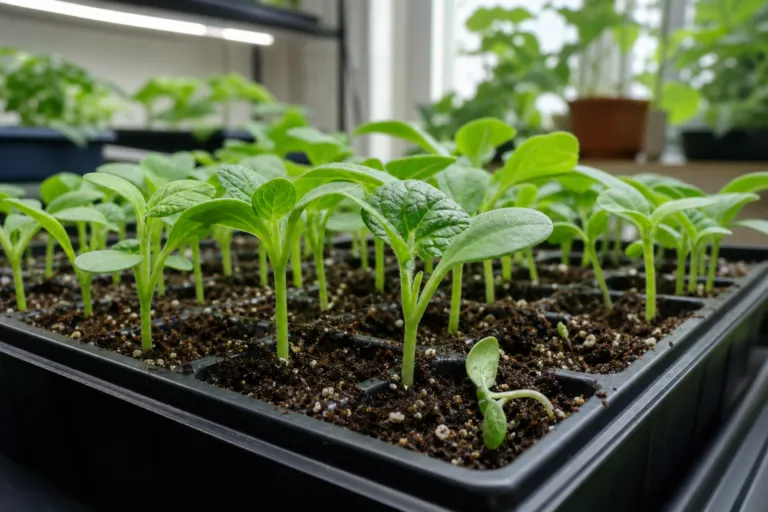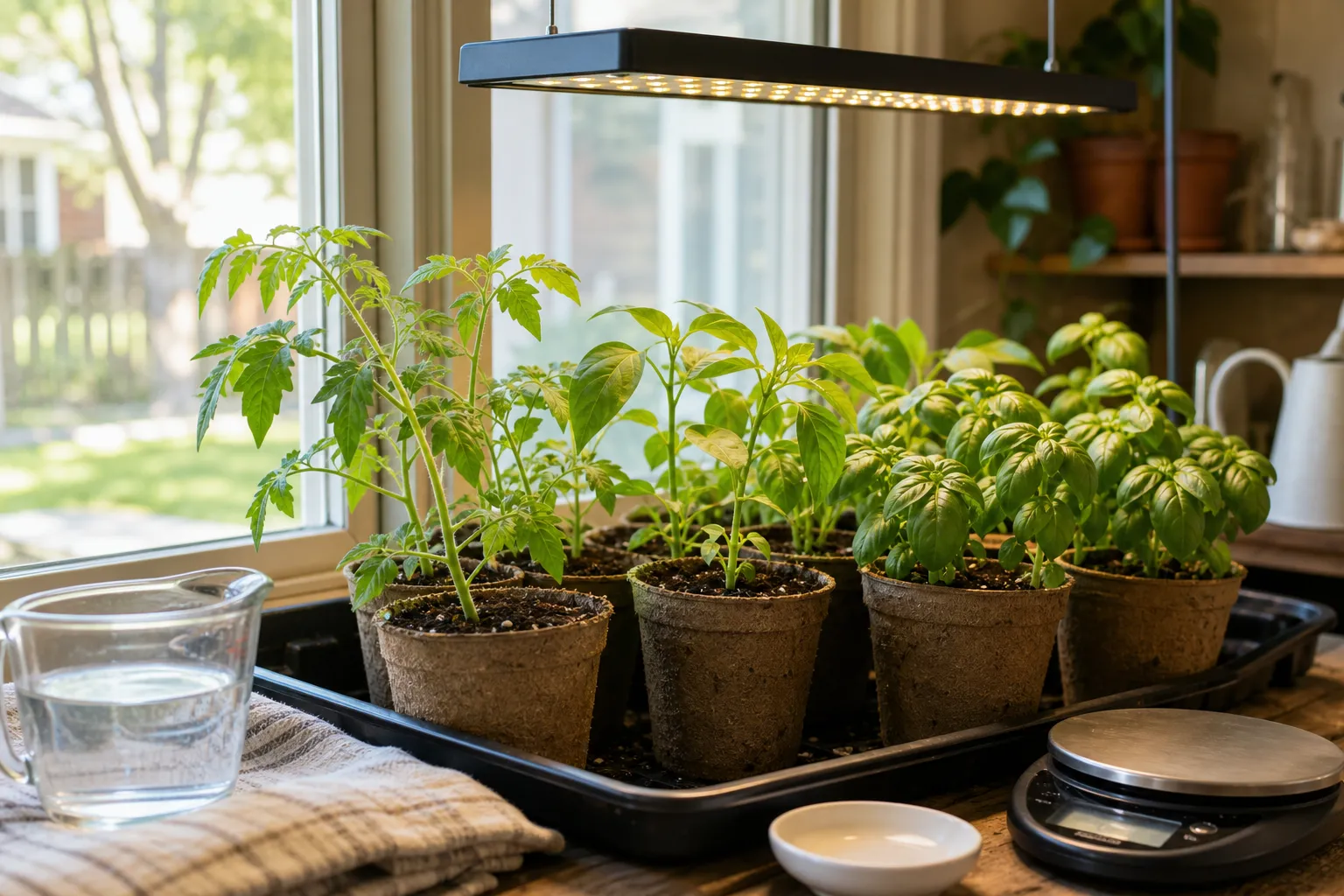
You place a tray of tomato, pepper, or flower seedlings beside a sunny window and expect sturdy little plants. Instead, the stems bend dramatically toward the glass, leaves crowd one side, and the whole tray looks as if it is trying to escape.
Don’t blame yourself – or your eyes. A room can look bright to you while still providing too little useful light for a young plant. Seedlings respond to light intensity, direction, duration, and temperature, not to how cheerful the room feels on a spring afternoon.
The good news is that this is one of the easiest seed-starting problems to understand and correct. Once you recognize what your seedlings are telling you, you can usually improve their shape within days and grow much stronger transplants for the garden.
The short answer: your seedlings are following the strongest light source
The bending behavior has a name: phototropism. It simply means that a plant grows toward light. When light reaches a seedling mainly from one side, the shaded side of the stem elongates more quickly, causing the stem to curve toward the brighter direction.
A windowsill makes this especially obvious. Even if sunlight fills the room, the window remains the most intense light source, so the seedlings angle toward it. Rotate the tray and they may gradually bend again toward the glass.
This directional growth is not automatically a sign of disease. A slight lean can be normal. The bigger warning sign is a combination of leaning and stretching: long spaces between leaves, thin stems, pale new growth, and seedlings that flop when watered or brushed.
Why a bright room can still be too dim for seedlings
Human vision is remarkably good at adjusting to indoor light. Your eyes make a room with white walls, reflective surfaces, and overhead fixtures appear well lit. Seedlings have no such visual advantage. They need considerably more light than most indoor rooms provide.
Several factors reduce the light that reaches the leaves:
- Window glass and screens: These reduce the amount of direct sunlight entering the growing space.
- Distance from the glass: A tray placed several feet from the window receives much less light than one directly beside it.
- Window direction: A north-facing window is often much weaker for sun-loving seedlings than a south- or west-facing window, especially in winter and early spring.
- Clouds and short days: A bright but overcast day may provide far less usable light than a clear day.
- Obstructions: Trees, neighboring buildings, porches, curtains, and exterior shades can reduce direct exposure.
- Indoor heat: Warm conditions can encourage rapid stem growth, making a light shortage more obvious.
Seedlings need light not only to make food through photosynthesis, but also to develop compact stems and short spaces between leaves. When the light supply is weak, they stretch upward and sideways in search of a better position.
Direction matters – but intensity matters more
Turning a tray can reduce one-sided growth, but it cannot create more light. It is a useful temporary measure, not a complete solution.
Try this simple test: rotate your seedling tray 180 degrees every day for several days. If the plants repeatedly lean toward the window, you have confirmed that the light is strongly directional. If the stems continue getting longer and thinner, the seedlings also need more total light – not just a more even distribution.
For a small number of tolerant seedlings, a very bright south-facing window may be enough. Many vegetable and flower seedlings, however, stay more compact under supplemental LED or fluorescent lighting. Extension guidance commonly recommends giving indoor seedlings about 12 to 16 hours of light per day, followed by a dark period each night.
Use a timer if possible. It makes the schedule consistent and saves you from remembering to switch the lights on and off.
My windowsill trial: the same seeds, three light setups
To see how much the setup changes plant shape, try a small comparison of your own. Sow the same variety at the same time and keep the containers together until germination. Then divide the seedlings into three groups:
- A bright window with no supplemental light.
- A bright window with a grow light several inches above the leaves.
- A grow light as the primary source, positioned directly over the tray.
Keep the potting mix, container size, room temperature, and watering routine as similar as possible. Measure stem height from the surface of the mix to the highest growing point once or twice a week. Also count the number of true leaves and note whether the stems stand upright without support.
In many homes, the window-only group will show the most pronounced lean and the longest stem. The group under a close overhead light should develop more evenly, with shorter spaces between leaves. The exact result depends on the fixture, crop, window, weather, and distance from the light, so treat this as a practical home experiment rather than a formal scientific trial.
Different varieties do not stretch at the same speed
It is easy to compare two seed trays and assume one is receiving better care. Variety can also explain some of the difference.
Tomatoes, peppers, cucumbers, squash, basil, and many annual flowers are naturally vigorous and can stretch quickly when light is marginal. Lettuce and some cool-season crops may remain shorter for longer, although they still become weak if light is inadequate. Compact or dwarf varieties may also look stockier than tall-growing types under identical conditions.
For a useful comparison, grow two varieties of the same crop side by side. For example, compare a compact patio tomato with an indeterminate tomato, or bush basil with a taller Genovese type. Label each container and record:
- Days from emergence to the first true leaves
- Stem height after one and two weeks
- Number of leaves
- Whether the plant leans toward the window
- How quickly the mix dries between waterings
This comparison helps you separate a variety’s natural growth habit from a true lighting problem. Even the compact type, however, should not become pale, floppy, or dramatically stretched.
How to set up a grow light without overcomplicating it
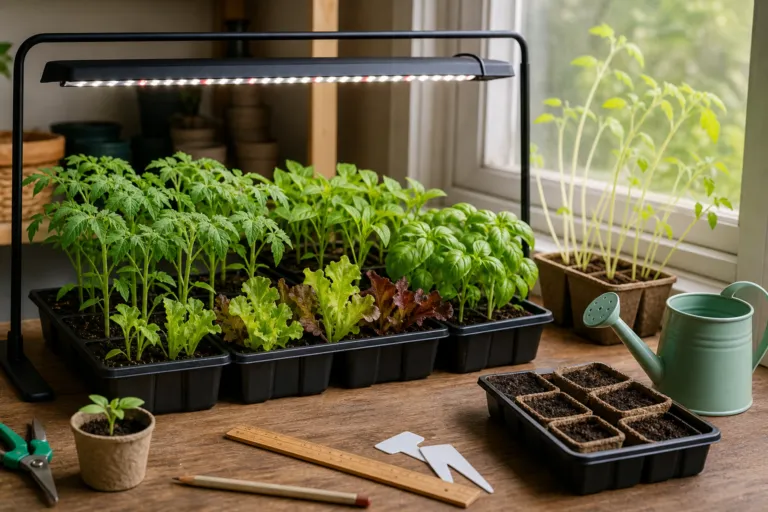
You do not need an expensive greenhouse system to improve seedlings. A basic LED shop light or seed-starting fixture can work well when it provides broad, even coverage and sits close enough to the foliage.
Position the light close to the leaves
A common mistake is hanging the fixture too high. Light intensity drops quickly as the distance increases. Start with the fixture roughly 2 to 4 inches above the tops of the seedlings, unless the manufacturer gives different instructions. Raise it as the plants grow so the leaves do not touch the fixture.
If the stems continue stretching, check the distance before buying a stronger bulb. If the leaves bleach, curl, develop dry patches, or feel unusually hot, move the light farther away and check the fixture’s instructions.
Cover the whole tray
A narrow bulb over the center of a wide tray can leave the outside seedlings leaning inward. Position the fixture so the light spreads across the entire growing area, or use two fixtures for a wider shelf.
Give seedlings a daily dark period
Keeping lights on around the clock is not a reliable way to improve growth. Aim for a regular cycle of roughly 12 to 16 hours of light and 8 to 12 hours of darkness, adjusting for the crop, fixture, and natural light available.
Watering: measure the mix, not the calendar
Light and watering interact. Low light slows growth and evaporation, so a tray that needed frequent watering near a warm window may stay wet under a cooler setup. Overwatering does not cause the classic window-leaning pattern, but soggy mix can weaken roots and make stretched stems even harder to support.
Instead of watering automatically every day, use a simple measurement routine:
- Check the surface and the weight of the container each morning.
- Insert a finger about 1 inch into the mix when the seedlings are large enough for the test, or lift the tray to judge whether it has become noticeably lighter.
- Record how much water you add. For a small cell or 3-inch pot, begin by testing about 1 to 2 fluid ounces, then adjust according to drainage and moisture.
- Water slowly until a small amount drains from the bottom, then empty standing water from the tray.
- Write down the date, amount, and container weight if you want a precise comparison.
There is no universal correct volume because cell size, potting mix, crop, temperature, humidity, and root development all change the result. The goal is evenly moist – not saturated – mix with good drainage.
For a more controlled experiment, weigh a dry, filled container before watering and again after drainage. A kitchen scale can show how much water the pot retains. For example, if a container weighs 12 ounces before watering and 16 ounces after drainage, it has retained about 4 ounces of water. Recheck it daily and water when the container becomes substantially lighter and the upper mix begins to dry.
Other reasons seedlings may lean or flop
Light is the leading cause of long, thin seedlings, but inspect the entire setup before deciding what to change.
Crowding
Several seedlings sharing one cell compete for the same light and space. Thin them to one strong seedling per cell or transplant extras carefully while they are small.
Uneven light
A tray may be bright on one side and shaded on the other. Move it closer to the center of the fixture, add reflective white material behind the tray, or reduce the width of the growing area.
Warm, stagnant air
Warmth can speed stem extension, while still air produces fragile growth. Once seedlings emerge, remove humidity domes and provide gentle air movement. A small fan aimed nearby – not blasting the plants – can help stems become sturdier.
Waterlogged or poorly draining mix
Constantly wet media limits air around the roots and can contribute to root problems. Use clean containers with drainage holes and a fresh, well-drained seed-starting mix.
Natural plant habit
Some seedlings lean briefly as they unfurl or recover from a seed coat sticking to a leaf. Watch the pattern over several days. Persistent stretching toward one direction points more strongly to uneven or insufficient light.
Can you rescue seedlings that already lean?
Often, yes – especially if the stems are green, the leaves look healthy, and the roots have not been damaged.
- Move the tray under a suitable overhead light as soon as possible.
- Bring the fixture close enough to prevent further stretching, following its safety and distance instructions.
- Thin crowded seedlings.
- Rotate window-grown plants daily while you improve the light setup.
- Support a severely tilted seedling temporarily with a loose plant label, but do not use support to hide an ongoing light problem.
- Transplant tomatoes more deeply when appropriate; tomatoes can form additional roots along a buried stem. Do not bury every crop deeply – follow the planting guidance for the specific plant.
Already elongated stems will not shrink, but new growth can emerge more compactly. If a seedling is pale, collapsing at the soil line, or showing mushy roots, it may have a moisture or disease problem rather than a simple light shortage.
A five-minute window check
Before sowing your next tray, stand where the seedlings will grow and observe the window at several times of day. Note when direct sun reaches the area, how long the sun lasts, and whether a building, tree, curtain, or screen blocks it.
Then ask yourself:
- Can the tray sit directly beside the brightest window?
- Will the window become cold at night or excessively hot in midday sun?
- Can you hang a light 2 to 4 inches above the plants?
- Can the light cover the full tray?
- Can you run it on a timer for a consistent schedule?
If the answer to the last three questions is yes, you are already close to a dependable indoor seed-starting system.
Let the lean be useful information
A seedling bending toward the window is not being difficult. It is giving you a clear signal: the strongest light is coming from one side, and the plant is trying to capture more of it.
Improve the light before you adjust fertilizer, water, or potting mix. Place a suitable fixture close above the leaves, keep the schedule consistent, thin crowded cells, and measure watering by the condition and weight of the mix rather than by habit.
With a few small changes, those floppy seedlings can become compact, upright transplants ready for the gradual transition outdoors. Think of the first leaning tray as a free lesson in your home’s growing conditions – and use it to make the next one stronger.