A top-heavy houseplant can seem to develop a personality overnight. One week it stands neatly in its pot; the next, its leaves lean toward the window, the stems splay outward, and the whole plant threatens to tip whenever you water it.
Fortunately, you usually do not need an elaborate setup. The safest solution combines gentle physical support with better light, a stable container, and a watering routine that keeps the roots healthy. Whether you are caring for a leaning monstera, a tall dracaena, a fiddle-leaf fig, or a trailing plant that has become difficult to manage, the goal is the same: support the plant without constricting its stems, crushing its roots, or hiding the problem that caused the weakness.
First, find out why the plant is falling over
Staking is useful, but it should not be the only response. A plant may become top-heavy because it has produced large leaves, grown toward a light source, developed a long bare stem, or outgrown a lightweight container. In some cases, soft or damaged roots are contributing to the instability.
Before choosing a support, check the plant and its pot for these clues:
- One-sided growth: The plant leans strongly toward a window or grow light.
- A long, bare stem: Lower leaves have dropped, leaving the leafy growth concentrated at the top.
- A small or light container: The plant tips when the foliage moves or when the soil is dry.
- Roots circling the pot: Roots are visible at the drainage holes or across the soil surface.
- Persistently wet soil: The mix stays soggy for many days, which may weaken roots and reduce the plant’s stability.
- Soft, dark, or damaged stems: A support will not correct decay or a serious injury.
If the plant looks healthy but simply has more foliage than its stem can comfortably hold, support makes sense. If you notice mushy roots, a sour smell, rapid yellowing, or a collapsing stem, deal with the underlying health problem first.
Choose the least restrictive support that will do the job
The best support is strong enough to steady the plant but subtle enough to let it move and grow. A support that locks every stem rigidly in place can rub against the plant, pinch expanding tissue, or encourage you to ignore poor light and weak growth.
Useful support options
- Bamboo stakes: A practical choice for a single upright stem or a small cluster of stems.
- Moss poles or coir poles: Helpful for climbing plants such as monstera and some philodendrons.
- Small trellises: Useful for vining plants, especially when several stems need guidance rather than one stem needing a stake.
- Hoop or ring supports: Good for plants that splay outward from the center of the pot.
- Plant clips and soft ties: Convenient for attaching stems without cutting into them.
- A heavier container: Often the simplest answer when the plant is healthy but the pot is easy to tip.
Match the support to the plant’s growth habit. A monstera usually benefits from a vertical support that encourages climbing. A dracaena with one leaning cane may need only one stake. A bushy plant with many outward-facing stems may look and grow better with a discreet ring or trellis than with several individual ties.
How to install a stake without damaging roots
Insert the stake carefully and avoid forcing it deep into the center of the pot. The densest roots often occupy that area, especially in a mature plant. Instead, place the support near the inner edge of the container, on the side opposite the direction of the lean.
- Water only if the plant actually needs water. Working with saturated soil makes the root ball heavier and easier to disturb. If the mix is already wet, wait until the surface has dried appropriately for that plant.
- Study the stem before inserting anything. Identify the strongest part of the plant and decide where the tie will sit.
- Use a thin, sturdy support. Choose a stake that reaches into the lower portion of the pot but does not need to extend dramatically above the plant.
- Insert it slowly near the pot wall. If you meet firm resistance, stop and try a slightly different position rather than pushing harder.
- Anchor the support before tying the plant. A loose stake can scrape the stem every time the plant moves.
For a plant that needs a pole, installing the support during repotting is often gentler because you can position it beside the root ball before adding fresh potting mix. If you are adding a pole to an established plant, work slowly and accept that a small amount of root disturbance may occur.
The safest way to tie a houseplant
Do not use bare wire, fishing line, thin string, or a narrow rubber band around a living stem. These materials can cut into the tissue as the stem expands or as the plant sways.
Choose soft plant tape, stretchy garden ties, fabric strips, broad paper-covered wire, or reusable hook-and-loop ties. Make each connection loose enough to slide a finger between the tie and the stem.
Use a figure-eight tie
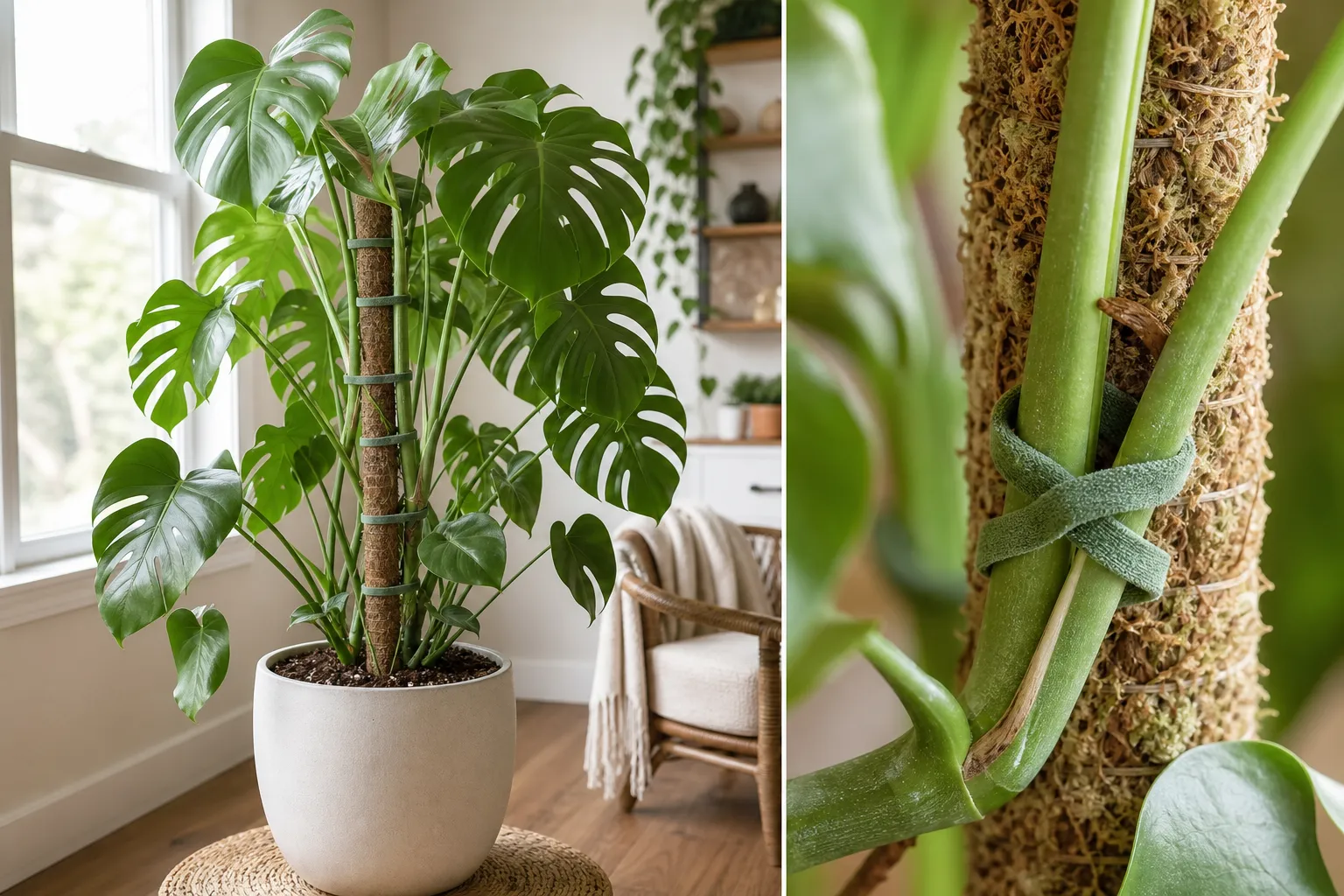
A figure-eight tie keeps the stem from rubbing directly against the stake. Wrap one loop around the support and the other loosely around the stem, with the crossing point between them. The tie should steady the plant, not pull it tightly against the support.
- Place the first tie below the heaviest section of foliage.
- Add a second tie higher up if the stem still bends or twists.
- Leave room for the stem to thicken.
- Check ties every few weeks during active growth.
- Replace or loosen any tie that leaves a mark.
Think of the support as a handrail, not a splint. The plant should remain slightly flexible. Gentle movement helps reveal whether the support is doing enough without forcing the stem into an unnatural position.
Support climbing plants in a way that suits their natural habit
Some houseplants are not really meant to stand alone. Monstera deliciosa, climbing philodendrons, pothos, and certain hoyas naturally produce long stems that seek something to climb or trail over. A support can improve the plant’s shape, but it will not turn every variety into a compact, upright specimen.
Monstera and large philodendrons
Use a firm moss pole, coir pole, trellis, or smooth board with enough strength to hold the mature plant. Guide the main stem toward the support and attach it at intervals. Avoid tying the leaf stalks, which are flexible and need to move; attach the thicker main stem instead.
Aerial roots may eventually grip a textured support, but you do not need to force them into place. Keep ties gentle while the plant adjusts. Large-leaved plants can become much heavier than they appear, so check that the pot and support will remain stable as new growth develops.
Pothos and other trailing plants
You have two good options: let the stems trail freely, or guide them up a trellis or pole. If the plant is only leaning because all its vines face one direction, rotating the pot gradually and improving light may solve more than staking.
Dracaena, yucca, and cane-form plants
These plants often need support when a tall cane carries a leafy crown. Use a single stake placed beside the cane and attach it with two or three loose ties. Avoid burying the support directly through the densest root area.
Fiddle-leaf figs and other single-stem plants
A stake can help a young or recently moved plant settle, but it will not correct severe legginess. Give the plant bright, indirect light, turn it a quarter turn every week or two, and avoid sudden changes that could cause additional stress. If the stem is damaged, support it temporarily and monitor the injury rather than tightening the tie.
Do not overlook the pot
Sometimes the plant is not unusually weak – the container is simply too light or too small for the top growth. A heavier ceramic or terracotta pot can improve stability, provided it has a drainage hole and is appropriate for the plant’s watering needs.
If roots are circling densely, growing from the drainage holes, or filling the soil mass, repotting may be appropriate during active growth, often in spring or early summer. Choose a container only modestly larger than the current one. An oversized pot holds more wet mix around the roots and can make watering harder to manage.
Set the plant at the same depth it was growing before. Do not bury a soft or damaged stem in an attempt to make it stand upright unless that plant is known to tolerate that technique. After repotting, water thoroughly enough to settle the mix, then allow excess water to drain away.
Use light and rotation to prevent future leaning
Weak, stretched growth often begins when a plant does not receive enough usable light. Move it closer to a bright window if the species can tolerate the intensity, or add a suitable grow light. Protect plants from sudden exposure to strong direct sun, which can scorch leaves.
Rotate the pot gradually so every side receives more even light. A quarter turn every week or two is a reasonable starting point, although fast-growing plants may need attention more often. Do not expect rotation to straighten an old, woody, or permanently bent stem; it mainly helps new growth develop more evenly.
Water by checking the soil – not by the calendar
Top-heavy plants are often watered inconsistently because their owners worry about the plant tipping. Too little water can cause wilting and unstable, dry root balls; too much can keep the roots oxygen-starved. Neither problem is solved by a stake.
Use a simple measurement trial to learn how quickly your plant dries. On watering day, check the soil with your finger or a wooden skewer, note the pot’s weight, and record how much water you apply. For example, you might test 2 cups of water in a 10-inch pot, allowing it to drain fully, then check the soil and pot weight again after two, four, and seven days. The useful result is not the number itself – it is the pattern for that plant, pot, soil mix, light level, and room temperature.
- Water when the soil has reached the dryness appropriate for the species.
- Apply water slowly and evenly across the surface.
- Stop when a little water begins to drain from the bottom.
- Empty the saucer or cachepot after drainage finishes.
- Record the interval between waterings rather than copying a fixed weekly schedule.
Use a smaller, more cautious amount for plants that prefer to dry more between waterings, and check the soil before repeating the process. A drainage hole matters more than a decorative layer of stones at the bottom of the container; stones do not replace proper drainage.
When pruning is better than adding more support
If a plant has become extremely leggy, several stakes may only create a crowded, temporary arrangement. Pruning can encourage a fuller shape, but timing and technique depend on the plant. Remove dead, broken, or badly damaged growth first, using clean, sharp tools.
For healthy but stretched plants, consider taking cuttings or shortening selected stems if the species responds well to pruning. Do not remove a large portion of foliage from a stressed plant all at once. A gradual approach gives the remaining roots and leaves time to adjust.
Some plants naturally grow tall or vine-like, while others are bred to remain compact. Comparing varieties can help set realistic expectations: a compact pothos cultivar may stay manageable in a small room, while a vigorous monstera or climbing philodendron will eventually need more space and a sturdier support system.
A quick support check every month
Once your plant is upright, add a recurring inspection to your routine. Look beneath the ties, along the stem, and at the point where the support enters the pot.
- Is the tie rubbing or leaving a groove?
- Has the stem grown beyond the support?
- Is the stake leaning inside the pot?
- Has the plant become heavier on one side?
- Does the container still feel stable?
- Is new growth pale, stretched, or unusually small?
Adjust the support before the plant collapses. Early, gentle guidance is much safer than trying to bend a mature stem back into position after it has been creased or snapped.
Help your plant stand tall – without forcing it
A top-heavy houseplant usually needs a combination of small improvements rather than one dramatic fix. Choose a support that matches the plant’s growth habit, place it carefully, use soft figure-eight ties, and leave enough room for natural movement. Then address the bigger picture: light, pot stability, root health, and watering.
Start with the least invasive solution and observe how the plant responds over the next few weeks. With patient adjustments, your support can disappear into the foliage while the plant grows stronger, steadier, and much easier to enjoy.