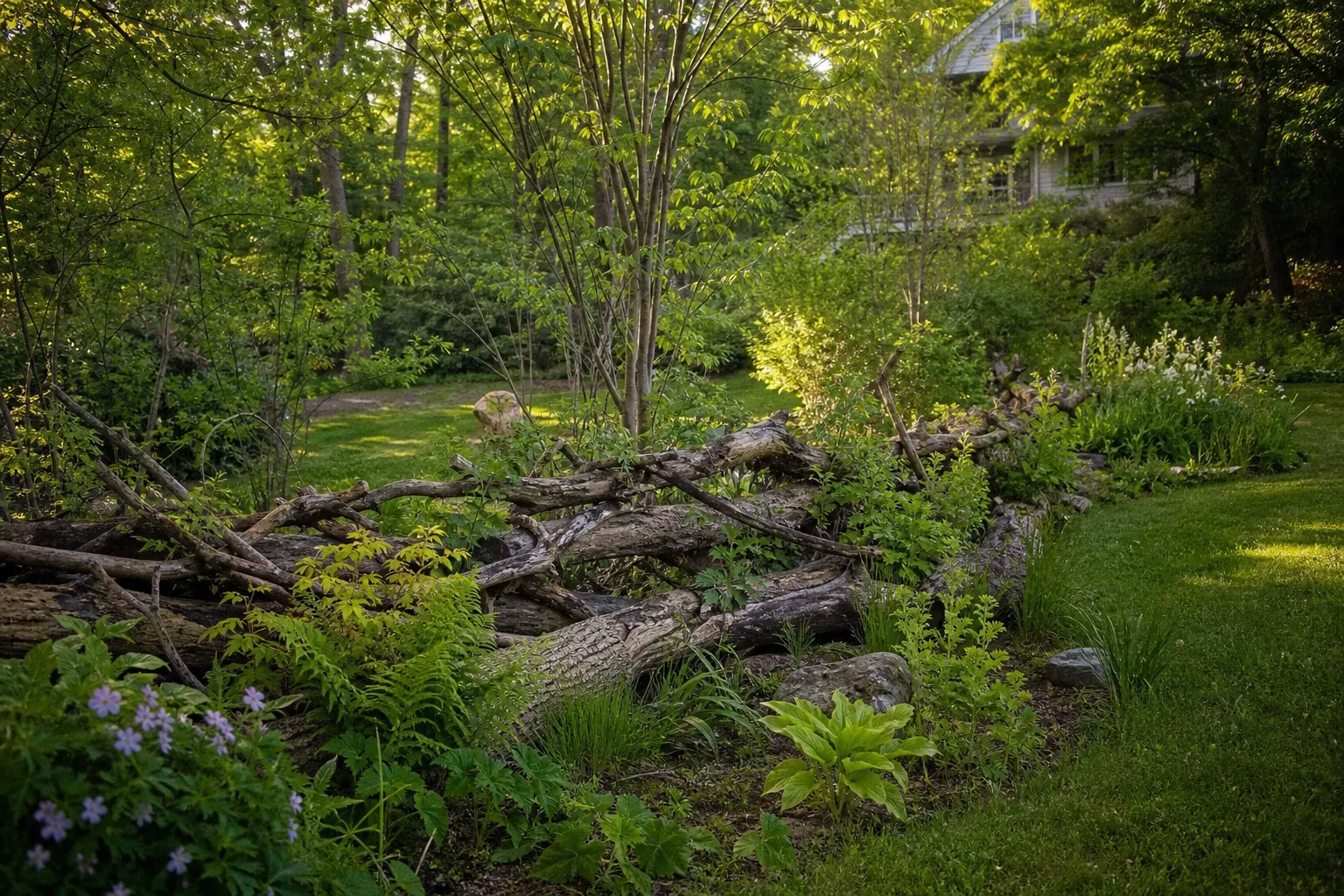
Yes—you can turn fallen branches, storm debris, and old logs into a useful property line instead of hauling everything away. A thoughtfully arranged deadwood border can define the edge of your yard, shelter birds and small wildlife, slow runoff, protect young plants, and give an ordinary boundary a sculptural, natural look.
The key is to treat the material as a designed habitat feature, not a random dumping ground. Choose sound pieces, stack them securely, leave room for maintenance, and keep the border away from structures and high-risk areas. With a little planning, your “debris pile” can become a living edge that changes beautifully as wood weathers and plants fill in around it.
What the deadwood aesthetic actually means
Deadwood landscaping uses fallen trunks, large limbs, stumps, bark, and smaller brush as visible elements in the garden. In forest ecology, larger fallen wood is often called coarse woody debris. It provides cover, travel routes, nesting opportunities, and feeding places for insects, amphibians, reptiles, birds, and small mammals.
In a backyard, you do not need to recreate a forest floor. Instead, think of deadwood as a low, porous boundary. It can mark the transition between lawn and planting bed, separate a mowed area from a meadow, or create a soft visual screen along a fence without the expense of masonry or manufactured edging.
Why a property line is a good location
Property edges often receive less foot traffic and can accommodate a more relaxed style. A deadwood line also works well where a formal hedge would struggle, such as beneath mature trees, along a sloping boundary, or beside a naturalized planting area.
- Visual definition: Logs give an informal boundary a clear shape.
- Wildlife cover: Openings beneath and between logs create shelter.
- Soil protection: Wood can slow moving water and reduce erosion on gentle slopes.
- Low-cost structure: You can reuse material already on your property.
- Seasonal interest: Bark, lichen, moss, seedheads, and changing foliage keep the border attractive year-round.
Start with a safe, suitable site
Before moving a single log, walk the proposed line after rain and during the growing season. Watch where water collects, where snow slides, and where you need access for mowing, pruning, fencing, or utility work.
Keep deadwood well away from your home, deck, propane tanks, firewood storage, sheds, and other structures. In wildfire-prone regions, a brushy or woody border can add fuel, especially when it connects continuously to trees or dense shrubs. Local fire guidance should take priority over aesthetic goals.
Do not leave a standing dead tree or a large unstable limb near a house, driveway, play area, or neighboring property. A certified arborist can assess hazardous trees. A fallen log is usually easier to manage, but it still needs to sit securely and should not be positioned where it could roll downhill.
Use the right material
Favor untreated, locally sourced wood from ordinary pruning, storm cleanup, or tree removal. A mix of sizes will look more natural and provide more varied habitat than a row of identical logs.
- Use thick trunks and sturdy limbs as the foundation.
- Add medium branches to create texture and small gaps.
- Use twiggy material sparingly as a loose upper layer.
- Leave some wood partly exposed to weather and some in contact with soil.
- Avoid painted, stained, pressure-treated, or chemically treated lumber.
- Do not import firewood or woody material from distant areas, because it can spread pests and diseases.
Be cautious with branches from trees showing obvious disease symptoms or heavy insect activity. If you are uncertain, ask your county Extension office, state forestry agency, or a qualified tree professional before distributing that material around the yard.
Three practical designs for a deadwood property line
1. The low log ribbon
This is the simplest option: place logs end to end in a gently irregular line. Use pieces roughly 6 to 18 inches in diameter, depending on what you have available, and vary their orientation rather than creating a perfectly straight wall.
For stability, partially nest the bottom logs into shallow soil depressions. On a slope, align longer logs roughly across the contour rather than pointing directly downhill. That arrangement can help slow runoff and reduces the chance of logs becoming rolling hazards.
Plant small shrubs, sedges, ferns, or ground covers on the garden side, but leave enough space to inspect the wood. A 2- to 3-foot planting strip usually gives you room to weed, water, and replace plants without climbing over the logs.
2. The wildlife brush wall
For a more substantial habitat feature, build a loose brush pile along the boundary. Start with the largest logs at the bottom, using them to lift the pile slightly above the soil. Add medium branches across the base and place smaller limbs on top.
Keep the pile open rather than tightly packed. Small animals can use the protected spaces underneath, while birds may use higher branches as perches. A brush wall can be especially useful beside a meadow, shrub border, or water feature where food and cover are already nearby.
Do not make the entire property line one uninterrupted mass. Break a long border into sections with open gaps. This improves visibility, makes mowing easier, and reduces the continuous connection of combustible material.
3. The planted deadwood hedge
This design combines a low log line with living plants. Place the wood first, then add a layered planting scheme: low ground covers at the front, medium shrubs in the middle, and taller plants or small trees farther back where appropriate.
Choose plants for your region and light conditions rather than copying a list from another climate. In the Northeast and upper Midwest, ferns, serviceberries, dogwoods, and native sedges may suit a partly shaded edge. In the Southeast, consider regionally native shrubs and woodland perennials that tolerate humid summers. In the Southwest and interior West, use drought-adapted native plants and keep the wood line more open, especially where wildfire risk is high.
Match the plants to sun, soil, and drainage
Deadwood does not fix poor planting conditions. Before choosing plants, observe how many hours of direct sun reach the boundary. Full sun generally means six or more hours of direct light, while part shade may receive morning sun or filtered light for much of the day.
Drainage matters just as much. A log border can slow water, but it should not create a permanently saturated trench around plants that need air in the root zone. If the soil stays wet for days after rainfall, select moisture-tolerant species or shape the bed so excess water can move safely away.
Species differ widely in their water needs. A native sedge, drought-tolerant shrub, and moisture-loving fern may all look attractive together, but they should not automatically share the same irrigation schedule. Group plants with similar needs and let the deadwood define the groups.
A simple watering measurement
Rather than guessing, measure your irrigation. Place three straight-sided cans—such as tuna cans or small rain gauges—around the planted edge while a sprinkler runs. Measure the water depth in each container and calculate the average.
For a new planting, you might record an average of 0.5 inch from a 30-minute run. If the soil is sandy and dries quickly, two such applications in a week may be more useful than one heavy session. If the soil is clay-heavy or the weather is cool, the same schedule could leave roots too wet. Check the soil 2 to 3 inches below the surface before watering again.
Use that measurement as a starting point, not a universal prescription. Rainfall, soil type, plant maturity, mulch, wind, and local summer temperatures all change the result. Deep, occasional watering is usually preferable to frequent shallow splashes once plants are established, but newly planted shrubs and perennials need closer monitoring.
A small growing trial can reveal what works
If you are unsure which plants will handle the boundary, run a one-season trial before planting the entire length. Choose three plant types with different habits—for example, one spreading ground cover, one clumping grass or sedge, and one compact shrub.
Plant three to five specimens of each type in comparable spots. Record the planting date, weekly rainfall or irrigation, hours of sun, and any signs of wilting, yellowing, slug damage, or winter injury. At the end of the season, compare survival, growth, maintenance, and how well each plant complements the wood.
This kind of side-by-side test often reveals differences that plant labels cannot. One variety may grow quickly but flop into the path, while another stays compact and needs less water. A third may tolerate the soil beautifully but spread farther than you expected. Use the trial to refine the border before investing in dozens of plants.
How to make the border look intentional
The difference between an attractive deadwood edge and an untidy pile is repetition. Repeat a few forms, colors, or materials along the length instead of using every piece in a different way.
- Keep most logs within a consistent height range.
- Repeat three to five plant types rather than collecting too many.
- Use a simple curve or a series of broad angles.
- Leave deliberate openings at gates, paths, and maintenance points.
- Place the most sculptural stump or trunk section where it can be seen.
- Use low plants to soften the front edge, but avoid hiding every piece of wood.
Aged bark, moss, and natural cracks are part of the appeal. You do not need to scrub or preserve the wood. Let the material weather, but inspect it occasionally for movement, sharp splinters, or branches that have become unstable.
Common mistakes to avoid
- Building too close to the house: Keep woody debris out of the home ignition zone and follow local wildfire recommendations.
- Creating a solid wall: Dense, continuous piles can block airflow, trap moisture, restrict wildlife movement, and become difficult to maintain.
- Ignoring drainage: Do not dam a natural swale or redirect stormwater toward a foundation or neighboring property.
- Overwatering the planting strip: Wet soil can suffocate roots and encourage decline in plants that prefer good drainage.
- Choosing plants by appearance alone: Compare mature size, sunlight needs, hardiness, and water requirements.
- Using invasive vines to hide the wood: A fast cover can escape into nearby vegetation and create more work later.
- Forgetting access: Leave enough room for a mower, wheelbarrow, hose, and routine inspection.
Keep the border healthy and useful
Once or twice a year, walk the full length of the boundary. Remove new invasive weeds before they seed, trim plants that block paths, and reset logs that have shifted. During dry, windy weather, check that the feature has not become a continuous bridge of dry brush between trees or structures.
As the wood decomposes, some pieces will sink into the soil and others will become soft. That is a benefit for habitat, but not every piece needs to remain forever. Replace a collapsing log only if the border still needs structure; otherwise, let the decaying wood return organic matter to the garden.
For a cleaner look, add a narrow mowed strip on one side or use a crisp edge between lawn and planting bed. This small contrast makes the natural materials appear deliberate rather than neglected.
A boundary with a longer life
The deadwood aesthetic works because it accepts change. A fresh branch may begin as a structural element, become a perch or shelter, develop fungi and moss, and eventually disappear into the soil. Plants around it will mature, reseed, and respond to different seasons.
Start with one manageable section—perhaps 15 to 25 feet—rather than transforming the entire property line at once. Build safely, measure your watering, compare plants in a small trial, and adjust as you learn. With those simple steps, backyard debris can become a functional, wildlife-friendly edge that feels rooted in the landscape rather than imposed on it.