
 Source:
He Chusan palm (Trachycarpus fortunei) short overview
he Chusan palm (Trachycarpus fortunei) is a distinctive evergreen palm valued for its fan-shaped fronds, shaggy fiber-covered trunk, and unusually strong cold tolerance. Native to south-central China and northern Myanmar, it grows slowly in a single-stemmed form and adapts to sun or partial shade when drainage is good. In the United States it is useful as a specimen, entryway accent, courtyard plant, or large container palm in suitable climates.
Taxonomic classification
He Chusan palm (Trachycarpus fortunei) care guide
Light and placement
Grow in full sun to partial shade; in hot regions, morning sun or bright filtered light can limit scorch, while colder sites benefit from a sheltered south- or east-facing position. Excessive shade produces weaker, slower growth and less dense crowns; intense reflected afternoon heat can brown leaf margins, especially when soil is dry.
Watering and humidity
Water deeply and thoroughly, then allow the upper soil to dry slightly before watering again. Keep newly planted palms consistently moist during establishment, reduce irrigation in cool weather, and water during prolonged summer drought. Established plants tolerate some dryness but perform best with occasional deep irrigation rather than frequent shallow watering.
Soil and growing medium
Use a well-drained loam, sandy loam, or amended clay that does not remain saturated. The species tolerates somewhat acidic through alkaline soils, but compacted or persistently wet ground increases root-rot risk. In alkaline soils, monitor for manganese-related yellowing and maintain good drainage.
Feeding
Feed in spring and again in early summer only if growth or foliage indicates a need. A slow-release palm fertilizer with micronutrients is preferable to repeated strong applications. Do not fertilize drought-stressed, newly transplanted, or frost-damaged plants until active growth resumes.
Growth and habit
Growth is slow, especially in cool climates. The palm normally forms one upright trunk rather than a clump, and old leaf bases leave a persistent fibrous covering. Slow juvenile growth makes young plants suitable for containers, but mature specimens eventually need substantial overhead and root-zone space.
Planting and repotting
Plant in spring or early summer after severe freezes have passed, setting the root ball at the same depth it occupied in its container. Water deeply during the first growing season, mulch without touching the trunk, and allow ample lateral room for the crown. Avoid low spots where water stands.
Repot container plants in spring when roots fill the pot, moving up only one container size. Use a coarse, free-draining palm mix and avoid burying the trunk or disturbing the root ball more than necessary. Large specimens are difficult to move once established.
Propagation and pruning
Propagation
Propagate from fresh seed. Germination is more reliable when seed is cleaned, kept warm and evenly moist, and sown soon after ripening. Because the species is dioecious, seed production requires compatible male and female plants; seedlings are not reliably sexed before flowering.
Pruning
Remove only dead, badly damaged, or hazardous fronds, cutting cleanly without injuring the trunk. Do not strip green leaves for appearance, and avoid climbing practices that wound the fibrous trunk. Sterilize tools between plants when disease is suspected.
Overwintering
Young palms and plants at the cold edge benefit from a sheltered site, a thick root-zone mulch, and temporary protection from drying winds and severe freezes. Keep the crown dry during hard freezes when practical, and do not prune frost-damaged fronds until new growth reveals what remains viable. Containers may be overwintered in a bright, cool location.
Uses
A durable ornamental specimen for warm-temperate landscapes, courtyards, entryways, patios, and large containers. Its trunk fibers have traditional craft uses in parts of Asia. The species is also reported in botanical sources as having food and medicinal uses in its native range, but those uses are not recommendations for home preparation or treatment.
Appearance
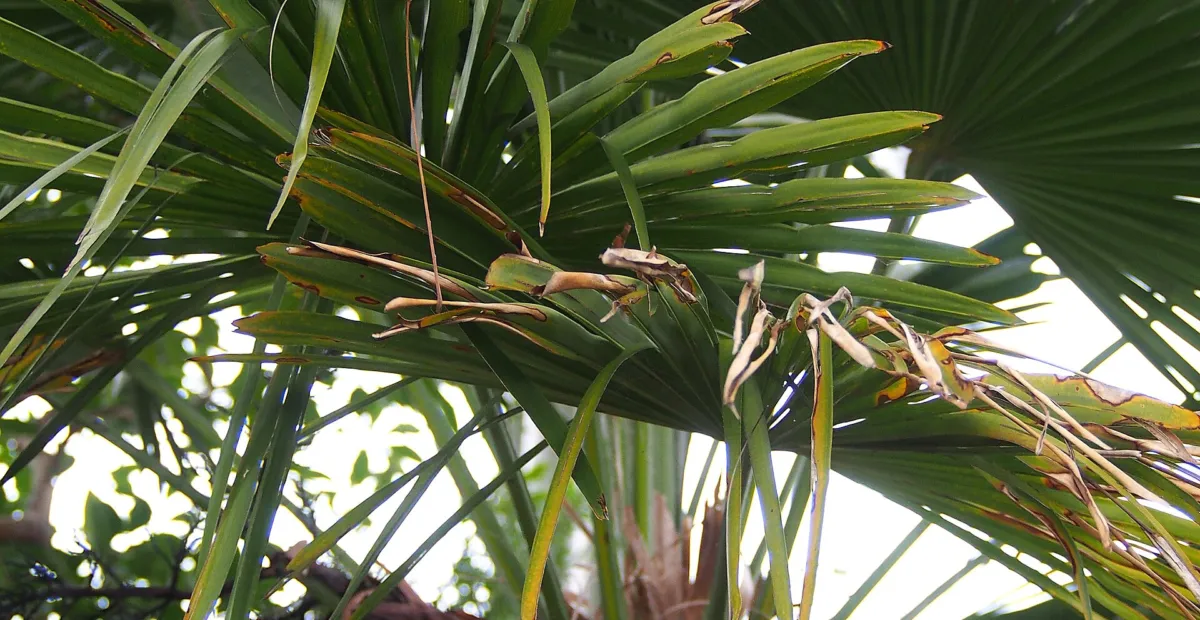
The species has broad, fan-shaped leaves divided into stiff segments and carried on rough, sometimes finely toothed petioles. Its solitary trunk is wrapped in dense brown fibers, giving a burlap-like appearance. Persistent old leaf bases may form a skirt beneath the crown, although gardeners often remove dead fronds.
Flowering
This dioecious palm produces small yellow to white flowers in dense, drooping panicles near the crown. Male and female flowers occur on separate plants; female plants can develop blue to black, grape-like drupes when pollinated by a compatible male. Flowering is typically strongest in summer in the United States.
Pollination and visitors
The small, nectar- and pollen-bearing flowers may be visited by bees, but reliable species-specific pollinator records are limited. Male and female plants are separate, so fruiting requires compatible plants and successful pollen transfer.
Trachycarpus fortunei photos
Click any photo for a larger view. Source, author and license are shown separately.
Diseases and pests
Diseases
Root rot is favored by saturated soil. Leaf spots, lethal yellowing-type syndromes, lethal bronzing, and other palm diseases may occur in affected regions. Reduce stress, avoid trunk wounds, provide drainage, remove badly affected tissue when appropriate, and obtain a local diagnosis before using fungicides or other treatments.
Pests
Scale insects and palm aphids are the most commonly reported pests. Inspect leaf bases and undersides regularly, especially on stressed container plants. Improve plant vigor first; use targeted horticultural oil or another locally labeled treatment only when monitoring confirms a problem. Deer may browse small plants.
Toxicity and pollen
The ASPCA lists Trachycarpus fortunei as non-toxic to dogs and cats. No specific human toxic principle is well established. Normal plant handling is appropriate, but sharp petiole teeth and fibrous material can cause mechanical irritation, and any substantial ingestion should be discussed with a medical or veterinary professional.
- Typical season
- Late spring through summer
- Pollination / pollen
- Heavy, insect-associated palm pollen
The palm produces pollen during flowering, but it is not generally regarded as a major airborne allergen in the United States. Exposure is likely greatest near flowering plants, particularly male plants; individual sensitivity can still vary.
Native habitat
The species is native from south-central China to northern Myanmar, where it occurs in temperate to montane environments. It favors moisture-available but well-drained soils and climates with cool winters, while cultivated plants tolerate a broad range of garden soils if waterlogging is avoided.
Interesting fact
The trunk is clothed in persistent brown fibers derived from old leaf bases.
It is among the most cold-hardy commonly cultivated palms.
The species is dioecious, with male and female plants separate.
Its fan leaves can exceed about 3 feet across in favorable conditions.
Frequently asked questions (FAQ)
The most relevant questions about this plant, with short and direct answers.
🌱Quick care
What is Trachycarpus fortunei commonly called?⌄
Trachycarpus fortunei is the he Chusan palm, also widely known in the United States as windmill palm. It is a single-trunk, fan-leaved palm in the Arecaceae family.
How fast does Trachycarpus fortunei grow?⌄
Trachycarpus fortunei grows slowly to moderately, often taking many years to develop a substantial trunk. Mature landscape plants commonly reach about 20 to 30 feet tall, although size varies by climate and growing conditions.
Is Trachycarpus fortunei easy to grow?⌄
Yes, Trachycarpus fortunei is generally easy to grow when planted in well-drained soil and protected from extreme winter conditions. It tolerates sun, shade, drought after establishment, and a range of soil types.
🌤️Environment and placement
How much sun does Trachycarpus fortunei need?⌄
Trachycarpus fortunei grows in full sun to shade, but partial shade or protection from intense afternoon sun is often ideal. Plants in full sun may need more irrigation during hot, dry weather.
Can Trachycarpus fortunei grow in shade?⌄
Yes, Trachycarpus fortunei can grow well in partial shade and light shade. Growth may be slower and the crown less dense than it would be in brighter light.
What USDA hardiness zone is Trachycarpus fortunei?⌄
Trachycarpus fortunei is generally suitable for USDA Zones 7 or 8 through 11, depending on the source, local exposure, and plant provenance. Cold damage is more likely at the lower edge of its range, especially with wind or wet soil.
How cold hardy is Trachycarpus fortunei?⌄
Trachycarpus fortunei is one of the more cold-hardy palms and can tolerate brief temperatures near 10°F once established, with damage varying by plant and exposure. Young palms and plants at the cold edge benefit from winter protection.
Can Trachycarpus fortunei survive snow and freezing weather?⌄
Established Trachycarpus fortunei can usually tolerate light snow and brief freezes, but prolonged cold may damage fronds or the growing point. Keep the crown dry and protect young plants during severe cold events.
Does Trachycarpus fortunei tolerate wind?⌄
Trachycarpus fortunei tolerates ordinary wind, but strong or drying winds can split its fan leaves and increase winter injury. A sheltered site usually produces better-looking foliage.
Can Trachycarpus fortunei grow near the coast?⌄
Yes, Trachycarpus fortunei has moderate tolerance of salt spray and coastal conditions. It still performs best in well-drained soil with protection from the strongest ocean winds.
💧Care and problems
How often should I water Trachycarpus fortunei?⌄
Water Trachycarpus fortunei deeply when the top few inches of soil begin to dry during its establishment period. Once established, it is moderately drought-tolerant, but regular water improves growth during prolonged heat or drought.
What soil does Trachycarpus fortunei prefer?⌄
Trachycarpus fortunei prefers well-drained loam, sandy loam, or clay that does not remain saturated. Improve drainage rather than planting it in a site with standing water or consistently soggy soil.
Does Trachycarpus fortunei need fertilizer?⌄
Trachycarpus fortunei usually needs little fertilizer in reasonably fertile soil, but a slow-release palm fertilizer can help when growth is weak or leaves show nutrient deficiency symptoms. Base applications on a soil test when possible.
Why are my Trachycarpus fortunei leaves turning brown?⌄
Brown leaves can result from drought, winter burn, wind damage, salt exposure, old age, or root problems. Check soil moisture and drainage first, and remove only leaves that are fully dead.
Why are the leaves on my Trachycarpus fortunei turning yellow?⌄
Yellow leaves may indicate natural aging, poor drainage, nutrient deficiency, or stress from cold or drought. If several new leaves are yellow, check the roots, soil conditions, and fertilizer history rather than treating the symptom alone.
What pests affect Trachycarpus fortunei?⌄
Scale insects and aphids are among the pests that can affect Trachycarpus fortunei. Inspect fronds and leaf bases regularly, especially when leaves become sticky, distorted, pale, or covered with black sooty mold.
What diseases affect Trachycarpus fortunei?⌄
Trachycarpus fortunei can suffer from root rot, leaf spots, and certain palm trunk or vascular diseases. Good drainage, avoiding trunk wounds, and removing severely diseased material can reduce risk, but serious decline may require professional diagnosis.
🪴Planting and repotting
When is the best time to plant Trachycarpus fortunei?⌄
Plant Trachycarpus fortunei in spring or early summer after the danger of severe frost has passed. This gives the palm a long warm season to establish roots before winter.
How do I plant Trachycarpus fortunei in the ground?⌄
Plant Trachycarpus fortunei at the same depth it was growing in its container, with the root ball in well-drained native soil. Water thoroughly after planting and apply a thin mulch layer without piling mulch against the trunk.
Can Trachycarpus fortunei grow in a container?⌄
Yes, Trachycarpus fortunei can grow in a large container with drainage holes and a porous potting mix. Container plants need more frequent watering and may require winter protection because their roots are less insulated.
How often should I repot Trachycarpus fortunei?⌄
Repot Trachycarpus fortunei only when roots fill the container or growth has clearly slowed from restricted roots. Move it into a slightly larger pot with fresh, well-drained mix rather than making a large jump in container size.
✂️Propagation and pruning
How do you propagate Trachycarpus fortunei?⌄
Trachycarpus fortunei is usually propagated from fresh seed. Remove the fruit pulp, sow the seeds in a warm, moist, well-drained medium, and expect germination to take several weeks or sometimes longer.
Can Trachycarpus fortunei be grown from cuttings?⌄
No, Trachycarpus fortunei is not normally propagated from ordinary stem or leaf cuttings. Seed propagation is the practical method because the species grows from a single growing point.
When should I prune Trachycarpus fortunei?⌄
Prune Trachycarpus fortunei only to remove completely dead, damaged, or hazardous fronds. Use clean tools and avoid cutting into the trunk or removing green fronds unnecessarily.
Should I remove the fibers from a Trachycarpus fortunei trunk?⌄
No, the brown fibers are a natural feature of Trachycarpus fortunei and generally should be left in place. Removing them can expose the trunk and create unnecessary wounds.
⚠️Toxicity and safety
Is Trachycarpus fortunei toxic to dogs?⌄
No, Trachycarpus fortunei is considered non-toxic to dogs. However, eating large amounts of any plant material can still cause temporary digestive upset.
Is Trachycarpus fortunei toxic to cats?⌄
No, Trachycarpus fortunei is considered non-toxic to cats. Its stiff or rough plant parts may still cause minor irritation if chewed extensively.
Is Trachycarpus fortunei safe to plant around pets?⌄
Trachycarpus fortunei is generally safe to plant around dogs and cats because it is classified as non-toxic. Keep pets away from fallen leaf stalks or sharp plant debris that could cause mechanical injury.
🌸Flowering and special interest
Does Trachycarpus fortunei flower?⌄
Yes, mature Trachycarpus fortunei produces branching clusters of small yellowish flowers, usually during warm-season growth. Flowering is more likely when the palm receives adequate light and has reached reproductive maturity.
Does Trachycarpus fortunei produce fruit?⌄
Yes, female Trachycarpus fortunei plants can produce small blue-black fruits after flowering, especially when pollinated. Male and female flowers are typically borne on separate plants, so fruiting is not guaranteed for every palm.
Why is my Trachycarpus fortunei not flowering?⌄
A Trachycarpus fortunei may not flower because it is still immature, lacks sufficient light, is stressed, or is a male plant without a fruiting role. Flowering also varies with climate and growing conditions.
Similar plants
 Arikury Palm (Syagrus schizophylla) care guideSyagrus schizophylla
 Rio Grande palmetto (Sabal mexicana) care guideSabal mexicana
 Broadleaf lady palm or bamboo palm (Rhapis excelsa) care guideRhapis excelsa
 Loulu (Pritchardia glabrata) care guidePritchardia glabrata
 Ravenea glauca care guideRavenea glauca
 Needle palm (Rhapidophyllum hystrix) care guideRhapidophyllum hystrix