
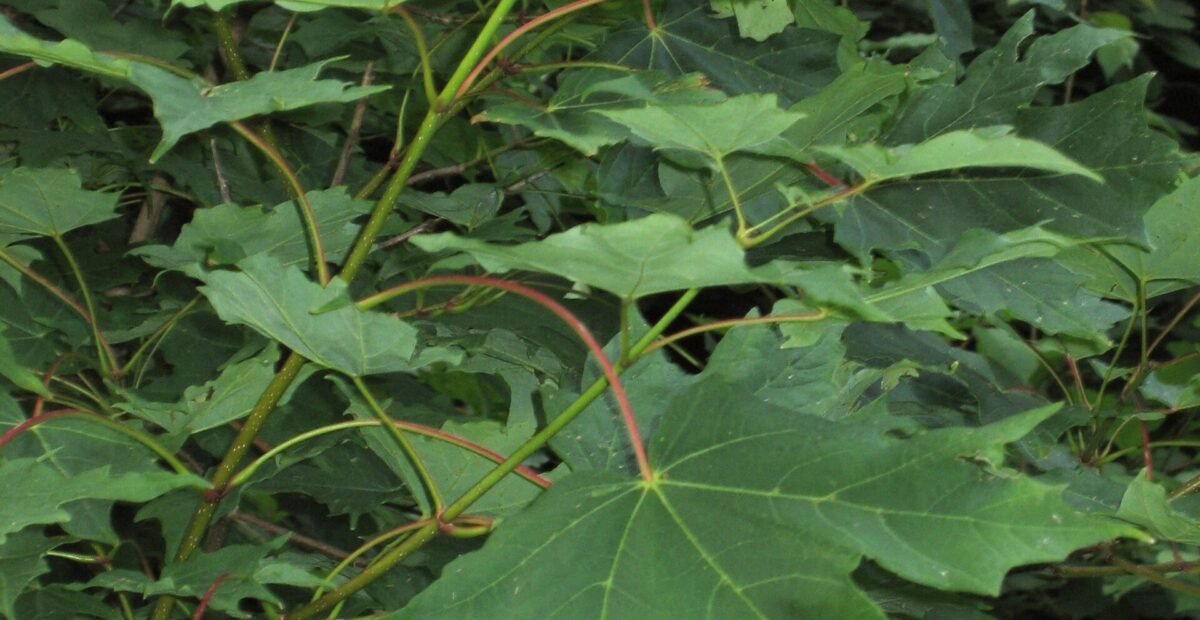
Sugar maple (Acer saccharum) short overview
Sugar maple is a long-lived deciduous tree native to the cool, moist forests of eastern North America. It forms a broad, dense crown, displays distinctive five-lobed leaves that often turn brilliant orange, red, or yellow in fall, and is valued both as a shade tree and as the principal source of traditional maple syrup. It performs best in deep, fertile, well-drained soil with steady moisture and room to mature.
Taxonomic classification
Sugar maple (Acer saccharum) care guide
Light and placement
Plant in full sun for the strongest growth and best fall color, or in partial shade where summers are hot. Young trees tolerate substantial shade, especially in woodland settings. Morning or open eastern light is useful in warmer regions; avoid reflected heat and intense afternoon exposure on dry sites. Scorched margins, premature fall color, and wilt suggest excessive heat or drought, while sparse growth and a thin crown may indicate insufficient light.
Watering and humidity
Water deeply over the root zone when the upper several inches of soil begin to dry, especially during the first two to three growing seasons. Maintain even moisture but never leave roots in saturated soil. Increase watering during prolonged summer heat and drought, and reduce supplemental irrigation after leaf fall. A 2–4 inch organic mulch layer helps stabilize soil moisture and temperature; keep mulch away from the trunk.
Soil and growing medium
Use deep, fertile soil with good internal drainage and substantial organic matter. Loams and silt loams are especially suitable; avoid shallow, compacted, drought-prone, or persistently waterlogged ground. Sugar maple commonly grows in soils from strongly acidic to slightly alkaline, but performs especially well around pH 5.5–7.3. Do not heavily amend a broad planting hole with rich compost alone; improve the wider soil profile instead.
Feeding
Test soil before fertilizing. Established trees in fertile ground often need no routine feeding. If growth is weak and nutrients are deficient, apply a slow-release, complete tree fertilizer in early spring according to the label, or top-dress the root zone with compost. Do not fertilize drought-stressed, newly transplanted, or late-season trees, and avoid excess nitrogen that can encourage weak shoots or nutrient imbalance.
Growth and habit
This species develops a strong central trunk and a dense, rounded to oval crown. It is highly shade tolerant as a young forest tree and can persist beneath a canopy before responding strongly when light increases. Growth is generally moderate, with slower enlargement in stressful southern or urban sites. Its substantial root zone and mature canopy require generous spacing from buildings, pavement, overhead wires, and competing trees.
Planting and repotting
Choose a spacious site with deep, moisture-retentive but well-drained soil. Dig a broad hole no deeper than the root ball, set the root flare at or just above grade, backfill with native soil, and water thoroughly. Mulch 2–4 inches deep in a wide ring without touching the trunk. Protect young trees from mower damage, drought, browsing, and severe competition while roots establish.
Not a practical long-term container plant because the species becomes a large tree and develops an extensive root system. Young nursery trees can be shifted during dormancy if root-bound, but transplant into the landscape promptly. When transplanting, preserve the root flare, avoid deep planting, and provide regular aftercare through the first several growing seasons.
Propagation and pruning
Propagation
Propagate primarily from fresh seed, which has physiological dormancy and generally requires moist chilling before spring germination. Collect mature samaras promptly and prevent them from drying. Seedlings vary genetically and may not reproduce a selected tree’s traits. Named cultivars are commonly propagated by grafting onto compatible maple rootstock; this is a specialist method.
Pruning
Prune during dormancy or in summer after the main spring sap flow, removing dead, damaged, crossing, or poorly attached branches. Develop a strong central structure in young trees with light, staged cuts rather than heavy reduction. Avoid topping and large unnecessary wounds. Do not remove large limbs merely because the tree bleeds sap after late-winter cuts; the bleeding is usually cosmetic.
Overwintering
Fully hardy outdoors across much of the United States. Young trees benefit from a 2–4 inch mulch layer and protection from rodents, deer, mower injury, and desiccating winter winds. Do not wrap trunks tightly with impermeable materials. In southern regions, winter protection is less important than protecting roots and foliage from drought, heat, and reflected pavement stress.
Uses
A premier North American shade and specimen tree, sugar maple is also the principal commercial source of maple syrup and an important hardwood timber species. It is valuable in large native plantings and woodland restoration. Its size, sensitivity to road salt, compaction, air pollution, and drought make it a poor choice for narrow urban strips or heavily salted streets.
Appearance
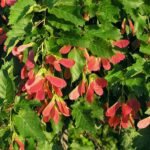
Leaves are opposite, palmately lobed, and typically five-lobed with smooth or nearly smooth margins; they differ from silver maple by having broader lobes and fewer deeply cut sinuses. Fall color can range from yellow and orange to red. Young bark is smooth and gray, becoming darker and deeply furrowed with age. Paired winged samaras are held in nearly parallel pairs and mature in autumn.
Flowering
Flowers appear in early spring, commonly from late March through mid-May depending on latitude and elevation, and usually precede full leaf expansion. The clusters are apetalous and greenish yellow, with separate functional male and female phases commonly occurring on the same tree. Individual flowers may appear bisexual, but usually only one sex is functionally active. The resulting paired samaras mature later in the season.
Pollination and visitors
Sugar maple flowers provide pollen and some nectar resources for early-season bees and flower flies. Research also indicates that pollination can occur freely without insect assistance, so insect visitation should not be treated as essential for seed set. The tree can contribute useful early-spring pollen resources, but it is not a complete pollinator planting by itself.
Acer saccharum photos
Click any photo for a larger view. Source, author and license are shown separately.
Diseases and pests
Diseases
Common problems include tar spot, anthracnose, leaf scorch, verticillium wilt, and root disorders associated with poor drainage or compaction. Rake and dispose of heavily infected fallen leaves where practical, improve airflow, mulch correctly, and avoid overhead irrigation. Leaf scorch is often environmental rather than infectious. Remove severely damaged branches with clean cuts; fungicides are rarely justified for routine cosmetic leaf diseases on mature trees.
Pests
Potential pests include Asian longhorned beetle where present, maple petiole borer, maple bladder gall mites, scale insects, aphids, and defoliating caterpillars. Inspect trunks, branch unions, and new growth, especially on stressed trees. Favor watering, mulch, root-zone protection, and reduction of compaction before using pesticides. Follow state regulations and licensed-arborist advice for regulated pests such as Asian longhorned beetle.
Related diseases and pests
Only Plant Doctor profiles whose host data indicate this plant may be affected are shown here.
 DiseasePhytophthora cactorum crown, collar, root and fruit rotPhytophthora cactorum
 Environmental stressIron Deficiency Chlorosis
 Environmental stressManganese deficiency
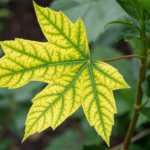 Environmental stressLime-Induced Chlorosis
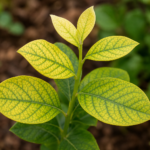 Environmental stressHigh-pH-induced iron deficiency
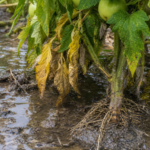 Environmental stressFlooding injury
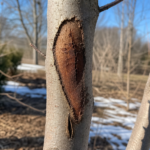 Environmental stressNapégés (sunscald)
 Environmental stressSalt stress
Toxicity and pollen
Reliable veterinary and poison-control evidence does not establish sugar maple as a routinely dangerous ornamental plant for people, dogs, or cats. However, plant material should not be intentionally eaten, and wilted or fallen maple leaves should be kept away from horses because serious maple-leaf poisoning is strongly associated with certain other maple species, especially red maple. Correct identification is important; seek veterinary advice after substantial equine ingestion.
- Typical season
- March–May in much of the United States
- Pollination / pollen
- Abundant seasonal tree pollen released in spring; dispersal can occur without insect assistance
Sugar maple releases airborne pollen during early spring flowering. Although flowers may receive visits from bees and flower flies and seed production can occur without insects, airborne pollen is still relevant to people with spring tree-pollen sensitivity. Exact exposure varies with local bloom timing, weather, wind, tree abundance, and individual sensitivity.
Native habitat
In the wild, sugar maple is characteristic of cool, moist, mesic forests, ravines, upland coves, and rich lowland sites rather than swamps. It favors deep soils with organic matter and reliable moisture, though it tolerates a broad mineral-soil range. Its natural distribution extends across much of eastern North America, with abundance influenced by climate, elevation, soil depth, and disturbance.
Interesting fact
Sugar maple is among the most shade-tolerant large hardwoods in eastern North America. Its leaves are the emblematic source of the Canadian flag’s maple symbol, although the flag does not identify a species. Trees often begin flowering only after reaching substantial age. The species can produce heavy, synchronized seed crops known as mast events. Its autumn display results from several pigments becoming visible as chlorophyll breaks down.
Frequently asked questions (FAQ)
The most relevant questions about this plant, with short and direct answers.
🌱Quick care
How do you care for a sugar maple?⌄
Give sugar maple full sun to shade, deep fertile soil, and consistent moisture without waterlogging. Protect it from drought, soil compaction, road salt, and excessive heat.
How fast does sugar maple grow?⌄
Sugar maple has a slow to moderate growth rate, influenced strongly by soil depth, moisture, light, competition, and climate. Trees usually grow faster in open, well-watered conditions than in dense forest shade or stressful urban sites.
Is sugar maple native to the United States?⌄
Yes, sugar maple is native to eastern and central North America, including much of the northeastern, Great Lakes, Appalachian, and upper Midwestern United States. Its natural range extends into parts of Canada.
🌤️Environment and placement
How much sun does sugar maple need?⌄
Sugar maple grows in full sun, partial shade, or shade. It develops best with ample light but is notably shade-tolerant, especially when young.
What USDA hardiness zones can sugar maple grow in?⌄
Sugar maple is generally suited to USDA Hardiness Zones 3 through 8, depending on the local climate and cultivar. It performs best where summers are not excessively hot or dry.
Can sugar maple grow in shade?⌄
Yes, sugar maple is highly shade-tolerant and can survive for long periods under limited light. A mature tree usually develops a fuller crown with more sunlight, provided the site does not become hot and dry.
Can sugar maple tolerate full sun?⌄
Yes, sugar maple can grow in full sun when its roots have dependable moisture and the soil remains cool and well-drained. Full sun on hot, dry, or paved sites can increase leaf scorch and stress.
Is sugar maple a good street tree?⌄
Sugar maple is usually a poor choice for harsh urban planting sites because it is sensitive to compacted soil, heat, air pollution, drought, and deicing salt. It is better suited to spacious lawns, parks, and woodland-edge settings.
How large does a sugar maple become?⌄
A sugar maple commonly reaches about 50–80 feet tall, with exceptional trees growing taller and developing a broad, dense crown. Allow substantial room for both the canopy and root system.
💧Care and problems
How often should you water a sugar maple?⌄
Water deeply whenever the soil begins to dry, especially during drought and while the tree is establishing. Newly planted trees commonly need about 5–7 gallons weekly, adjusted for rainfall, soil, and heat.
How do you water a newly planted sugar maple?⌄
Water the root ball slowly and thoroughly, checking soil moisture about 4–8 inches deep before watering again. During the first season, avoid short, frequent watering that encourages shallow roots.
Should you mulch around a sugar maple?⌄
Yes, apply about 2–3 inches of organic mulch over the root zone to conserve moisture and moderate soil temperature. Keep mulch several inches away from the trunk and do not create a mulch volcano.
Why are sugar maple leaves turning brown?⌄
Brown or red-brown patches can result from drought, heat, leaf scorch, salt exposure, root damage, or diseases such as anthracnose. Check soil moisture, drainage, recent construction, and deicing-salt exposure before treating the foliage.
Why is my sugar maple losing leaves early?⌄
Early leaf drop may follow drought, heat, salt injury, root damage, severe soil compaction, or disease. Improve watering and root-zone conditions, but seek a local arborist diagnosis if dieback or repeated early defoliation occurs.
What pests and diseases affect sugar maple?⌄
Sugar maple may be affected by aphids, borers, scale, anthracnose, leaf spot, tar spot, cankers, and Verticillium wilt. Healthy trees in suitable sites usually have fewer serious problems than stressed trees.
How do you protect sugar maple from road salt?⌄
Keep sugar maple away from salt-treated roads, sidewalks, and snow piles whenever possible. Use non-salt traction materials, prevent salty runoff from reaching the root zone, and irrigate deeply during dry periods to help flush salts from soil.
Does sugar maple need fertilizer?⌄
Sugar maple usually does not need routine fertilizer when planted in fertile soil and growing normally. Test the soil before fertilizing, because excess nitrogen can encourage weak late-season growth and will not correct drainage or root problems.
🪴Planting and repotting
What type of soil is best for sugar maple?⌄
Plant sugar maple in deep, fertile, well-drained loam that stays moderately moist. Slightly acidic to neutral soil is usually suitable, while compacted, shallow, or poorly drained soil can cause decline.
Can sugar maple grow in clay soil?⌄
Sugar maple can tolerate some clay if the site drains well and the soil is not compacted. Improve the planting area broadly with organic matter rather than creating a sharply different pocket around the roots.
When is the best time to plant sugar maple?⌄
Plant sugar maple in spring or fall when temperatures are mild and soil moisture is reliable. Avoid planting during frozen ground, extreme summer heat, or severe drought.
How far apart should sugar maple trees be planted?⌄
Space sugar maple well away from buildings, pavement, overhead wires, septic systems, and other large trees because its canopy and roots need room. The exact distance depends on the mature size and the site design.
How do you plant a sugar maple tree?⌄
Dig a broad hole no deeper than the root ball, place the tree with the root flare at or slightly above grade, and backfill with the original soil. Water thoroughly and add a shallow mulch layer without covering the trunk.
Can sugar maple be grown in a container?⌄
Sugar maple is not a good long-term container plant because it becomes a large, long-lived tree with extensive roots. Seedlings can be grown temporarily in containers but should be transplanted before becoming root-bound.
✂️Propagation and pruning
When should you prune a sugar maple?⌄
Prune sugar maple during dormancy or another season recommended by a local arborist, removing dead, damaged, crossing, or poorly attached branches. Avoid heavy pruning and never remove more than necessary from a mature tree.
Can you prune sugar maple in spring?⌄
Yes, but pruning in late winter or early spring may cause heavy sap flow, which is usually harmless but messy. For structural pruning, follow local arboricultural guidance and avoid large unnecessary cuts.
How do you grow sugar maple from seed?⌄
Collect mature samaras in late summer or early fall and give the seeds moist cold stratification for about 40–90 days at 33–39°F. Sow them about ¼–1 inch deep and keep the medium consistently moist.
Can sugar maple be propagated from cuttings?⌄
Sugar maple is most reliably propagated from seed, while cuttings can be difficult and inconsistent for home gardeners. Layering or nursery propagation may work, but seed is generally the practical method for this species.
⚠️Toxicity and safety
Is sugar maple toxic to dogs or cats?⌄
Species-specific toxicity evidence for Acer saccharum is limited, so it should not be assumed completely risk-free. Prevent pets from chewing large amounts of leaves, bark, seeds, or wilted plant material, and contact a veterinarian if ingestion causes symptoms.
Are sugar maple seeds edible?⌄
Sugar maple seeds are not generally treated as a household food, and reliable species-specific safety guidance is limited. Do not encourage children or pets to consume them, especially in large quantities.
Are sugar maple roots invasive?⌄
Sugar maple roots are not considered invasive in the usual ecological sense, but mature roots can be extensive and may lift pavement or interfere with drains, septic systems, or shallow utilities. Plant it where the root system has adequate space.
🌸Flowering and special interest
Does sugar maple produce flowers?⌄
Yes, sugar maple produces small yellow-green flowers in drooping clusters in spring, often before or as the leaves emerge. The flowers are modest but are followed by paired winged samaras.
When does sugar maple produce seeds?⌄
Sugar maple samaras typically mature in late summer or early fall. Collect them promptly when fully developed, because viability can decline if seeds dry out or remain exposed for too long.
Can you tap a sugar maple for syrup?⌄
Yes, mature sugar maple trees can be tapped for maple sap, but a landscape tree must be healthy, large enough, and managed carefully to avoid injury. Sap production depends on suitable freeze-thaw weather and does not make young trees appropriate for tapping.
How much sap does it take to make maple syrup from sugar maple?⌄
A common estimate is about 32 gallons of sugar maple sap to produce 1 gallon of maple syrup, although the ratio varies with sap sugar concentration. Home syrup production also requires safe collection, boiling, and sanitation practices.
Similar plants
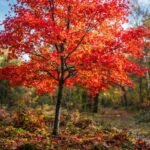 Amur Maple (Acer tataricum ginnala) care guideAcer tataricum ginnala
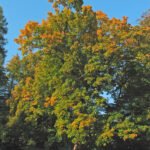 He Norway maple (Acer platanoides) care guideAcer platanoides
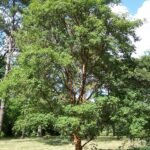 Paperbark Maple (Acer griseum) care guideAcer griseum
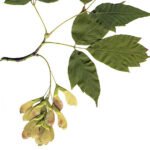 Boxelder (Acer negundo) care guideAcer negundo
 Acer palmatum care guideAcer palmatum
 Tatar Maple (Acer tataricum) care guideAcer tataricum