
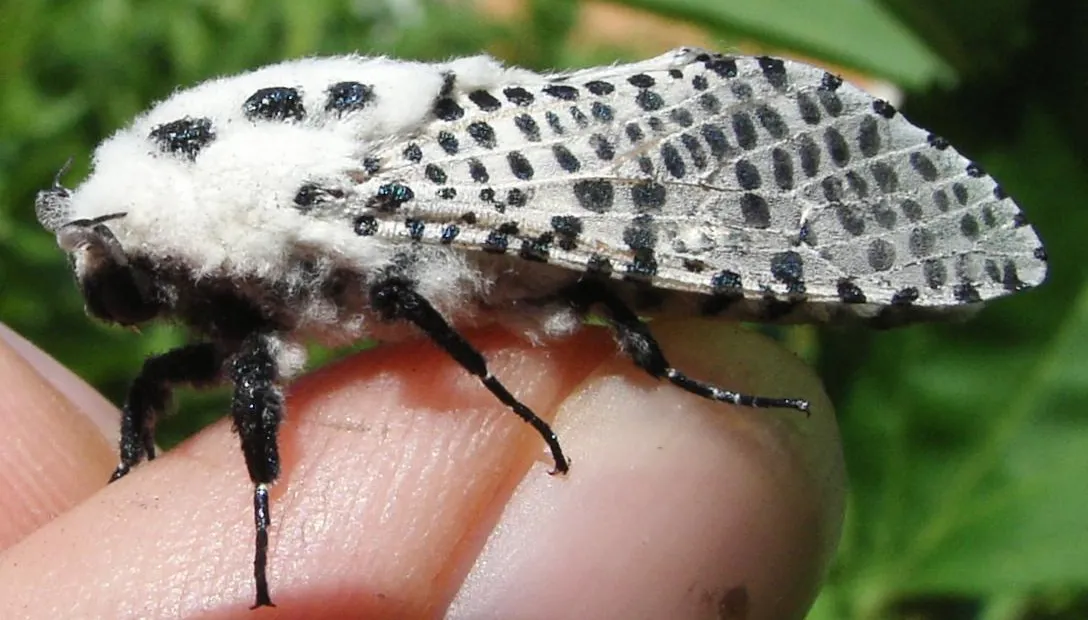
Leopard moth
Zeuzera pyrinaLeopard moth overview
Leopard moth, Zeuzera pyrina, is a wood-boring moth whose larvae tunnel inside the young branches and stems of many deciduous trees and shrubs. In the United States it is especially associated with apple, pear, cherry, maple, ash, elm, walnut and other broadleaf hosts. Wilting shoot tips, orange-brown frass and round exit holes are useful clues, but internal boring can remain hidden for months.
Typical conditions
Overview
Leopard moth is a serious but often cryptic borer of broadleaf trees and shrubs. The damaging stage is the caterpillar, not the conspicuously spotted adult moth. Larvae enter young shoots or small branches and feed within the wood, disrupting water movement and weakening structural tissues.
In the United States, documented hosts include apple, ash, beech, birch, blackcurrant, cherry, chestnut, cotoneaster, elm, hawthorn, lilac, maple, mountain ash, oak, pear, plum, poplar, quince, rhododendron, walnut and willow. Host records vary by region and source; a record on one plant does not mean every cultivar is equally susceptible.
Symptoms and identification
- Terminal shoots wilt, flag, yellow or die back beyond the entry point.
- Small round holes occur in young stems or branches, commonly on shoots about 0.4–1.2 inches in diameter.
- Orange-brown or reddish frass may be pushed from galleries or accumulate below holes.
- Branches may crack or break in wind when galleries are extensive.
- Older infestations can cause repeated dieback, reduced vigor and localized branch death.
- Adults are white to gray-white with numerous dark blue-black spots; they may be confused with the unrelated giant leopard moth, Hypercompe scribonia.
Causes and spread
Females lay eggs on bark, in crevices or near wounds during the adult flight period, generally from summer into early fall depending on latitude. Newly hatched larvae penetrate shoots and feed internally. Infested nursery stock, firewood, pruned branches and movement of woody material can spread the pest locally. Stressed, drought-affected or mechanically injured trees may be more vulnerable, although vigorous trees can also be attacked.
Life cycle and persistence
Eggs hatch after a variable incubation period, and young larvae bore into twigs or small branches. The larva develops within the wood, commonly over one year and sometimes longer depending on climate and host conditions. During development it enlarges a gallery and expels frass through the entrance hole. Pupation occurs inside the gallery or near the bark, followed by adult emergence during the seasonal flight period. Exact timing varies substantially with latitude, temperature and host plant.
Treatment and control
Inspect suspect branches carefully and trace the gallery toward the larva. In small branches, prune below the active gallery and destroy the material. Where the larva is accessible, it may sometimes be removed with a flexible wire or probing tool, but avoid enlarging wounds or damaging the cambium. Sealants and paint generally do not eliminate larvae already inside wood.
For valuable trees or orchard blocks, combine monitoring with advice from a certified arborist, extension specialist or licensed crop adviser. Because larvae are protected inside stems, treatments aimed at exposed adults or newly hatched larvae must be precisely timed and may provide limited benefit once galleries are established.
Low-impact and biological control
- Use sanitation and prompt removal of infested branches as the primary low-impact control.
- Support tree vigor through irrigation, mulching and reduction of avoidable stress.
- Encourage insectivorous birds and conserve predators, while recognizing that natural enemies may not reach larvae deep inside wood.
- Use pheromone traps for detection, flight timing and possible mass trapping only where local recommendations support the approach.
- Consider biological or entomopathogenic products only when they are specifically registered and supported for the crop, pest and use site.
Prevention
- Maintain tree vigor with appropriate irrigation during drought, mulch kept away from the trunk and correct pruning practices.
- Inspect nursery trees, replacement branches and transported firewood for holes, frass and weakened shoots.
- Prune and destroy clearly infested twigs and small branches before adult emergence; do not leave cut material near host trees.
- Avoid unnecessary trunk and branch injuries caused by mowers, trimmers, stakes and improper pruning.
- Monitor susceptible fruit and landscape trees during summer and early fall for wilting terminals, fresh frass and adult moths.
- Use pheromone monitoring or trapping where locally available through an extension or crop-adviser program.
Interesting facts
- The spotted adult is one of the easiest stages to recognize, but it is the concealed caterpillar that causes plant injury.
- Larvae are sometimes called carpenterworms because they develop inside woody tissues.
- Leopard moth has a broad host range, yet regional abundance and crop importance can differ greatly.
- The species was reported in the United States in the late nineteenth century and has been recorded from a range of eastern and northeastern states.
- Its common name can cause confusion with the giant leopard moth, which belongs to a different family and does not create the same type of stem galleries.
Use only products legally authorized for leopard moth or the applicable wood-boring caterpillar on the specific crop or ornamental plant in the United States, and follow the current product label exactly. Do not infer efficacy from a product labeled for a different borer, crop or application site. Professional application and precise timing may be necessary; cultural and mechanical controls are often more reliable against larvae already protected inside wood.
Affected plants
The plants below are linked to this problem by structured host-plant data. The list updates automatically as new plant profiles are added.
 Field maple (Acer campestre) care guideAcer campestre
 Paperbark Maple (Acer griseum) care guideAcer griseum
 Downy Japanese Maple (Acer japonicum) care guideAcer japonicum
 Boxelder (Acer negundo) care guideAcer negundo
 Acer palmatum care guideAcer palmatum
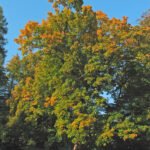 He Norway maple (Acer platanoides) care guideAcer platanoides
 Sycamore maple (Acer pseudoplatanus) care guideAcer pseudoplatanus
 Red maple (Acer rubrum) care guideAcer rubrum
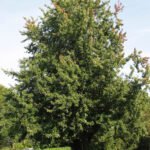 Silver maple (Acer saccharinum) care guideAcer saccharinum
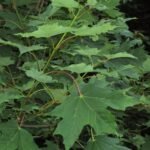 Sugar maple (Acer saccharum) care guideAcer saccharum
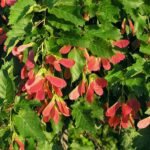 Tatar Maple (Acer tataricum) care guideAcer tataricum
 Amur Maple (Acer tataricum ginnala) care guideAcer tataricum ginnala