
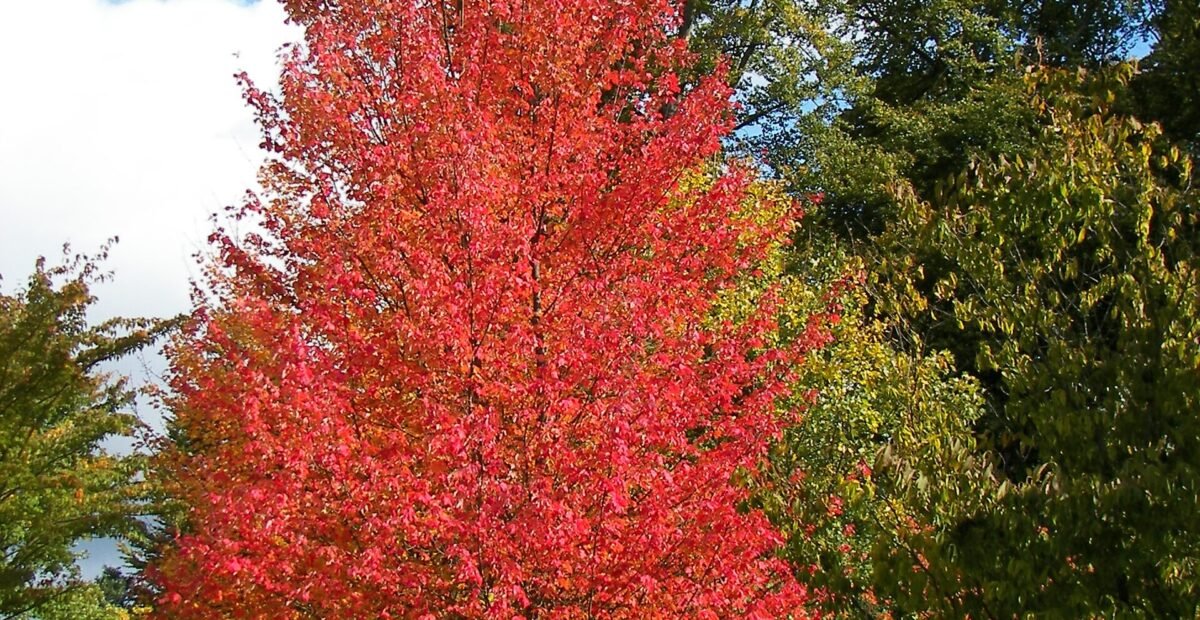
Red maple (Acer rubrum) short overview
Red maple is a widespread native deciduous tree of eastern and central North America, valued for brilliant red autumn foliage, reddish spring flowers, and adaptable growth. It performs best in moist, slightly acidic soil but tolerates a remarkably broad range of sites, from wet lowlands to upland forests. Choose a cultivar carefully for mature size and branch structure, and avoid alkaline soil, compacted planting sites, and locations too close to pavement.
Taxonomic classification
Red maple (Acer rubrum) care guide
Light and placement
Plant in full sun for the strongest growth and best autumn color, or in partial shade where summers are hot and dry. Morning sun with protection from intense late-afternoon heat can reduce leaf scorch in dry climates. Sparse growth and weak fall color suggest insufficient light; bleached, scorched, or prematurely browned leaves indicate excessive heat, drought, or reflected light.
Watering and humidity
Water deeply and slowly when the upper several inches of soil begin to dry, especially during the first two to three growing seasons. Maintain even moisture rather than alternating drought and saturation. Established trees tolerate brief dry periods but perform best with regular moisture; reduce supplemental watering in cool, wet weather and water before the ground freezes after a dry autumn.
Soil and growing medium
Use a broad, root-zone-wide planting area rather than a small amended pocket. Red maple accepts loam, clay, sandy soils, and wet sites, but drainage should still prevent prolonged stagnant water around the trunk. Slightly acidic soil supports nutrient availability; on alkaline sites, chlorosis may develop and correcting the entire root zone is more effective than repeatedly adding small amounts of fertilizer.
Feeding
Do not routinely fertilize a healthy established tree. In late winter or early spring, use a soil test to guide any correction, and apply a slow-release, low-salt fertilizer only when deficiency or poor growth is documented. Compost may be used as a thin surface mulch, but avoid piling organic matter against the trunk. Do not feed drought-stressed, newly transplanted, or late-season trees.
Growth and habit
Red maple is generally fast growing when moisture and light are favorable, with a rounded to oval crown and ascending branches. It develops a relatively shallow, spreading root system that can compete strongly with lawn and understory plants. Select a soundly structured cultivar for restricted urban sites, and allow ample clearance from pavement, utilities, and buildings.
Planting and repotting
Plant a container or balled-and-burlapped tree with the root flare visible and the top of the root ball level with or slightly above surrounding soil. Backfill with the native soil, water thoroughly, and apply 2–3 inches of mulch over the root zone while keeping mulch away from the trunk. Stake only when necessary, and provide consistent moisture during establishment.
Not generally suitable as a long-term container tree because of its eventual size and vigorous root system. If grown temporarily in a container, transplant while dormant or in early spring, move it before roots circle heavily, and avoid disturbing the root ball more than necessary.
Propagation and pruning
Propagation
The species is commonly propagated from seed, which should be collected when mature and sown promptly or handled with appropriate cold-moist stratification. Selected cultivars are propagated by budding or grafting, and softwood cuttings may root under mist with professional protocols.
Pruning
Prune during dormancy to remove dead, damaged, crossing, or poorly attached branches. Establish one strong central structure when needed, but avoid severe topping and large unnecessary cuts. Red maple can be prone to weak branch attachments in some forms, so begin structural pruning while young and use proper reduction cuts.
Overwintering
Established trees are highly cold hardy and generally need no winter protection. Protect young trunks from rodent damage and winter sunscald where relevant, maintain mulch over the root zone without touching the trunk, and water thoroughly before the ground freezes if autumn has been dry.
Uses
Used as a native shade, lawn, park, street, wetland, woodland-edge, and wildlife-supporting tree. It provides early-season flowers, seeds for wildlife, and valuable fall color. Because surface roots can lift pavement and form a dense root mat, it is not ideal for narrow planting strips or small beds beneath the canopy.
Appearance
Leaves are opposite, usually three- to five-lobed, with serrated margins and a paler underside. Young twigs, petioles, buds, and flowers often show red coloration. Small red flowers appear before or with the leaves, followed by paired winged samaras. Gray bark becomes darker and more furrowed with age, while autumn foliage may range from yellow-orange to vivid scarlet.
Flowering
Red maple is among the earliest North American trees to flower, commonly blooming from late winter into early spring before full leaf expansion. Flowers are small and borne in slender clusters. Individual trees may be predominantly male, predominantly female, or bear flowers of both sexes; female flowers develop paired samaras after pollination.
Pollination and visitors
The early flowers provide pollen and nectar resources before many woody plants bloom. Red maple flowers are reported as both wind- and insect-pollinated, with bees and other small insects among the documented visitors. Because wind can also move pollen, animal visitation does not fully describe the species’ pollination system.
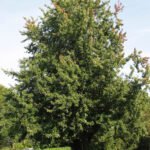
Acer rubrum photos
Click any photo for a larger view. Source, author and license are shown separately.
Diseases and pests
Diseases
Potential problems include Verticillium wilt, cankers, fungal leaf spots, root rots, and physiological chlorosis on alkaline soil. Improve drainage, avoid trunk injury and soil compaction, remove diseased wood during dry weather, sanitize tools, and avoid unnecessary irrigation or fertilizer. Seek an arborist evaluation for wilt, major dieback, or structural defects.
Pests
Aphids, scale, borers, leafhoppers, caterpillars, and occasionally invasive spotted lanternfly may occur. Monitor new growth and branch unions, conserve beneficial insects, and use targeted management only when damage is significant. Correct watering stress and avoid trunk wounds, which can increase vulnerability to secondary problems.
Related diseases and pests
Only Plant Doctor profiles whose host data indicate this plant may be affected are shown here.
 DiseasePhytophthora cactorum crown, collar, root and fruit rotPhytophthora cactorum
 Environmental stressIron Deficiency Chlorosis
 Environmental stressManganese deficiency
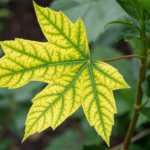 Environmental stressLime-Induced Chlorosis
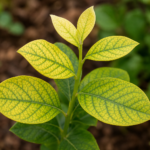 Environmental stressHigh-pH-induced iron deficiency
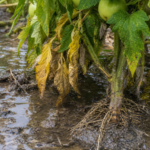 Environmental stressFlooding injury
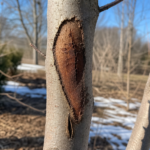 Environmental stressNapégés (sunscald)
 Environmental stressSalt stress
Toxicity and pollen
ASPCA identifies red maple as toxic to horses, especially when wilted leaves are eaten; the toxic principle can damage red blood cells and may cause severe illness. The same source lists it as non-toxic to dogs and cats. Do not allow horses access to fallen, wilted, or storm-damaged foliage, and seek veterinary advice after suspected ingestion.
- Typical season
- Late winter to early spring, commonly February–April depending on region
- Pollination / pollen
- Light, wind-dispersible pollen produced by male flowers
Red maple releases pollen during its early flowering period. Male flowers can contribute airborne pollen, and regional allergy references include red maple among monitored tree pollen sources. Insect pollination may reduce airborne release compared with strongly wind-pollinated trees, but exposure is not zero; local weather and the proportion of male trees affect pollen levels.
Native habitat
Native across a broad portion of eastern and central North America, red maple occurs in upland deciduous forests, bottomlands, swamps, stream margins, peatlands, and disturbed sites. It tolerates wide variation in moisture, soil texture, fertility, elevation, and light, although moderately moist soils generally support the best growth.
Interesting fact
Red maple produces its paired winged seeds in spring, unusually early for a native maple. The species is highly variable in leaf shape, growth form, flowering sex, and autumn color. It naturally hybridizes with silver maple to form Freeman maple, Acer × freemanii. Its Latin epithet rubrum refers to the plant’s red coloration.
Frequently asked questions (FAQ)
The most relevant questions about this plant, with short and direct answers.
🌱Quick care
How do you care for a red maple?⌄
Grow red maple (Acer rubrum) in full sun to partial or moderate shade, keep the soil consistently moist, and mulch over the root zone without touching the trunk. Water deeply during drought, especially while the tree is establishing. ([missouribotanicalgarden.org](https://www.missouribotanicalgarden.org/PlantFinder/PlantFinderDetails.aspx?kempercode=j170&utm_source=openai))
Is red maple native to the United States?⌄
Yes, red maple is native to eastern and central North America and occurs across a broad range of United States habitats. It is widely used as a native landscape and shade tree. ([missouribotanicalgarden.org](https://www.missouribotanicalgarden.org/PlantFinder/PlantFinderDetails.aspx?kempercode=j170&utm_source=openai))
Is red maple a good shade tree?⌄
Red maple is a widely used shade tree because it establishes readily, grows relatively quickly, and develops a substantial canopy. Choose a cultivar suited to the site and provide adequate room for mature roots and branches. ([extension.umn.edu](https://extension.umn.edu/lawns-and-landscapes-minnesota/red-maple?utm_source=openai))
🌤️Environment and placement
How much sun does a red maple need?⌄
Red maple grows in full sun to shade, but full sun or partial shade generally produces stronger growth and better fall color. Shade can be useful in hot, dry sites because the species does not tolerate prolonged drought well. ([missouribotanicalgarden.org](https://www.missouribotanicalgarden.org/PlantFinder/PlantFinderDetails.aspx?kempercode=j170&utm_source=openai))
What USDA zones can red maple grow in?⌄
Red maple is generally hardy in USDA Zones 3 through 9. Cultivars can vary, so check the hardiness range of a named selection before planting. ([missouribotanicalgarden.org](https://www.missouribotanicalgarden.org/PlantFinder/PlantFinderDetails.aspx?kempercode=j170&utm_source=openai))
How big does a red maple get?⌄
A red maple commonly reaches about 40–70 feet tall and 30–50 feet wide, although size varies by soil, climate, and cultivar. Give it substantial room to develop its mature canopy. ([missouribotanicalgarden.org](https://www.missouribotanicalgarden.org/PlantFinder/PlantFinderDetails.aspx?kempercode=j170&utm_source=openai))
Can red maple grow in wet soil?⌄
Yes, red maple tolerates moist, periodically wet, and some poorly drained soils, making it suitable for many rain-garden or low-lying sites. It still performs best where excess water is not permanently stagnant and the soil has some drainage. ([missouribotanicalgarden.org](https://www.missouribotanicalgarden.org/PlantFinder/PlantFinderDetails.aspx?kempercode=j170&utm_source=openai))
Can red maple grow in clay soil?⌄
Red maple can grow in clay as well as sandy or loamy soils, provided the site is not severely compacted and the roots receive adequate oxygen. Improve drainage where water remains stagnant for long periods. ([extension.umn.edu](https://extension.umn.edu/lawns-and-landscapes-minnesota/red-maple?utm_source=openai))
💧Care and problems
Does red maple tolerate drought?⌄
Red maple has limited drought tolerance and may need supplemental irrigation during prolonged dry weather, even after establishment. A deep mulch layer and thorough, infrequent watering help reduce moisture stress. ([extension.psu.edu](https://extension.psu.edu/downloadable/download/sample/sample_id/110653/?utm_source=openai))
How often should you water a newly planted red maple?⌄
Water a newly planted red maple daily for the first 1–2 weeks, every 2–3 days for the next 12 weeks, and then weekly until the root system is established, adjusting for rainfall and soil moisture. ([extension.umn.edu](https://extension.umn.edu/how/planting-and-transplanting-trees-and-shrubs?utm_source=openai))
How much mulch should you put around a red maple?⌄
Apply about 2–4 inches of mulch over the root zone, extending toward the drip line when practical, and keep it several inches away from the trunk. Do not pile mulch against the bark. ([extension.psu.edu](https://extension.psu.edu/native-plants-of-pa-red-maple-acer-rubrum?utm_source=openai))
Why are my red maple leaves turning brown?⌄
Brown leaf margins or early leaf drop can result from drought, heat, compacted soil, salt injury, or bacterial leaf scorch. If browning affects individual branches and appears in midsummer, ask a local arborist or extension office to evaluate the tree. ([extension.psu.edu](https://extension.psu.edu/maple-diseases?utm_source=openai))
What pests commonly affect red maple?⌄
Common red maple pests include aphids, leafhoppers, borers, scale insects, caterpillars, and sometimes spotted lanternfly. Healthy watering, mulch, and avoidance of trunk or root damage help reduce stress and pest problems. ([missouribotanicalgarden.org](https://www.missouribotanicalgarden.org/PlantFinder/PlantFinderDetails.aspx?kempercode=j170&utm_source=openai))
What diseases affect red maple trees?⌄
Red maple can develop bacterial leaf scorch, verticillium wilt, cankers, fungal leaf spots, and root rots. Symptoms such as progressive branch dieback, wilt, cankers, or recurring midsummer scorch warrant professional diagnosis. ([missouribotanicalgarden.org](https://www.missouribotanicalgarden.org/PlantFinder/PlantFinderDetails.aspx?kempercode=j170&utm_source=openai))
🪴Planting and repotting
Where should you plant a red maple?⌄
Plant red maple in an open site with room for a large canopy, away from buildings, overhead wires, driveways, and sidewalks. Its shallow, spreading roots can buckle nearby hardscaping when the tree is planted too close. ([missouribotanicalgarden.org](https://www.missouribotanicalgarden.org/PlantFinder/PlantFinderDetails.aspx?kempercode=j170&utm_source=openai))
When is the best time to plant a red maple?⌄
Plant red maple during the dormant season, especially in fall or early spring, when temperatures are moderate and soil moisture is more dependable. Container-grown trees can be planted at other times if they receive careful irrigation. ([extension.umn.edu](https://extension.umn.edu/how/planting-and-transplanting-trees-and-shrubs?utm_source=openai))
How do you plant a red maple tree?⌄
Dig a planting hole wider than the root ball, set the root flare at or slightly above the finished soil line, backfill with the native soil, water thoroughly, and apply 2–4 inches of mulch away from the trunk. Planting too deeply can damage root and trunk health. ([extension.psu.edu](https://extension.psu.edu/native-plants-of-pa-red-maple-acer-rubrum?utm_source=openai))
Can you plant red maple in a rain garden?⌄
Yes, red maple can work in a large rain garden or moist landscape because it tolerates wet soil and provides shade, fall color, and wildlife value. Allow enough space for its mature size and avoid sites that remain flooded for extended periods. ([missouribotanicalgarden.org](https://www.missouribotanicalgarden.org/PlantFinder/PlantFinderDetails.aspx?kempercode=j170&utm_source=openai))
Can red maple be grown in a container?⌄
Red maple is not a good long-term container plant because it becomes a large, woody tree with an extensive root system. A container is suitable only temporarily for a young nursery tree before planting it in the landscape. ([missouribotanicalgarden.org](https://www.missouribotanicalgarden.org/PlantFinder/PlantFinderDetails.aspx?kempercode=j170&utm_source=openai))
✂️Propagation and pruning
How do you prune a red maple?⌄
Prune red maple mainly to remove dead, damaged, crossing, or poorly attached branches and to establish a strong structure while the tree is young. Avoid topping and remove no more than necessary; hire a qualified arborist for mature or high branches. ([extension.psu.edu](https://extension.psu.edu/native-plants-of-pa-red-maple-acer-rubrum?utm_source=openai))
Can you grow red maple from seed?⌄
Yes, red maple can be grown from its winged seeds, called samaras, although seedlings may vary in growth habit, fall color, and other traits. Named cultivars are usually propagated clonally to preserve their specific characteristics. ([missouribotanicalgarden.org](https://www.missouribotanicalgarden.org/PlantFinder/PlantFinderDetails.aspx?kempercode=j170&utm_source=openai))
Are red maple cultivars always true Acer rubrum?⌄
No, some nursery cultivars sold as red maple are hybrids of red maple and silver maple, botanically classified as Acer × freemanii. Check the cultivar’s labeling and characteristics if species identity or predictable growth is important. ([extension.psu.edu](https://extension.psu.edu/native-plants-of-pa-red-maple-acer-rubrum?utm_source=openai))
⚠️Toxicity and safety
Is red maple toxic to horses?⌄
Yes, red maple leaves are toxic to horses, especially when they are wilted, fallen, or dried. Keep horses away from red maple leaves and do not include them in hay; contact a veterinarian immediately if ingestion is suspected. ([research.fs.usda.gov](https://research.fs.usda.gov/feis/species-reviews/acerub?utm_source=openai))
Are red maple leaves safe for dogs and cats?⌄
Red maple is generally considered non-toxic to dogs and cats, but pets should not be encouraged to eat large amounts of leaves or plant material. The major documented livestock concern is exposure of horses to red maple leaves. ([research.fs.usda.gov](https://research.fs.usda.gov/feis/species-reviews/acerub?utm_source=openai))
Is red maple safe to plant near a pasture?⌄
Use caution planting red maple near horse pasture because fallen, wilted, or dried leaves can poison horses. Choose a location where leaves cannot blow or be carried into grazing areas, and remove hazardous leaves promptly. ([research.fs.usda.gov](https://research.fs.usda.gov/feis/species-reviews/acerub?utm_source=openai))
🌸Flowering and special interest
When does red maple bloom?⌄
Red maple usually blooms in late winter or early spring, commonly from March through April in much of the United States, before the leaves emerge. Flowers are typically red or pinkish-red. ([missouribotanicalgarden.org](https://www.missouribotanicalgarden.org/PlantFinder/PlantFinderDetails.aspx?kempercode=j170&utm_source=openai))
Does red maple have good fall color?⌄
Red maple is valued for orange-to-red fall foliage, but the intensity and timing can vary among seedlings and cultivars. Adequate moisture and somewhat acidic soil may improve fall color, while drought and alkaline urban soil can reduce it. ([missouribotanicalgarden.org](https://www.missouribotanicalgarden.org/PlantFinder/PlantFinderDetails.aspx?kempercode=j170&utm_source=openai))
Does red maple produce flowers or seeds?⌄
Yes, red maple produces small flowers followed by paired, winged samaras that ripen in spring or early summer. The seeds are eaten by birds and small mammals and may germinate readily where soil conditions are favorable. ([missouribotanicalgarden.org](https://www.missouribotanicalgarden.org/PlantFinder/PlantFinderDetails.aspx?kempercode=j170&utm_source=openai))
Similar plants
 Paperbark Maple (Acer griseum) care guideAcer griseum
 Acer palmatum care guideAcer palmatum
 He Norway maple (Acer platanoides) care guideAcer platanoides
 Boxelder (Acer negundo) care guideAcer negundo
 Tatar Maple (Acer tataricum) care guideAcer tataricum
 Silver maple (Acer saccharinum) care guideAcer saccharinum