
 Source:
 Black scale
Saissetia oleaeBlack scale overview
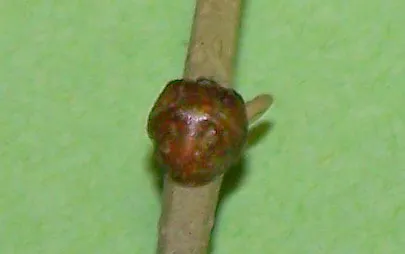
Black scale, Saissetia oleae, is a soft scale insect that weakens plants by sucking phloem sap and coating foliage with sticky honeydew. Dark, dome-shaped females with an H-shaped ridge are often accompanied by ants and black sooty mold. Olive and citrus are important U.S. hosts, but avocado, fruit trees and ornamentals may also be affected. Control is most effective when crawler stages and natural enemies are carefully managed.
Typical conditions
Overview
Black scale is a sap-feeding soft scale rather than a plant disease. Adult females are usually dark brown to black, rounded or oval, about 0.2 inch (5 mm) across, and commonly show a raised H-shaped ridge on the back. Crawlers and young nymphs are much smaller and yellow to orange.
Settled scales occur on leaves, petioles, twigs and branches. Feeding removes plant sap and produces honeydew, a sticky waste product that supports dark sooty mold on leaves and fruit. Light infestations may be tolerated, while heavy populations can reduce vigor, flowering, yield and ornamental quality.
Symptoms and identification
Look for dark, dome-shaped scales attached firmly to twigs, branches or leaves. Immature stages may appear as yellow-orange crawlers or flattened young scales. A hand lens helps reveal small crawlers and settled nymphs.
- Sticky, shiny honeydew on leaves, fruit, branches, vehicles or surfaces below the canopy.
- Black sooty mold growing over honeydew-coated leaves and fruit.
- Ant activity around infested stems or foliage.
- Reduced plant vigor, smaller growth, leaf yellowing, premature leaf drop, twig dieback or reduced flowering and fruit production in severe infestations.
Sooty mold alone does not identify black scale; inspect the plant above the mold for living scales, crawlers or old scale bodies.
Causes and spread
Spread occurs mainly when crawlers move short distances across the host or are transported on infested nursery stock, cut branches and plant material. Dense canopies and nearby touching plants make movement and establishment easier. Ants may increase survival by tending honeydew-producing scales and interfering with biological control.
Outbreaks are also associated with warm, humid, sheltered conditions and the loss of natural enemies after nonselective pesticide applications. Wind, tools and animals may contribute locally, but nursery and plant-material movement is the more important long-distance pathway.
Life cycle and persistence
Females reproduce without mating and lay roughly 1,000–2,500 eggs beneath the mature, hardened body. Eggs hatch into mobile crawlers, generally during warm periods, although timing and number of generations vary by climate and host.
Crawlers move over leaves and young shoots before settling and inserting their mouthparts. They pass through two nymphal molts. Older nymphs and adults commonly shift toward twigs and woody growth. Black scale often has one generation annually in California interior olive districts, while cooler coastal areas and some Florida conditions may support more than one generation.
Second- or third-instar nymphs may overwinter and are more tolerant of unfavorable weather than eggs or first-instar crawlers. Monitor for crawler emergence rather than relying only on calendar dates.
Treatment and control
Confirm that the insects are living black scale before treating; old dead scales can remain attached for months. Start with the least disruptive effective option.
- Prune out and discard heavily infested twigs when this will not damage the plant.
- Open dense growth and correct ant access to the canopy.
- Target the crawler stage, when scales are mobile and lack the protective adult covering. Use only a currently labeled horticultural oil, insecticidal soap or other legal product suitable for the crop and site.
- Repeat monitoring after treatment because eggs beneath mature females and settled older scales may survive.
- For valuable trees or persistent infestations, consult a licensed arborist, crop adviser or Cooperative Extension specialist about registered systemic or other selective options and timing.
Do not expect a single spray to eliminate adults protected by their waxy covering. Protect pollinators and avoid applications during bloom unless the label specifically permits safe use.
Low-impact and biological control
Begin with monitoring and cultural measures. Inspect leaves, petioles and young twigs with a hand lens, and record crawler activity. Prune congested interior branches where appropriate to improve light and airflow, but avoid severe pruning that stimulates excessive soft regrowth.
- Remove heavily infested shoots when practical and dispose of them away from healthy plants.
- Control ants by removing bridges to the canopy and using appropriately placed physical barriers or bait-based ant management; never apply sticky material directly to bark without checking plant-safety guidance.
- Conserve naturally occurring parasitoid wasps, lady beetles, lacewings and other predators by avoiding unnecessary broad-spectrum insecticides.
- Wash honeydew and sooty mold from suitable plants with a firm water spray after the scale population is reduced.
- Horticultural oils or insecticidal soaps may be useful against exposed crawlers or young scales when a U.S.-labeled product permits the crop and site. Test sensitive ornamentals first and avoid spraying drought-stressed, heat-stressed or water-stressed plants.
Prevention
Buy clean nursery plants and quarantine or inspect new acquisitions before placing them near established trees. Examine undersides of leaves, leaf axils, petioles and young twigs for crawlers and settled scales.
- Maintain open canopy structure with species-appropriate pruning.
- Avoid excessive nitrogen and unnecessary irrigation that produce dense, succulent growth.
- Keep branches from touching neighboring plants where feasible.
- Monitor during the local crawler period using frequent visual inspections and, where appropriate, sticky monitoring cards or tap sampling.
- Manage ants and preserve beneficial insects.
- Clean pruning tools between plants when removing infested material.
Interesting facts
- The species is also called Mediterranean black scale, olive scale or olive soft scale.
- The raised H-shaped ridge is a useful field clue on immature and developing females, although it may become less obvious on older egg-laying females.
- Honeydew attracts ants, which may defend scales from parasitoids and predators.
- Sooty mold is usually growing on the sugary excretion rather than directly infecting healthy plant tissue.
- Open, airy tree structure is generally less favorable than dense, shaded branching.
Use only insecticides legally authorized for black scale on the specific crop or ornamental and in the state where treatment occurs. Always follow the current product label, including crop, timing, rate, personal-protective equipment, reentry and pollinator precautions. Avoid broad-spectrum sprays when possible because they can kill parasitoids and predators and trigger scale outbreaks. Adult females and eggs are difficult to reach; any chemical intervention must be timed to the exposed crawler stage and confirmed against the current U.S. label.
Affected plants
The plants below are linked to this problem by structured host-plant data. The list updates automatically as new plant profiles are added.
 Field maple (Acer campestre) care guideAcer campestre
 Paperbark Maple (Acer griseum) care guideAcer griseum
 Downy Japanese Maple (Acer japonicum) care guideAcer japonicum
 Boxelder (Acer negundo) care guideAcer negundo
 Acer palmatum care guideAcer palmatum
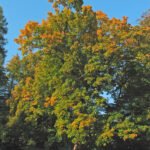 He Norway maple (Acer platanoides) care guideAcer platanoides
 Sycamore maple (Acer pseudoplatanus) care guideAcer pseudoplatanus
 Red maple (Acer rubrum) care guideAcer rubrum
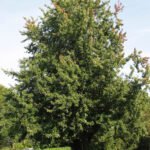 Silver maple (Acer saccharinum) care guideAcer saccharinum
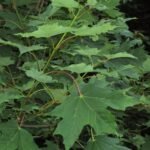 Sugar maple (Acer saccharum) care guideAcer saccharum
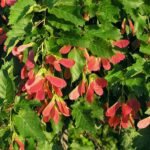 Tatar Maple (Acer tataricum) care guideAcer tataricum
 Amur Maple (Acer tataricum ginnala) care guideAcer tataricum ginnala