
Tomato mosaic virus
Tobamovirus tomatotessellatiTomato mosaic virus overview
Tomato mosaic virus (ToMV) is a highly contagious viral disease of tomato and other documented solanaceous hosts. It produces irregular light- and dark-green leaf mosaics, distortion, stunting and sometimes uneven fruit coloring. Because symptoms overlap with tobacco mosaic virus, herbicide injury and nutritional problems, laboratory confirmation is advisable. There is no curative treatment; prevention depends on clean seed and transplants, sanitation, resistant varieties and prompt removal of infected plants.
Typical conditions
Overview
Tomato mosaic virus (ToMV) is a persistent, sap-transmitted virus in the family Virgaviridae and genus Tobamovirus. In the United States it is encountered in gardens, greenhouses and field production, but visual diagnosis should be treated as provisional because ToMV resembles tobacco mosaic virus, other tomato viruses, herbicide injury and some nutrient disorders.
Young plants infected early may be stunted and produce fewer or smaller fruits. Symptom intensity varies with tomato cultivar, virus strain, plant age, temperature and light conditions. Infected fruit may remain edible, but yield, appearance and market quality can decline.
Symptoms and identification
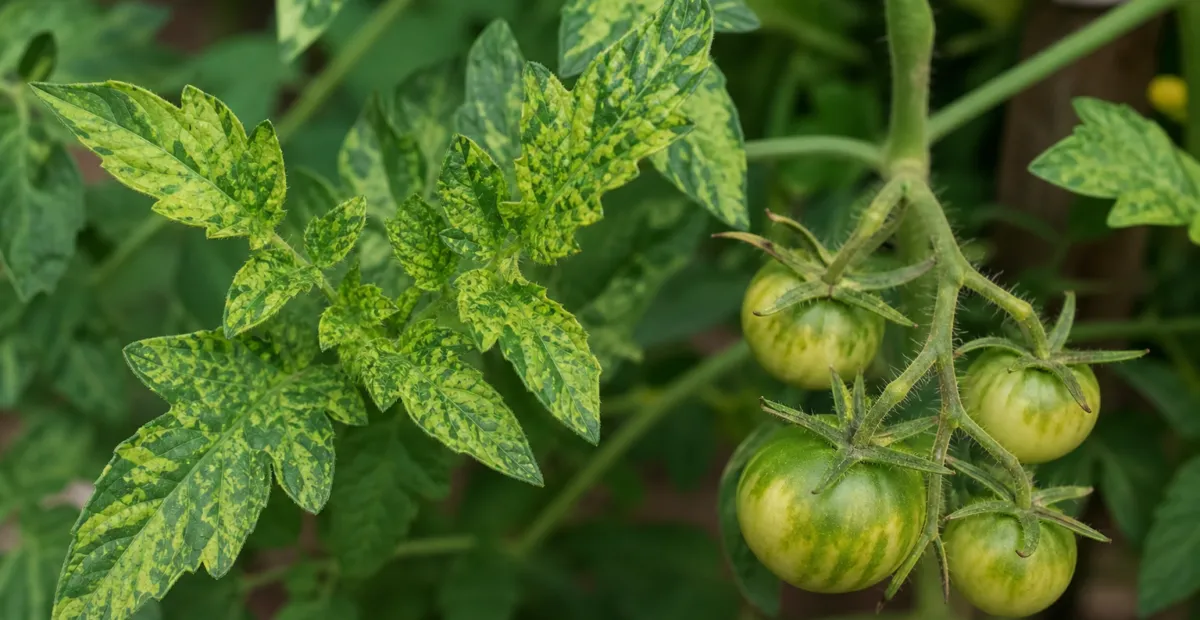
The characteristic symptom is a patchy mosaic of light- and dark-green areas on tomato leaves. Young leaves may be puckered, narrowed, curled, reduced in size or distorted into fernlike or shoestring forms. Plants infected early can be noticeably stunted, with shortened internodes and reduced vigor.
- Irregular green or yellow-green mottling on foliage
- Leaf distortion, narrowing, curling or shoestring-like growth
- Reduced plant height and slower growth
- Fewer, smaller or unevenly developing fruits
- Uneven ripening or discolored areas on fruit in some host–strain combinations
Symptoms alone cannot reliably distinguish ToMV from tobacco mosaic virus, cucumber mosaic virus, tomato spotted wilt virus, herbicide injury or nutritional stress. Submit a representative plant to a diagnostic laboratory when the distinction affects management or plant-health decisions.
Causes and spread
ToMV spreads primarily through mechanical contact rather than through a specialized insect vector. Important pathways include infected seed and transplants, grafting, sap on hands and clothing, pruning and harvesting tools, trellis systems, stakes, greenhouse benches and plant debris.
Any activity that wounds or rubs plants can transfer virus from an infected plant to a healthy one. Volunteer tomatoes and some other solanaceous plants may act as reservoirs. Aphids and thrips are not considered the primary transmission route for ToMV, so spraying them does not cure or reliably prevent this disease.
Life cycle and persistence
ToMV multiplies inside living host cells and moves systemically through the plant. It has no insect-vector life cycle like many other plant viruses. Virus particles can persist for long periods in dried sap, crop debris, contaminated tools, stakes, clothing and greenhouse surfaces.
Primary infections commonly begin with contaminated seed, transplants, grafting material or contact with infected debris. Secondary spread occurs when sap is transferred during transplanting, pruning, suckering, staking, harvesting or other routine work. Mechanical contact between neighboring plants can also spread the virus. Infected perennial or volunteer solanaceous plants may help maintain inoculum between crops.
Treatment and control
There is no curative treatment that removes ToMV from an infected tomato plant. Once systemic infection is established, pruning out symptomatic leaves will not eradicate the virus and may spread it through contaminated tools or hands.
- Confirm the diagnosis through a university, state or commercial plant disease diagnostic laboratory when practical.
- Mark or isolate suspect plants and avoid handling healthy plants afterward.
- Remove badly affected plants promptly, preferably on a dry day and before pruning or harvesting other plants.
- Bag and dispose of infected plant material; clean and disinfect tools, supports and work surfaces.
- For valuable greenhouse or nursery crops, review sanitation, propagation records and lot tracing to identify the likely entry point.
- Replant with clean material and a resistant cultivar when available.
Do not rely on fungicides, bactericides or general-purpose insecticides to cure a viral infection.
Low-impact and biological control
There is no organic spray that cures ToMV after a plant is infected. Organic management is therefore preventive and sanitation-based.
- Buy certified, reputable seed and healthy transplants; avoid saving seed from plants with unexplained mosaic symptoms.
- Choose cultivars carrying documented ToMV resistance when suitable for the production system.
- Remove symptomatic plants promptly, including roots where practical. Bag material before carrying it through the garden and dispose of it according to local rules; do not place infected plants in home compost.
- Wash hands with soap and water before handling healthy plants after working with suspect plants.
- Clean soil and sap from tools, then use an appropriate disinfectant according to its current label and manufacturer directions.
- Do not smoke, handle tobacco products, or use tobacco-contaminated hands around tomato plants.
- Remove volunteer tomatoes, cull piles and solanaceous weeds near production areas.
- Use dedicated gloves, tools, stakes and ties in greenhouse or high-tunnel crops where practical.
Prevention
Start with clean propagation material and a low-contamination workflow. Inspect transplants before planting, separate suspect lots, and avoid unnecessary touching of leaves and growing points.
- Use seed and transplants from suppliers with appropriate plant-health and sanitation standards.
- Select varieties with documented ToMV resistance, while remembering that resistance may be strain-dependent.
- Work from healthy plants toward suspect plants, not the reverse.
- Disinfect tools, benches, stakes, trays and reusable equipment between crops or after contact with suspect plants.
- Remove infected plants and volunteer hosts promptly.
- Rotate away from tomato and other susceptible solanaceous crops where practical; rotation alone is not sufficient if contaminated equipment or debris remains.
- Maintain balanced irrigation and nutrition to limit stress, but do not attempt to correct mosaic symptoms with fertilizer.
Interesting facts
- ToMV is unusually stable compared with many plant viruses and can remain infectious in dried plant sap and contaminated materials.
- The name refers to the mosaic pattern produced by contrasting green areas in infected leaves.
- ToMV and tobacco mosaic virus are closely related and can be difficult to separate by appearance alone.
- Resistance codes such as ToMV in U.S. seed catalogs indicate resistance to selected Tomato mosaic virus strains, not universal protection from every tomato virus.
- Experimental host ranges can be broader than naturally important host ranges, so host records should be interpreted conservatively.
No pesticide cures an infected plant or eliminates Tomato mosaic virus from plant tissue. Use only products legally authorized for the crop and problem in your country, and follow the current label. Insecticides are not a reliable control for this mechanically transmitted virus, although managing insect damage can reduce wounds and general plant stress.
Affected plants
The plants below are linked to this problem by structured host-plant data. The list updates automatically as new plant profiles are added.
 Solanum aethiopicum care guideSolanum aethiopicum
 Solanum macrocarpon care guideSolanum macrocarpon
 Eggplant (Solanum melongena) care guideSolanum melongena
 Garden Huckleberry (Solanum scabrum) care guideSolanum scabrum
 Ullucus (Ullucus tuberosus) care guideUllucus tuberosus
 Black Gram (Vigna mungo) care guideVigna mungo
 Creole-bean (Vigna reflexopilosa) care guideVigna reflexopilosa
 String Bean (Phaseolus vulgaris) care guidePhaseolus vulgaris
 Cucumber (Cucumis sativus) care guideCucumis sativus
 Musk cucumber (Sicana odorifera) care guideSicana odorifera
 Flexuosus Group (Cucumis melo Flexuosus Group)Cucumis melo Flexuosus Group
 Noble Orchid (Cymbidium goeringii) care guideCymbidium goeringii