Eggplant (Solanum melongena) short overview
Eggplant (Solanum melongena) is a tender, warm-season vegetable grown for its glossy fruits, which may be purple, white, green, striped, or nearly black depending on the cultivar. Plants form sturdy, branching bushes with broad, softly lobed leaves and star-shaped flowers. Give eggplant full sun, fertile well-drained soil, steady moisture, and protection from cool nights. In the United States, it is commonly grown as an annual, often from transplants.
Taxonomic classification
Eggplant (Solanum melongena) care guide
Light and placement
Provide at least 6–8 hours of direct sun, ideally in a south-facing bed or against a warm wall that reflects light. Insufficient light produces weak, elongated growth and fewer flowers. Excessive heat combined with drought can cause leaf stress, sunscald on exposed fruit, and poor flower set, so maintain moisture and use light mulch without shading the canopy.
Watering and humidity
Keep soil consistently and evenly moist, watering deeply when the upper surface begins to dry. About 1 inch of water per week is a useful baseline, increased in sandy soil or hot weather. Avoid shallow daily watering and overhead irrigation. Irregular moisture can reduce yield, worsen bitterness, and contribute to blossom-end rot or fruit-quality problems.
Soil and growing medium
Use fertile, well-drained soil with good moisture-holding capacity and abundant organic matter. A loam or amended sandy loam is a practical choice. Eggplant performs across a fairly broad pH range, approximately 5.5–7.5, but drainage is essential because saturated roots reduce vigor and increase disease risk.
Feeding
Incorporate finished compost before planting and fertilize according to a soil test. A balanced vegetable fertilizer used at label rates can support growth, but excessive nitrogen produces lush foliage with delayed fruiting. Avoid repeated high-phosphorus applications unless a soil test shows deficiency. Side-dress lightly when plants begin setting fruit if growth is pale or weak.
Growth and habit
Eggplant develops a sturdy, branching habit and can become top-heavy when carrying multiple fruits. Growth is strongest in consistently warm weather. Support plants early, harvest promptly to encourage continued flowering, and keep the root zone evenly moist. Cool nights, drought, and heat extremes can reduce vigor and fruit set.
Planting and repotting
Start seeds indoors about 8 weeks before the intended outdoor planting date. Sow about 1/4 inch deep in warm seed-starting mix, ideally around 75–85°F. Set transplants out only after danger of frost has passed and nighttime temperatures remain above 50°F, preferably closer to 60°F. Harden plants gradually before full exposure.
Move seedlings into progressively larger containers only when roots fill the current pot. Transplant outdoors with the root ball intact after nights are reliably warm. Containers should have generous drainage holes and enough volume to support a substantial root system; a 5-gallon container is a useful minimum for one plant.
Propagation and pruning
Propagation
Propagate from seed. Sow indoors 7–9 weeks before outdoor planting in a warm medium; germination and early growth are strongest with bottom heat. Use fresh seed and provide bright overhead light after emergence. Seed saving requires mature, fully developed fruit and isolation from other eggplant cultivars if varietal purity matters.
Pruning
Routine pruning is usually unnecessary. Remove damaged or diseased leaves and any low growth touching the soil. In containers or very vigorous plants, selectively remove weak shoots to improve airflow, but avoid heavy cutting because leaves protect developing fruit from sunscald.
Overwintering
Eggplant does not tolerate frost. In most of the United States, harvest remaining fruit before freezing weather and remove plants after frost injury. In a heated greenhouse, plants may be maintained through winter with strong light, warmth, reduced watering, and careful pest monitoring, but outdoor overwintering is limited to frost-free climates.
Uses
Primarily grown for culinary use as a cooked vegetable, including grilling, roasting, stews, curries, and preserves. Fruits are harvested while glossy and firm, before seeds become hard. Eggplant can also be grown ornamentally for its flowers and unusually colored fruits. Do not make medicinal claims, and avoid home-canning plain eggplant because of botulism risk.
Appearance
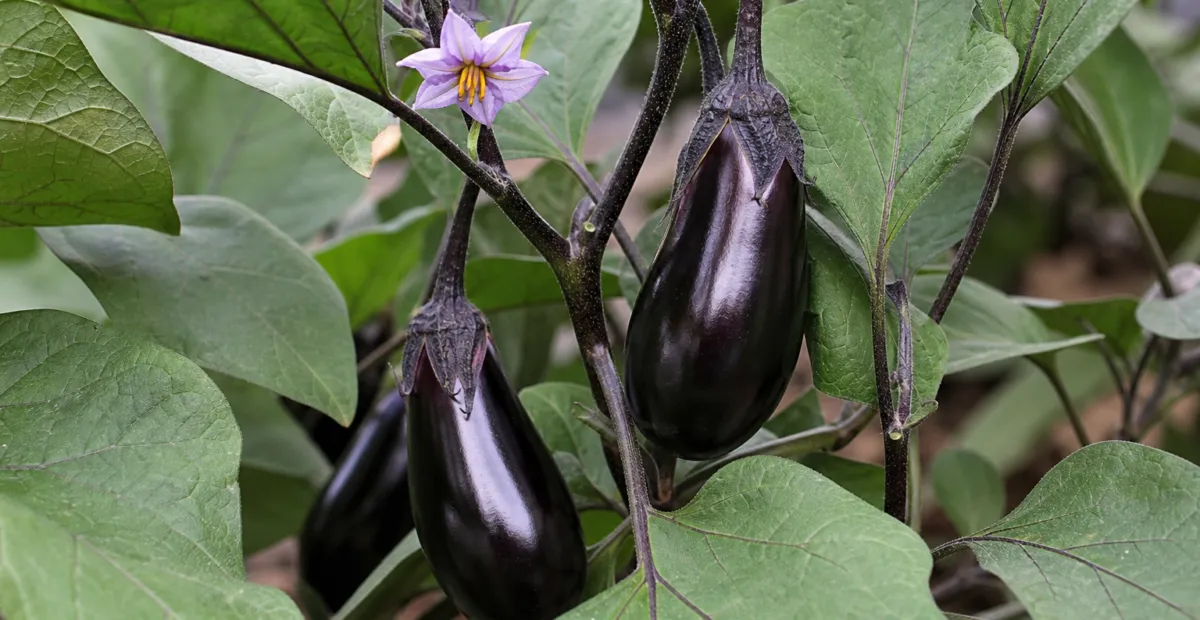
The plant has broad, softly lobed leaves with a slightly coarse texture and green stems that may become woody at the base during a long season. Flowers are conspicuous against the foliage, while fruits vary widely among cultivars in length, width, shape, skin color, and degree of gloss.
Flowering
Flowers are produced singly or in small clusters on branching stems. They are typically purple to lavender, sometimes white, with a five-lobed star-like corolla and prominent yellow anthers. Flowers are generally self-compatible, but fruit set can improve with gentle movement or bee visitation. Hot days above 90°F and unsuitable night temperatures can reduce flowering and fruit set.
Pollination and visitors
The flowers are self-compatible but have poricidal anthers, so vibration by bees can improve pollen release and fruit set. Bumblebees are effective buzz pollinators; other bees may also visit the flowers. Avoid treating flowers with insecticides during active visitation.
Solanum melongena photos
Click any photo for a larger view. Source, author and license are shown separately.
Diseases and pests
Diseases
Common problems include Verticillium wilt, early blight, Phytophthora-related rots, and fruit rots. Rotate away from eggplant, tomato, pepper, potato, and tomatillo beds for 3–4 years where practical. Water at the base, avoid wetting foliage, provide good spacing, remove diseased plant material, and use resistant cultivars when available. Do not compost plants with serious soilborne disease.
Pests
Flea beetles create numerous small holes in leaves; Colorado potato beetles can rapidly defoliate plants; cutworms may sever young stems at soil level; spider mites cause stippling or bronzing during hot, dry weather. Use row cover over young plants, inspect leaf undersides, hand-pick larger pests, maintain even moisture, and use targeted controls only when necessary.
Toxicity and pollen
Cultivated eggplant is widely eaten as a vegetable, but Solanum plants contain biologically active compounds and the leaves are not standard food. Rare food and respiratory allergies to eggplant have been reported, including reactions associated with fruit proteins and flower pollen. Avoid eating leaves or unripe plant parts, wash harvested fruit, and seek medical advice for suspected allergy symptoms.
- Typical season
- Late spring through summer in the United States
- Pollination / pollen
- Heavy, insect-associated pollen released from poricidal anthers
Eggplant pollen is not a major regionally monitored outdoor pollen category in the United States, so population-level exposure is expected to be low. Nevertheless, flower pollen can trigger respiratory or eye symptoms in sensitized people, particularly in greenhouses or dense plantings. Rare food allergies to eggplant fruit are also documented.
Native habitat
The species is cultivated worldwide but originated in tropical and subtropical Asia, with important diversity in South and Southeast Asia. It favors warm climates, fertile soils, and a long frost-free period. In temperate regions it is mainly a cultivated annual rather than a persistent wild plant.
Interesting fact
Eggplant flowers have poricidal anthers that release pollen when vibrated by visiting bees. The species includes a wide range of fruit shapes and colors, from long slender forms to round white or striped cultivars. Exact domestication pathways remain debated, with major diversity concentrated in Asia.
Frequently asked questions (FAQ)
The most relevant questions about this plant, with short and direct answers.
🌱Quick care
What is Solanum melongena commonly called in the United States?⌄
Solanum melongena is commonly called eggplant in the United States. It is a warm-season vegetable in the nightshade family, Solanaceae.
How much sun does eggplant need?⌄
Eggplant needs full sun, ideally at least 6–8 hours of direct sunlight daily. More light generally supports stronger growth and better fruit production.
How often should I water eggplant?⌄
Water eggplant consistently so the soil stays evenly moist but not waterlogged. About 1 inch of water per week is a useful starting point, with more frequent watering in sandy soil or hot, dry weather.
Is eggplant an annual or perennial?⌄
Eggplant is commonly grown as a warm-season annual in the United States. It can behave as a short-lived perennial only where winters remain frost-free.
🌤️Environment and placement
When can I plant eggplant outside?⌄
Plant eggplant outdoors after the danger of frost has passed and nighttime temperatures consistently stay above 50°F. Cold soil and chilly nights can stunt plants or delay fruiting.
What temperature is best for growing eggplant?⌄
Eggplant grows best in warm conditions, with soil temperatures around 70°F or warmer for planting and seed germination. Cool nights can reduce flowering and fruit development.
What is the best soil for eggplant?⌄
The best soil for eggplant is fertile, well-drained loam with a pH of approximately 5.5–7.5. Incorporating finished compost can improve fertility and moisture retention.
Can eggplant grow in containers?⌄
Yes, eggplant grows well in containers when given a compact variety, fertile potting mix, reliable drainage, and consistent moisture. Use a container large enough to support the plant’s mature size and stake it if needed.
How far apart should eggplant plants be spaced?⌄
Space standard eggplant plants about 18 inches apart, with 30–36 inches between rows. Compact varieties may require less room, so check the seed packet or plant label.
💧Care and problems
Why are my eggplant leaves full of small holes?⌄
Small round holes in eggplant leaves are commonly caused by flea beetles. Row covers on young plants, weed control, and regular inspection can help limit damage.
Why is my eggplant flowering but not producing fruit?⌄
Eggplant may flower without setting fruit when temperatures are too cool, excessively hot, or plants are under water stress. Keep soil evenly moist and protect plants from temperature extremes when possible.
Why are my eggplant leaves turning yellow and curling?⌄
Yellowing and inward-curling leaves can indicate verticillium wilt, water stress, root problems, or other disorders. Remove severely affected plants and avoid planting eggplant or related nightshades in the same location for several years.
Why are my eggplants bitter?⌄
Eggplants can become bitter when they are overmature or when plants experience inconsistent moisture or stressful temperatures. Harvest fruit while the skin is glossy and the flesh is firm.
Does eggplant need fertilizer?⌄
Eggplant benefits from fertile soil and fertilizer based on a soil test, but excessive nitrogen can produce leafy plants with delayed flowering and fruiting. Avoid overfertilizing.
Does eggplant need staking?⌄
Staking is not always required, but it helps support heavy fruit and keeps branches from bending or breaking. Install supports when planting to avoid damaging established roots.
Should I prune eggplant?⌄
Eggplant usually needs little pruning beyond removing damaged leaves and managing crowded growth. Pruning or removing suckers is optional and may promote earlier or larger fruit, but it also requires tying and monitoring.
🪴Planting and repotting
How deep should I plant eggplant seeds?⌄
Plant eggplant seeds about ¼ inch deep in a sterile seed-starting mix. Warm the seed-starting environment to roughly 75–85°F and keep the mix evenly moist.
When should I start eggplant seeds indoors?⌄
Start eggplant seeds indoors about eight weeks before you plan to transplant them outside. Seedlings typically need strong overhead light and warm conditions to remain compact and healthy.
How do I harden off eggplant seedlings?⌄
Harden off eggplant seedlings gradually over one to two weeks by exposing them to increasing amounts of outdoor light and wind. Bring them indoors if temperatures fall below about 55°F during the transition.
Can I plant eggplant after tomatoes or peppers?⌄
Avoid planting eggplant immediately after tomatoes, peppers, potatoes, tomatillos, or other Solanaceae crops. Rotate these crops to a different area for about three to four years when possible to reduce soilborne disease pressure.
✂️Propagation and pruning
Can eggplant be grown from cuttings?⌄
Eggplant is normally propagated from seed rather than cuttings. Starting fresh seed indoors is the most practical method for home gardeners.
Should I remove the first flowers from eggplant seedlings?⌄
Pinch off flower clusters that appear while eggplant seedlings are still indoors. This directs energy toward stronger vegetative growth before transplanting.
⚠️Toxicity and safety
Are eggplant leaves safe to eat?⌄
Eggplant leaves should not be eaten because the foliage and other green plant parts contain nightshade compounds and are not considered edible. The ripe fruit is the usual edible portion.
Is eggplant toxic to pets or people?⌄
Eggplant has low toxicity when the ripe fruit is prepared as food, but leaves and unknown unripe plant parts should be avoided. Keep pets and children from chewing the foliage or stems.
Can eggplant be canned at home?⌄
Plain eggplant is not recommended for home canning because it is a low-acid vegetable without a research-based plain-canning process. Freezing blanched slices is a safer home-preservation option.
🌸Flowering and special interest
Do eggplant flowers need pollination?⌄
Yes, eggplant flowers need pollination to develop fruit, but each flower is generally capable of self-pollination. Gentle movement from wind or insects usually provides adequate pollen transfer.
How long after flowering are eggplants ready to harvest?⌄
Eggplant fruit commonly reaches mature size about 10–20 days after flowering, depending on the variety and growing conditions. Harvest based on size, glossy skin, and firmness rather than waiting for the fruit to become dull.
How do I know when eggplant is ready to harvest?⌄
Harvest eggplant when the fruit is full-sized, firm, and has glossy skin. Cut it from the plant with sharp pruners or a knife, leaving about an inch of stem rather than pulling or twisting.