
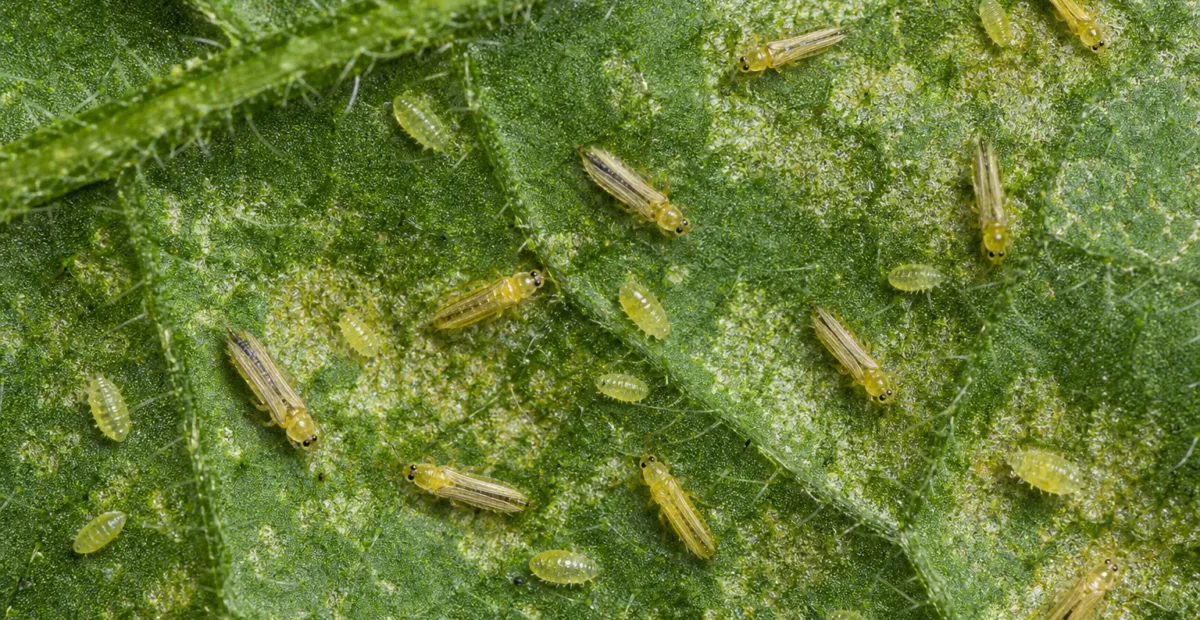
Melon thrips
Thrips palmi KarnyMelon thrips overview
Melon thrips (Thrips palmi) is a very small, warm-weather insect pest that feeds mainly on young leaves, flowers and developing fruit. It is especially damaging to cucumbers, melons, squash, peppers, eggplant and beans. Feeding causes silvery or bronze discoloration, crinkling, scarring and stunting; the pest can also transmit several plant viruses. In the United States, established field problems are concentrated mainly in southern Florida and Hawaii, although protected-culture introductions require careful mon…
Typical conditions
Overview
Melon thrips, Thrips palmi, is a tiny thrips in the family Thripidae. Adults are usually about 1 mm long and pale yellow to yellowish white, while larvae are smaller and pale. Adults and larvae commonly shelter on young leaves, growing points, flowers and small fruit.
Feeding removes cell contents and produces pale stippling, silvery patches, bronze discoloration, crinkling and distortion. Severe injury can reduce photosynthesis, stunt plants, scar fruit and cause premature leaf death. The species is also known to transmit several viruses, including capsicum chlorosis virus, groundnut bud necrosis virus, melon yellow spot virus, watermelon bud necrosis virus, watermelon silver mottle virus and tomato spotted wilt virus in documented pathosystems; transmission risk depends on the virus, crop and local thrips population.
Do not diagnose this species from damage alone. Western flower thrips, tobacco thrips and other species can produce similar symptoms.
Symptoms and identification
- Fine silvery, whitish or pale-yellow stippling on young leaves.
- Bronze or brown discoloration, especially after heavy feeding.
- Crinkled, curled, distorted or stunted growing tips.
- Scarring or russet-like injury on developing fruit and pods.
- Damaged flowers, flower buds and small fruit that may abort or become misshapen.
- Visible pale larvae or slender adults when foliage, flowers or vine tips are tapped over white paper.
Severe infestations may cause defoliation and reduced crop quality. Virus symptoms can vary widely and should not be attributed to melon thrips without confirming both the insect and the pathogen.
Causes and spread
Damage is caused by rasping-sucking feeding by larvae and adults. Eggs are inserted into plant tissue, so they are not exposed on the leaf surface. Pre-pupae and pupae occur in or just beneath the soil or leaf litter.
Spread occurs through infested transplants, cuttings, flowers, plant debris, weeds, workers and equipment. Adults can move between nearby host plants. Weeds in the nightshade, legume and aster families may maintain populations between crops. Movement of live plants and soil is a particular concern because hidden insects or immature stages may escape visual inspection.
Life cycle and persistence
Females insert individual eggs into leaves, flower buds, pods or other soft plant tissue. Eggs generally hatch in several days, with development becoming faster in warm conditions. The two feeding larval instars remain mainly on foliage, flowers or young fruit.
After larval feeding, the pre-pupa and pupa move to the soil surface or shallow soil and do not feed. Adults emerge, return to host tissue and reproduce. Under favorable warm conditions, a generation may be completed in about 2–3 weeks; cooler temperatures lengthen development substantially. Populations can persist year-round where suitable host crops are continuously available, with higher abundance reported during warm or seasonally favorable periods.
Treatment and control
Begin with confirmation and monitoring rather than treating symptoms alone. Inspect several plants across the planting, concentrate on young growth and flowers, and record adults and larvae separately. Remove badly infested leaves or flowers when practical, bagging and disposing of them away from the crop.
Use a layered IPM approach: improve sanitation, eliminate nearby host weeds, interrupt successive host crops, and conserve predators. In soil or field situations with a known infestation, cultivation or repeated soil disturbance may expose pupae to sunlight, but this must be compatible with the crop and soil-conservation plan.
When intervention is justified, select a product and application method that reaches the protected feeding sites on the crop. Coverage is difficult, and foliar treatments do not reliably control eggs inside plant tissue or pupae in soil. Rotate effective modes of action according to the current resistance-management guidance and local crop recommendations.
Low-impact and biological control
- Conserve naturally occurring Orius minute pirate bugs, predatory thrips and other beneficial arthropods by avoiding unnecessary broad-spectrum insecticides.
- Where locally available and compatible with the crop, biological-control programs may use predatory mites such as Neoseiulus cucumeris or Amblyseius swirskii; performance depends on release timing, humidity, prey density and crop structure.
- Commercial microbial products based on organisms such as Beauveria bassiana may help suppress thrips when the formulation is legally labeled for the crop and conditions support infection.
- Use reflective or silver mulch where appropriate; it can reduce colonization of young plants in some production systems but should not replace scouting.
- Use insecticidal soap, horticultural oil or other lower-risk materials only when they are labeled for the specific crop and site, and obtain thorough contact coverage without causing phytotoxicity.
Organic production does not mean risk-free control: repeated use of one material can select resistant populations, and sprays can harm beneficials.
Prevention
- Buy clean, inspected transplants and quarantine incoming plants for several weeks before placing them with established crops.
- Inspect growing tips, leaf undersides, flowers and small fruit with a hand lens; tap foliage over white paper to detect moving larvae and adults.
- Use yellow or blue sticky cards to detect adult activity, while recognizing that cards are monitoring tools rather than a complete control method.
- Remove crop debris promptly after harvest and maintain a host-free interval where practical.
- Control susceptible weeds in and around production areas, but avoid flowering weeds that are supporting beneficial predators until a replacement plan is in place.
- Avoid planting a susceptible crop immediately beside an infested crop or heavily infested field.
- Use insect-exclusion screening in greenhouses, seal unnecessary openings and inspect workers, tools and plant shipments.
- Favor selective measures that conserve minute pirate bugs and other natural enemies; unnecessary broad-spectrum sprays can worsen thrips outbreaks by removing predators.
Interesting facts
- Thrips palmi is often called melon thrips, although its host range extends well beyond melons and cucurbits.
- The species is difficult to manage because eggs are protected inside plant tissue and pupae are protected in soil or litter.
- In Hawaii and southern Florida, it is an important pest of vegetable crops; in much of the continental United States, outdoor establishment is limited by climate, while greenhouses can provide suitable conditions.
- Thrips species identification is subtle: body color and damage overlap among species, so reliable identification may require microscopic characters or specialist confirmation.
- Some insecticide programs have been associated with increased melon thrips abundance when natural enemies are destroyed.
Use only pesticides legally authorized and currently labeled in the United States for melon thrips or the specific crop and site. Follow the current label exactly, including rate, application interval, personal protective equipment, reentry interval, preharvest interval and resistance-management instructions. Product registrations and allowed crops vary by state and can change; consult your state extension service and the current label before use. Avoid routine broad-spectrum applications because they may disrupt predators and increase melon thrips pressure.
Affected plants
The plants below are linked to this problem by structured host-plant data. The list updates automatically as new plant profiles are added.
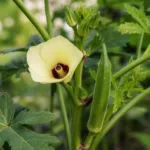 Okra (Abelmoschus esculentus) care guideAbelmoschus esculentus
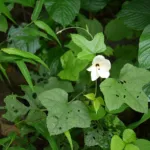 Aibika (Abelmoschus manihot) care guideAbelmoschus manihot
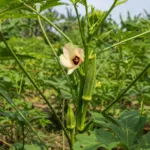 West African Okra (Abelmoschus caillei) care guideAbelmoschus caillei
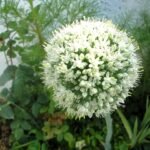 Onion (Allium cepa) care guideAllium cepa
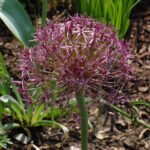 Allium christophii care guideAllium christophii
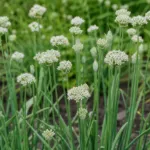 Bunching onion (Allium fistulosum) care guideAllium fistulosum
 Giant Allium (Allium giganteum) care guideAllium giganteum
 Ornamental onion (Allium) care guideAllium
 Garlic (Allium sativum) care guideAllium sativum
 Chives (Allium schoenoprasum) care guideAllium schoenoprasum
 Ransoms (Allium ursinum) care guideAllium ursinum
 Wild leek or broadleaf wild leek (Allium ampeloprasum) care guideAllium ampeloprasum