
 Source:
 Green Peach Aphid
Myzus persicaeGreen Peach Aphid overview
The green peach aphid, Myzus persicae, is a small, highly mobile sap-feeding pest found on peach and many vegetable, field, ornamental, and weed hosts across the United States. It causes curling, distortion, stunting, honeydew deposits, and sooty mold, but its greatest importance is often as a vector of plant viruses. Identification should be confirmed because several aphid species look similar.
Typical conditions
Overview
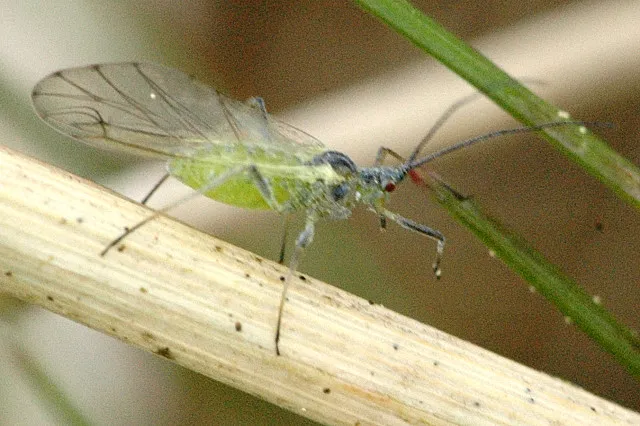
Myzus persicae, commonly called the green peach aphid or peach-potato aphid, is a widespread pest in the United States. Adults and nymphs are usually pale green, yellowish, or occasionally pinkish. Winged adults have a dark head and thorax and a conspicuous dark patch on the abdomen; wingless forms are pear-shaped and lack a waxy coating.
Species-level identification can be difficult because color varies and other aphids have similar shapes. Look for the converging frontal tubercles, relatively long cornicles, body color, host association, and—when present—the dark dorsal patch of winged adults. Confirmation may require an aphid key or specialist examination.
Populations may cause direct injury, particularly on young plants and tender shoots, but virus transmission can be more significant than feeding damage. Risk varies with crop, plant age, aphid density, virus pressure, natural-enemy activity, and local insecticide resistance.
Symptoms and identification
Feeding is concentrated on young shoots, growing points, flower tissue, and the undersides of leaves. Typical signs include:
- Leaf curling, puckering, twisting, yellowing, or distortion.
- Stunted shoots, delayed growth, wilting, or reduced vigor, especially in seedlings and water-stressed plants.
- Sticky honeydew on leaves, fruit, greenhouse surfaces, or objects beneath infested plants.
- Black sooty mold developing on honeydew-coated foliage or fruit.
- Visible colonies of pale green, yellow, pinkish, winged, or wingless aphids, along with cast skins.
- Virus-like mosaic, yellowing, rings, leaf distortion, or systemic decline in susceptible crops. These symptoms cannot by themselves prove aphid transmission or identify the virus.
On peach and related stone fruits, early-season feeding may distort young foliage and shoots. On older vegetable plants, moderate numbers may be tolerated when marketable tissue is not contaminated and plants are not stressed.
Causes and spread
Both wingless and winged females pierce plant tissue with slender mouthparts and remove phloem sap. Crowding, deteriorating host quality, short day length, temperature changes, and other environmental cues promote production of winged forms. These aphids can move within a planting or travel considerable distances on air currents.
In temperate regions, the pest commonly moves from overwintering Prunus hosts to herbaceous summer hosts, including vegetables, field crops, ornamentals, and weeds. Weedy areas and volunteer crops can maintain aphid populations and may serve as reservoirs for plant viruses. Ants may protect colonies in exchange for honeydew, interfering with natural enemies.
Virus transmission can occur during brief probing visits, so insecticides that reduce aphid numbers may not reliably prevent early virus infection. Avoid assuming that every aphid colony is this species; mixed aphid populations are common.
Life cycle and persistence
Where winters are cold and suitable alternate hosts do not persist, eggs are laid in autumn near buds and crevices of peach and other Prunus trees. The eggs are initially greenish or yellowish and become shiny black. They hatch in spring as buds open, and wingless females begin producing live young without mating.
Several mostly parthenogenetic generations develop on the primary host. As colonies increase or host quality declines, winged females migrate to summer hosts and establish new colonies. Nymphs pass through several molts before becoming adults; under favorable conditions, a generation may develop in roughly 10–12 days, allowing rapid population growth.
In autumn, winged sexual forms may return to Prunus, where mating occurs and eggs are deposited. In warmer U.S. regions, greenhouses, or areas with continuous host plants, populations may remain active year-round and reproduce without a distinct egg-laying phase.
Treatment and control
First determine whether treatment is justified. Examine a representative sample of plants, including lower leaf surfaces and growing points, and record aphid density, plant stress, natural enemies, crop stage, marketable-tissue risk, and virus concerns. Light colonies on established plants often decline naturally or can be removed with a firm spray of water.
On small plants, edible leafy crops, greenhouse crops, or crops at high virus risk, action may be warranted sooner than on older plants with nonmarketable older leaves. Prune and discard small, localized infestations where practical. Wash honeydew and sooty mold from plant surfaces after the aphid source is controlled.
When treatment is necessary, prioritize selective, well-timed measures that conserve parasitoids and predators. Thorough coverage of leaf undersides is important for contact materials. Rotate insecticide mode-of-action groups when repeated applications are unavoidable, because green peach aphid populations commonly show resistance to some insecticides. Do not use broad-spectrum products routinely or solely because aphids are present.
Low-impact and biological control
Conserve naturally occurring lady beetles, lacewing larvae, syrphid larvae, predatory bugs, and aphid parasitoids. Parasitized aphids become swollen, tan or brown mummies and should not be mistaken for live colonies. Avoid ants and disruptive broad-spectrum insecticides that interfere with biological control.
For small infestations, use a strong water spray directed at leaf undersides and shoot tips, repeat as needed, and remove badly infested leaves when this will not significantly injure the plant. In organically managed systems, insecticidal soaps, certain horticultural oils, azadirachtin or neem products, pyrethrins, and selected entomopathogenic fungi may be permitted, but product eligibility, crop registration, and effectiveness vary. These materials require direct contact and may injure stressed plants or beneficial arthropods.
Reflective mulch, row covers, weed management, sanitation, and habitat that supports beneficial insects are useful nonchemical components. Biological control may reduce aphid populations but may not prevent virus transmission from brief probing visits.
Prevention
- Inspect peach, nectarine, plum, vegetable seedlings, and ornamental growing points at least weekly during active growth; inspect leaf undersides and field edges especially carefully.
- Remove heavily infested weeds, volunteer plants, and crop debris when practical, while avoiding unnecessary disturbance of flowering plants that support beneficial insects.
- Use floating row covers on susceptible young vegetable crops where appropriate, removing them before pollination is needed and before heat buildup damages plants.
- Use silver or aluminum reflective mulch around young susceptible crops to delay colonization and reduce early-season virus pressure; effectiveness declines as foliage covers the reflective surface.
- Avoid excessive nitrogen fertilization and excessive pruning that produces highly succulent regrowth.
- Manage ants when they are tending aphids, using methods appropriate for the site and avoiding broad-spectrum sprays that kill beneficial insects.
- Start with clean transplants and quarantine or isolate newly purchased plants before placing them among established crops.
Interesting facts
- The species has a primary association with peach and other Prunus hosts but can develop on hundreds of plants in more than 40 plant families.
- The name “peach-potato aphid” reflects two important host associations, not a limitation to those crops.
- Green peach aphid is an important vector of numerous plant viruses, including viruses affecting potato, beet, lettuce, brassica, cucurbit, and solanaceous crops.
- Winged adults may appear even before colonies become extremely dense, allowing rapid movement between plants and fields.
- Color alone is unreliable: green peach aphids may be green, yellow, pinkish, or nearly whitish, and several other aphid species look similar.
Use only products legally authorized for green peach aphid on the specific crop and use site in the United States. Follow the current product label exactly, including crop, rate, application method, personal protective equipment, reentry interval, preharvest interval, pollinator precautions, resistance-management requirements, and restrictions protecting water. Registration and availability vary by state and crop; consult your state Extension service or a licensed pesticide professional before treatment.