
Dracaena Thrips
Parthenothrips dracaenaeDracaena Thrips overview
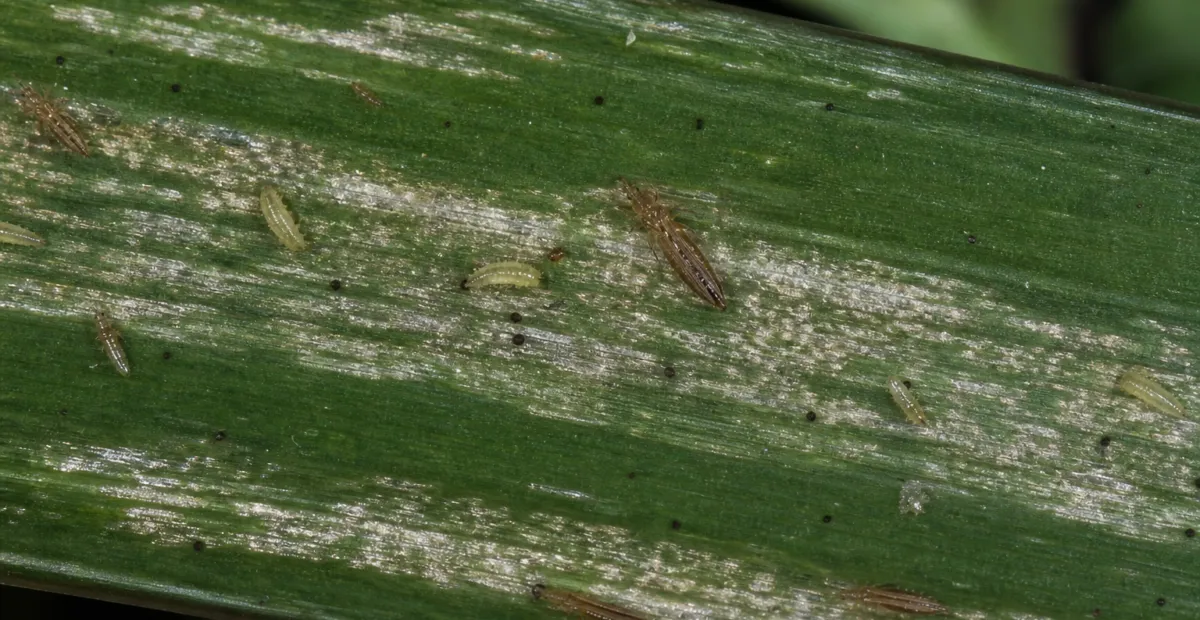
Dracaena thrips, Parthenothrips dracaenae, is a foliage-feeding thrips that mainly damages indoor and greenhouse ornamentals with firm leaves. Adults and larvae scrape and suck from mature foliage, producing silvery or bronze discoloration, fine dark specks and a loss of ornamental quality. Identification can be difficult because several thrips species cause similar injury.
Typical conditions
Overview
Parthenothrips dracaenae is commonly called dracaena thrips, palm thrips or parlour palm thrips. Despite the common name “palm thrips,” it is not restricted to palms. Adults are brown to golden brown, and the broad forewings have a characteristic reticulated appearance with darker bands. Species-level confirmation normally requires microscopic examination; silvery leaf injury alone cannot reliably distinguish it from other thrips.
In the United States, it is most relevant to indoor plants, conservatories, nurseries and protected ornamental production. It is generally managed as a localized foliage pest rather than as a disease or a known plant-virus vector.
Symptoms and identification
- Irregular silver, gray or bronze patches on mature leaves caused by scraping and sap removal.
- Fine pale stippling, surface scarring and loss of the normal glossy appearance.
- Small black fecal specks may occur among feeding scars.
- Leaves can become yellowed, desiccated or prematurely shed when feeding is prolonged or severe.
- Adults and larvae may be found on leaf surfaces, especially on firm, mature foliage; pupal stages may also remain on leaves.
Check suspicious plants with a hand lens. Gently tapping foliage over white paper can reveal slender, slow-moving thrips, but a laboratory or specialist identification is preferable when species identity matters.
Causes and spread
Both larvae and adults feed by rasping the leaf surface and sucking the released cell contents. Infestations commonly enter a collection or greenhouse on infested plants, cuttings or foliage. Adults can move short distances between neighboring plants, while plant handling, pruning tools, carts and close plant spacing assist local spread. New infestations may remain unnoticed because injury develops gradually and the species can be relatively slow-moving.
Do not diagnose this species solely from damage: western flower thrips, greenhouse thrips and other thrips can produce similar silvering.
Life cycle and persistence
Females insert very small eggs into plant tissue. Larvae feed on the foliage, followed by nonfeeding or less active immature stages before adults emerge. Development is strongly temperature-dependent: reported completion ranges from about one week under warm greenhouse conditions to several weeks outdoors under cooler or fluctuating conditions. Warm protected environments can therefore support multiple overlapping generations, while cooler conditions slow development.
Reproduction may be largely female-based at warm temperatures, with males more frequent at lower temperatures. Exact generation timing in a US home or greenhouse depends on temperature, host quality and humidity.
Treatment and control
- Confirm that live thrips are present before treating; old silvering remains after the insects are gone.
- Move the plant away from uninfested plants and remove heavily damaged leaves where this will not harm the plant.
- Rinse foliage thoroughly with a firm but non-damaging stream of water, concentrating on leaf surfaces, undersides and leaf bases. Repeat at intervals because eggs and protected stages may survive one washing.
- For valuable greenhouse or interiorscape plants, combine sanitation with frequent scouting and, where suitable, releases of commercially available biological control agents.
- Evaluate progress by counting adults on sticky cards and inspecting a consistent number of leaves weekly rather than relying only on visual appearance.
Systemic or foliar treatments may be less effective when coverage is incomplete or when repeated applications select for resistant thrips. Integrated measures are usually more reliable than a single spray.
Low-impact and biological control
Begin with isolation, pruning of severely injured foliage, water washing and sticky-card monitoring. On suitable greenhouse ornamentals, biological control may include predatory mites such as Amblyseius or Neoseiulus species and minute pirate bugs such as Orius species. Their success depends on correct pest identification, release timing, adequate prey availability and compatible greenhouse practices.
Insecticidal soaps, horticultural oils and other reduced-risk products can suppress exposed larvae and adults when the label permits use on the specific ornamental crop. Thorough coverage is essential, and foliage should first be tested for phytotoxicity on a small section.
Prevention
- Inspect new plants, especially Dracaena, Howea and other broad-leaved ornamentals, before purchase or placement.
- Isolate newcomers for at least 2–3 weeks and inspect mature leaves with a hand lens several times during quarantine.
- Use yellow or blue sticky cards to detect flying adults; cards are monitoring tools, not a complete control method.
- Space plants so foliage does not touch, and remove badly damaged leaves and fallen debris.
- Clean benches, shelves, carts and tools between plant groups.
- Avoid moving infested plants through the home, greenhouse or retail area until monitoring shows activity has declined.
Interesting facts
- The species has unusually broad, reticulated forewings with darkened bands, a useful diagnostic character for specialists.
- It is widely associated with cultivated Howea, or Kentia/parlor palms, even though “palm thrips” is not a restriction to palm hosts.
- Records show that it can breed on a range of ornamental plants, but published host lists differ among regions and observation methods.
- It is generally considered a cosmetic foliage pest of protected ornamentals rather than a major outdoor crop pest in the United States.
- Thrips injury can remain visible for weeks after successful control because damaged leaf cells do not regenerate.
Use only products legally authorized and currently labeled in the United States for thrips on the specific crop or ornamental site. Follow the current label exactly, including rate, application interval, personal protective equipment, re-entry requirements and restrictions for indoor use, greenhouses, pollinators and edible plants. Do not use agricultural pesticides on houseplants unless the label specifically allows that use.