
Blackleg of Canola and Brassicas
Leptosphaeria maculansBlackleg of Canola and Brassicas overview
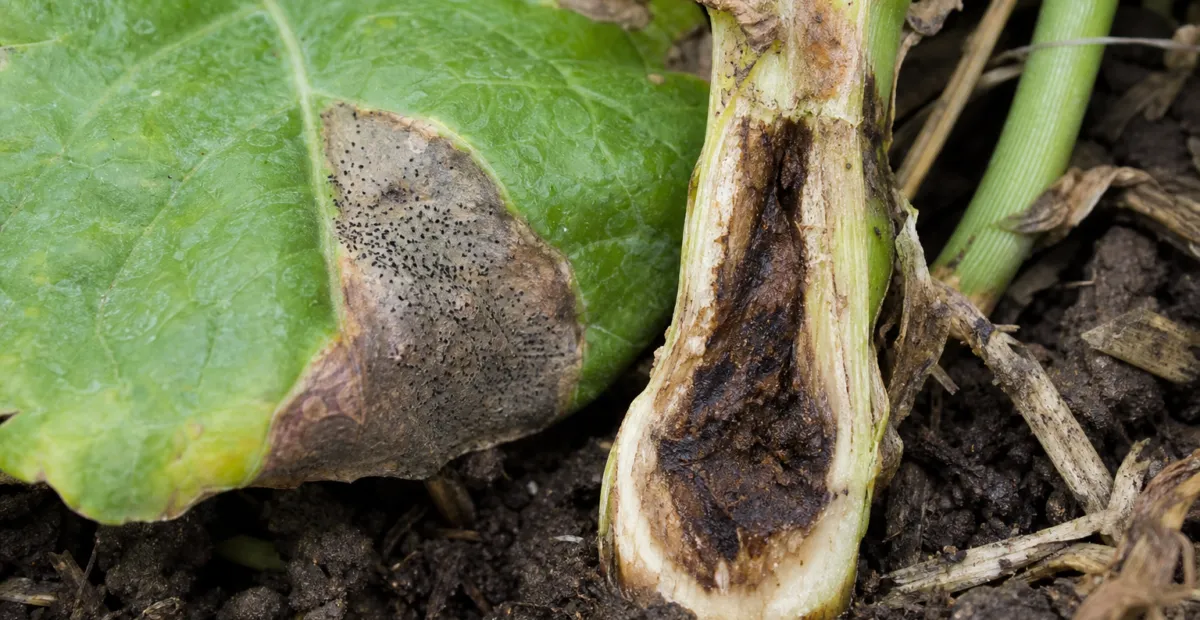
Blackleg, also called Phoma stem canker, is a serious fungal disease of canola, rapeseed and other susceptible Brassica crops. Early infections produce gray-green leaf spots that may contain tiny black pycnidia; the fungus can then grow through the leaf stalk into the stem base, forming a crown canker. Severe infections weaken stems, cause premature ripening and lodging, and may reduce yield substantially.
Typical conditions
Overview
Blackleg, also known as Phoma stem canker, is caused by the ascomycete fungus Leptosphaeria maculans. It is especially important in canola and rapeseed (Brassica napus) but can also affect other cultivated Brassica species. In the United States, disease importance varies by production region, cultivar resistance, pathogen population and weather.
The leaf spot is often only the visible entry point. After infection, the fungus may grow through the leaf petiole toward the stem base, where a canker can girdle vascular tissue. Early infection, susceptible genetics and favorable fall or spring weather increase the risk of severe yield loss.
Symptoms and identification
Initial symptoms are usually gray-green, ash-gray or tan circular to irregular lesions on cotyledons and lower leaves. Lesions may enlarge, coalesce and extend along leaf veins or petioles. Small black pycnidia, resembling pepper-like dots, may occur within or around the lesion, although they can be difficult to see in older, weathered tissue.
Stem infections produce elongated brown to gray lesions, often at the crown or lower stem. A severe crown canker may partially or completely girdle the stem, restricting water and nutrient movement. Affected plants may mature prematurely, have shriveled seed, break at the base or lodge before harvest. Symptoms can resemble damping-off, insect injury, Alternaria leaf spot or other stem diseases, so laboratory confirmation may be needed.
Causes and spread
The main inoculum source is infected Brassica residue left on or near the soil surface. The fungus survives there in mycelium and sexual fruiting bodies called pseudothecia. After wetting by rain or prolonged moisture, pseudothecia can release airborne ascospores that travel to nearby or downwind crops. Short-distance spread by pycnidiospores may occur within infected tissue, but it is generally less important for initiating epidemics.
The pathogen may also be introduced in infected or infested seed, although seed transmission is usually a minor source compared with infected crop residue. Volunteer canola, susceptible Brassica weeds and neighboring infected fields can help maintain inoculum between crop cycles.
Life cycle and persistence
Leptosphaeria maculans overwinters and survives the intercrop period in infected canola or Brassica debris. Under suitable moisture and temperature conditions, pseudothecia mature and release ascospores. In the canola disease cycle, important ascospore release commonly follows rainfall during cool conditions; the APS educational reference gives approximately 46–54°F (8–12°C) for release.
Ascospores germinate in free water and enter young leaves mainly through stomata, with infection favored by susceptible early growth stages. The fungus initially produces a leaf lesion, then may grow internally through the petiole and into the stem. At maturity, new pseudothecia and pycnidia develop in dead or infected tissue, completing the cycle and replenishing residue inoculum.
Treatment and control
There is no curative treatment that removes a well-established crown canker. Management is most effective before or shortly after infection through resistant genetics, rotation, residue management and, where justified, a properly timed fungicide or seed-treatment program.
In commercial canola, consider disease risk, cultivar resistance, local extension recommendations, disease history, weather and the crop growth stage before using a fungicide. Seed treatments may help protect seedlings in some situations but should not be relied on as the only control measure. Remove or destroy severely diseased volunteer plants where feasible, and plan future rotations around the infected field rather than attempting to rescue heavily cankered plants.
Low-impact and biological control
Organic and low-input management should emphasize prevention rather than eradication. Use certified clean seed and the most resistant suitable cultivar available. Extend the interval between susceptible Brassica crops, rotate with nonhost cereals, manage volunteer canola and cruciferous weeds, and encourage rapid breakdown of infected residue through appropriate chopping, incorporation or residue-handling practices.
Do not save seed from a visibly diseased crop. Biological products have not replaced resistant cultivars and cultural controls for dependable blackleg management; use only products that are approved for organic production and specifically permitted for the crop and disease in the United States.
Prevention
- Plant certified, inspected, high-quality seed from a reputable supplier.
- Choose cultivars with effective blackleg resistance appropriate for the U.S. production region, while recognizing that resistance can vary with local pathogen populations.
- Use a rotation that separates canola or other susceptible Brassica crops by at least two or three growing seasons where practical; rotate with nonhost crops such as wheat, barley, corn or other suitable crops.
- Avoid planting into heavily infected canola stubble and manage residue to accelerate decomposition when agronomically appropriate.
- Control volunteer canola and susceptible cruciferous weeds, and avoid moving contaminated residue or seed between fields.
- Scout young crops after wet periods and inspect the crown and lower stem near flowering or maturity to assess disease severity.
Interesting facts
- The disease name “blackleg” refers to the darkened, girdled lower stem or crown rather than to a single black fungal structure.
- The leaf lesion is often less damaging than the later stem canker; early leaf infection can serve as the route for systemic movement into the stem.
- Leptosphaeria maculans is frequently discussed alongside the related species Leptosphaeria biglobosa, but the two species differ in aggressiveness and disease contribution.
- Pathogen populations can vary in virulence, so a cultivar that performs well in one region may not provide the same protection elsewhere.
Use fungicides or fungicide seed treatments only when they are legally authorized for blackleg on the specific crop in the United States and when they fit current local extension guidance. Follow the current product label for crop, timing, rate, personal protective equipment, reentry interval, preharvest interval and resistance-management requirements. Do not assume that a product labeled for another Brassica disease or another country is legal or effective for blackleg. Rotate fungicide modes of action where labels and local recommendations call for it.