
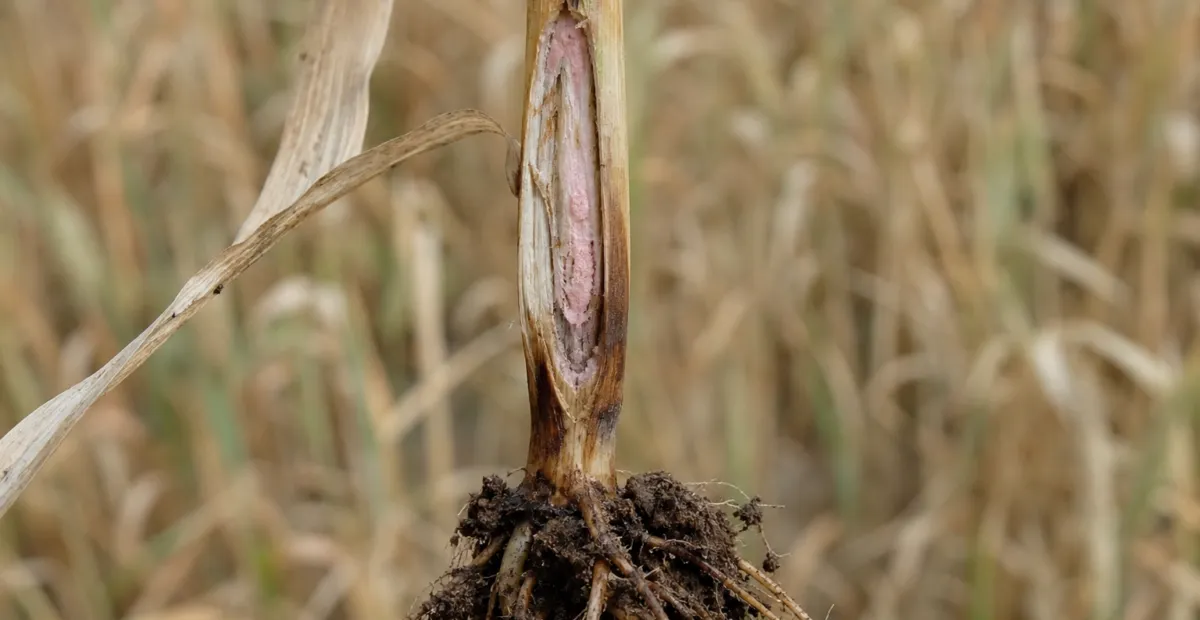
Fusarium culmorum Crown Rot and Head Blight of Cereals
Fusarium culmorum (Wm. G. Sm.) Sacc.Fusarium culmorum Crown Rot and Head Blight of Cereals overview
Fusarium culmorum is a soil- and residue-associated fungal pathogen that most consistently affects wheat and other small grains. It can cause crown, foot, root and seedling rots, premature white heads, and—under suitable flowering weather—Fusarium head blight. Symptoms overlap with other Fusarium species, so laboratory confirmation may be needed for a reliable diagnosis.
Typical conditions
Overview
Fusarium culmorum is a soilborne and residue-associated fungus that infects cereal roots, crowns, subcrown internodes and lower stems. It is an important cause of Fusarium crown rot in wheat and may also infect barley, oats and rye. The same species can contribute to Fusarium head blight, especially where flowering occurs during wet weather. Because several Fusarium species may occur together, a diagnosis based only on field symptoms is provisional.
In U.S. production, crown rot is especially important in areas where cereal crops experience drought or other water stress after infection. Head blight risk is concentrated around flowering and early grain development, while crown and root infections may begin during seedling establishment or later in the season.
Symptoms and identification
Symptoms depend on the infected tissue and growth stage:
- Seed rot, poor emergence, damping-off, weak seedlings and reduced stands.
- Brown to chocolate-brown discoloration of roots, the subcrown internode, crown and lower stem.
- White, pink, salmon or reddish fungal growth may be visible beneath leaf sheaths or inside severely infected stems.
- Stunting, premature death of tillers, poor grain fill and individual premature white heads, often made more obvious by drought stress.
- On wheat or barley heads, Fusarium head blight causes prematurely bleached spikelets; pink-orange sporulation may develop during warm, moist conditions.
These symptoms overlap with common root rot, take-all, other Fusarium species, Bipolaris diseases, insect injury and drought. Split the lower stem and examine the crown, but submit representative tissue to a plant diagnostic laboratory when species-level identification matters.
Causes and spread
The pathogen survives and builds up in infested soil, infected seed and cereal residues, particularly wheat and other grass residues. Infection is favored when roots or crown tissues are stressed, wounded or growing in conditions that promote prolonged contact with inoculum. Soil movement, contaminated equipment, plant debris, volunteer cereals and grassy weeds can redistribute inoculum within or between fields.
For head blight, airborne spores and residue-produced inoculum can reach flowering cereal heads. Rainfall, irrigation, dew and high humidity around anthesis promote infection. Grain may become contaminated with mycotoxins, but toxin production varies with strain, host, weather and disease development; grain affected by Fusarium head blight should be evaluated under applicable grain-quality and feed-safety procedures.
Life cycle and persistence
Fusarium culmorum persists between crops as mycelium and spores in soil, seed and crop residue. Under favorable conditions, inoculum infects germinating seed, roots and the stem base. The fungus colonizes crown and vascular-associated tissues, and disease expression often becomes more severe when plants later experience limited soil moisture or heat stress.
In cereal residues, the fungus can produce spores that spread locally by rain splash, soil movement or air currents. Around cereal flowering, spores can infect exposed spikelets and developing grain. The exact balance between soilborne crown-rot infection and head-blight infection depends on crop stage, residue, weather and the particular isolate.
Treatment and control
There is no reliable way to cure crown or root tissue after it has been colonized. Remove or isolate severely affected plants only in small plantings, and correct contributing stress where possible. For commercial cereal fields, management is primarily preventive: rotation, resistant cultivars, seed quality, residue and weed management, and avoidance of severe water stress.
If Fusarium head blight is developing, document the growth stage and disease distribution, obtain a diagnosis when needed, and follow local extension recommendations. Harvesting and grain handling should minimize spread of contaminated material, and suspect grain should be tested or directed according to applicable food, feed and grain-marketing requirements.
Low-impact and biological control
Organic and low-input programs should emphasize rotation away from small grains, certified clean seed, resistant or tolerant cultivars, removal or decomposition of heavily infected cereal residue, control of volunteer cereals and grassy weeds, equipment sanitation, and balanced crop nutrition. Commercial microbial seed treatments or other biological products may provide variable suppression in some systems; use only products registered or permitted for the specific crop and disease in the United States, and follow the current label. No biological treatment should be represented as a dependable cure for established crown rot.
Prevention
Use an integrated approach rather than relying on one control measure:
- Plant certified, high-quality seed and have suspect seed tested when seedling blight is a concern.
- Rotate cereals with non-host broadleaf crops where practical; avoid tight wheat-after-wheat sequences in fields with recurring crown rot.
- Select cultivars with useful resistance or tolerance to Fusarium crown rot and head blight when locally available. Resistance is usually partial, not absolute.
- Manage volunteer wheat, grassy weeds and alternate grass hosts that can maintain Fusarium inoculum.
- Use balanced fertility, appropriate seeding rates and planting dates, and avoid practices that intensify drought stress or excessive canopy humidity.
- Clean soil and residue from planting and harvest equipment before moving between fields.
- Reduce unnecessary irrigation during flowering and improve field drainage where waterlogging contributes to root disease; do not create drought stress through avoidable water deficits.
- Use regional Fusarium head blight forecasting and crop scouting to time decisions around wheat and barley flowering.
Interesting facts
- Fusarium culmorum is one member of a broader Fusarium head blight complex; finding Fusarium symptoms does not by itself prove that this species is responsible.
- Crown rot can produce a striking chocolate-brown lower stem or crown, while infected heads may appear prematurely white because water and nutrient movement is disrupted.
- The pathogen is associated with cereal and grass hosts, so grassy weeds and volunteer cereals can undermine rotation benefits.
- Some isolates produce trichothecene mycotoxins, including deoxynivalenol or nivalenol-type toxins; toxin risk cannot be judged reliably from visual symptoms alone.
- Species-level identification commonly requires culture, morphological examination and/or molecular testing because multiple Fusarium species may be present in the same plant.
Use only fungicides, seed treatments or other pesticides legally authorized in the United States for the specific crop, disease and application site. Follow the current product label, including crop, timing, rate, personal protective equipment, reentry, preharvest interval and resistance-management requirements. Foliar fungicides used for Fusarium head blight are timing-sensitive and generally do not cure established crown rot; product availability and labels change, so consult current state extension guidance and the label before use.