
Wheat Stripe Rust
Puccinia striiformis f. sp. tritici Erikss.Wheat Stripe Rust overview
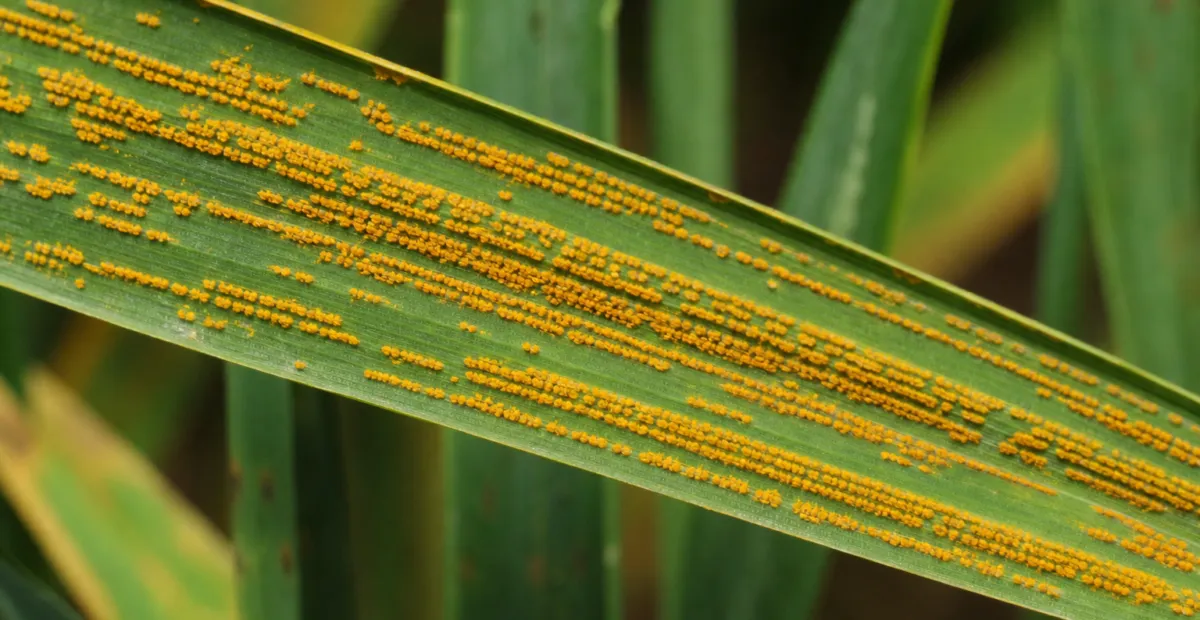
Wheat stripe rust, also called yellow rust, is a cool-weather fungal disease caused primarily by Puccinia striiformis f. sp. tritici. It produces yellow to orange, powdery pustules arranged in narrow stripes on wheat leaves and sometimes heads. Early infection can reduce photosynthesis, grain filling, and yield, especially on susceptible cultivars during cool, moist spring weather.
Typical conditions
Overview
Wheat stripe rust, also known as yellow rust, is caused mainly by Puccinia striiformis forma specialis tritici. It is an important disease of winter and spring wheat in the United States, particularly in the Pacific Northwest, California, and other regions where wheat develops during cool, moist weather. Disease importance varies by cultivar, pathogen race, planting season, and local weather.
The disease can attack leaves, leaf sheaths, glumes, awns, and occasionally other parts of the wheat head. Severe early infections reduce green leaf area and may cause shriveled grain, lodging, or substantial yield loss. Infection of the flag leaf and upper leaves is especially damaging because these tissues contribute heavily to grain filling.
Symptoms and identification
The first symptoms are small, pale green to yellow flecks that enlarge into narrow, yellow to orange, powdery pustules. Pustules usually occur in parallel rows or stripes along the length of wheat leaves, although patterns may be less regular on older or resistant tissue.
- Yellow-orange uredinia arranged in linear stripes on leaves.
- Powdery spores that rub off onto fingers or clothing.
- Lesions and pustules on leaf sheaths, glumes, awns, and occasionally the spike.
- Premature leaf yellowing, drying, and loss of photosynthetic area.
- Stunting or reduced tillering after severe early infection.
- Reduced kernel size and grain filling when upper leaves or heads are heavily infected.
Stripe rust can resemble nutrient streaking or other cereal rusts. The orderly yellow pustule stripes and cool-season development are useful diagnostic clues, but laboratory or extension confirmation may be needed when symptoms are atypical.
Causes and spread
The disease is caused by specialized populations of Puccinia striiformis. In wheat, the principal pathogen is P. striiformis f. sp. tritici; related formae speciales can attack other grasses and barley. Different races vary in which wheat resistance genes they can overcome.
Wind-dispersed urediniospores spread the disease between plants and fields. Spores landing on wet, susceptible foliage germinate and penetrate the leaf. New pustules then produce additional spores, allowing rapid secondary spread when weather remains favorable. Volunteer wheat, fall-seeded crops, infected crop residues, and nearby susceptible cereals can help maintain local inoculum, although long-distance wind transport is also important.
Barberry species have been demonstrated as an alternate host for some populations of the stripe rust fungus, but the epidemiological importance of this sexual cycle differs by region and is not a sufficient basis for diagnosing or managing every US wheat outbreak.
Life cycle and persistence
Under suitable conditions, urediniospores germinate on wet wheat foliage and infect through natural openings or directly through the epidermis. A latent period follows, after which yellow-orange uredinia erupt through the leaf surface and release more urediniospores. Several repeating infection cycles may occur during one growing season.
As plants mature or conditions become less favorable, the pathogen can produce darker telia containing teliospores. Teliospores may germinate to produce basidiospores. Sexual stages involving barberry have been documented, but recurring epidemics in US wheat are commonly driven by clonal urediniospore spread, infected volunteer wheat, and survival in regions with suitable temperatures.
Stripe rust develops more rapidly than many other wheat rusts because it is favored by relatively low temperatures. Sporulation slows or stops during hot, dry weather but may resume after cool, moist conditions return.
Treatment and control
Begin with accurate diagnosis and timely scouting. Fungicide decisions should consider cultivar resistance, disease incidence and severity, wheat growth stage, weather forecasts, yield potential, and the value of protecting the flag leaf and upper canopy.
In commercial wheat, a labeled foliar fungicide may be justified when stripe rust is actively increasing and conditions favor continued development. Applications are generally most useful before extensive upper-canopy damage occurs; late treatment cannot restore already killed leaf tissue. Follow current state extension guidance for thresholds, timing, product restrictions, preharvest intervals, and resistance-management recommendations.
For home or small garden plantings of wheat, removing volunteer wheat and heavily infected plants can reduce local inoculum, but it will not prevent spores arriving from neighboring fields. Resistant varieties and good airflow are usually more practical than repeated spraying.
Low-impact and biological control
No reliable curative organic treatment eliminates established stripe rust from infected wheat tissue. The strongest nonchemical approach is prevention through resistant cultivars, crop rotation, volunteer-wheat control, canopy drying, and early removal of isolated infected plants where feasible.
- Choose resistant cultivars suited to the local US production region.
- Destroy volunteer wheat and manage grassy hosts that are maintaining disease near the crop.
- Avoid overhead irrigation and irrigate early enough for foliage to dry quickly.
- Improve air movement by avoiding excessive plant density and nitrogen-driven lush growth.
- Use approved organic fungicide products only when the product label specifically allows the crop and disease; efficacy is often inconsistent compared with genetic resistance and professionally timed conventional programs.
Prevention
Use an integrated strategy centered on host resistance and field monitoring.
- Plant locally adapted wheat cultivars with strong, currently recommended stripe-rust resistance. Resistance ratings can change as pathogen races change, so consult current state variety trials and extension recommendations.
- Scout winter wheat in spring and spring wheat soon after emergence, concentrating on lower leaves first and then the flag leaf and upper canopy.
- Control volunteer wheat and avoid allowing infected volunteer plants to bridge the period between crops.
- Use locally appropriate planting dates and avoid practices that create excessively dense, lush canopies.
- Maintain balanced fertility; excessive nitrogen can produce dense, succulent growth that favors disease development.
- Manage irrigation to reduce unnecessary leaf wetness and improve canopy drying.
- Remove or incorporate heavily infected crop residues where practical, while recognizing that windborne spores may arrive from outside the field.
- Report unusual or rapidly spreading outbreaks to the local county extension office or state small-grain disease specialist.
Interesting facts
- The common names stripe rust and yellow rust describe the characteristic linear arrangement and yellow-orange color of the pustules.
- Stripe rust is favored by cooler temperatures than wheat leaf rust and stem rust, so it can become important early in the season.
- The wheat pathogen is divided into races that differ in virulence; a cultivar considered resistant in one year or region may become susceptible when the pathogen population changes.
- Puccinia striiformis is a species complex containing host-specialized forms, including pathogens of wheat, barley, and other grasses.
- Under suitable conditions, repeated urediniospore cycles can produce rapid field-level spread from a few initial infection sites.
Use only fungicides legally authorized in the United States for stripe rust on the specific crop and site, and follow the current product label exactly, including rate, timing, personal protective equipment, preharvest interval, rotational restrictions, and resistance-management instructions. Product registrations and labels can change; verify current federal and state requirements before application. Do not use pesticides labeled only for ornamental plants, another rust disease, or another crop.