
Yellow Plum Sawfly
Hoplocampa flava (Linnaeus)Yellow Plum Sawfly overview
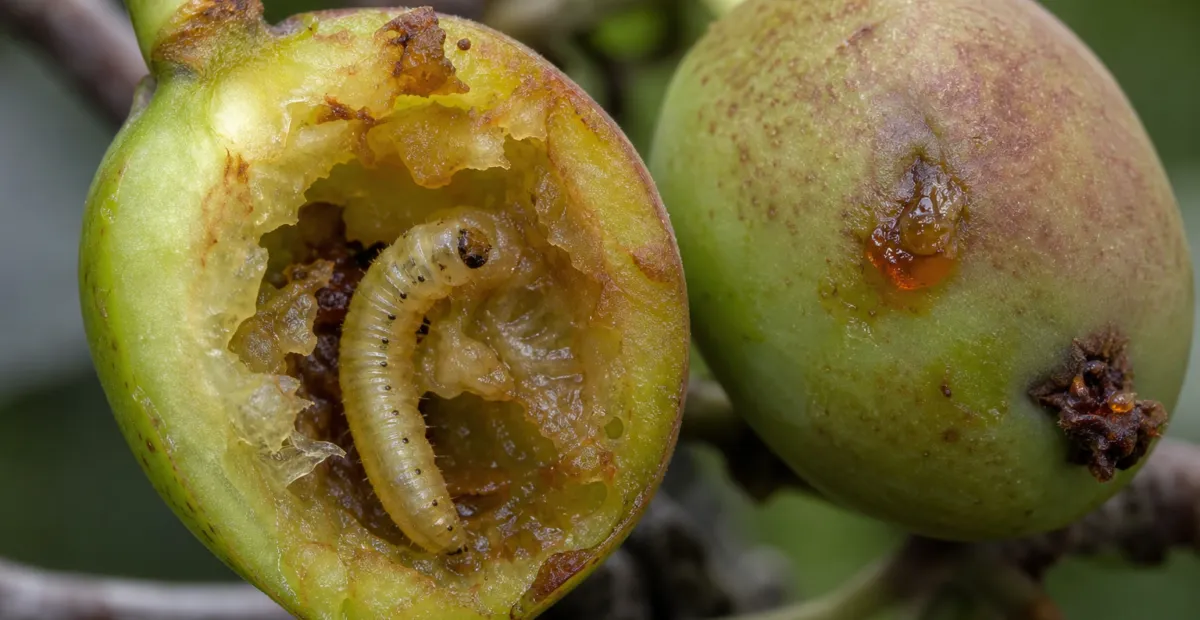
The yellow plum sawfly, Hoplocampa flava, is a fruit-damaging sawfly associated primarily with European plum and myrobalan plum. Adults appear around plum bloom, and larvae enter newly developing fruit, often causing gum exudation, internal seed feeding, fruit distortion and premature fruit drop. Confirming the larva inside affected fruit is important because plum fruit moth and other pests can produce similar symptoms.
Typical conditions
Overview
Hoplocampa flava is a sawfly in the family Tenthredinidae, not a true fly and not a caterpillar. Adults resemble small, broad-waisted wasps and are active around plum bloom. Females insert eggs into plum flowers or the calyx of developing fruit. After hatching, larvae tunnel into young fruit and feed internally, commonly around the seed.
Reports consistently associate this species with European plum and myrobalan plum. Some older or secondary references mention other Prunus hosts, but host records can be confused with the closely related black plum sawfly, Hoplocampa minuta, so broader host claims should be treated cautiously.
Symptoms and identification
- Small, misshapen or prematurely yellowing fruitlets shortly after bloom.
- Amber or translucent gum exuding from a feeding wound or fruit surface.
- Internal tunnels and feeding around the developing seed when fruit is cut open.
- Premature fruit drop, sometimes with a small exit hole or frass.
- Larvae are pale or whitish, slightly curved, and sawfly-like, with several pairs of abdominal prolegs rather than the fewer prolegs typical of moth caterpillars.
Symptoms overlap with plum fruit moth and other fruit-infesting insects. Cut open several affected fruitlets and retain the larva for expert identification when possible.
Causes and spread
Damage is caused by larval feeding after eggs are laid in plum flowers. Adult activity and egg-laying are concentrated around bloom, while larvae spread locally by moving from flowers into nearby fruitlets. Mature larvae leave infested fruit and enter the soil, where they form a cocoon or remain in a resting stage. Movement of infested nursery stock, soil or fruit could aid long-distance spread, although the principal orchard cycle is soil-to-tree-to-soil.
Life cycle and persistence
Most sources describe one generation per year. Adults emerge from soil cocoons in spring, generally coinciding with flowering of early plum cultivars. Females feed on pollen or nectar and lay eggs in flowers or at the fruit calyx. Larvae hatch after bloom, enter young fruit and may damage several fruitlets during development. Mature larvae exit fallen or damaged fruit and burrow into the soil, where they remain through the summer and winter before pupating and emerging the following spring. Emergence timing varies with temperature, cultivar bloom date and local conditions.
Treatment and control
Management is most effective before larvae enter fruit. Scout during bloom and immediately after petal fall, record adult activity and fruitlet injury, and base any intervention on local crop value, confirmed identification and the treatment threshold used by the grower’s state extension program. Once larvae are protected inside fruit, contact treatments are generally less reliable.
For home orchards, remove and dispose of damaged fruit, improve monitoring in the following spring and avoid unnecessary broad-spectrum sprays that can harm pollinators and natural enemies. In commercial orchards, coordinate timing with bloom, pollinator protection requirements and integrated management of other plum pests.
Low-impact and biological control
- Sanitation is the most practical low-risk measure: promptly remove fallen and infested fruit before mature larvae exit.
- Entomopathogenic nematodes, including some Steinernema and Heterorhabditis species, have shown experimental potential against exposed plum sawfly stages in soil, but performance depends strongly on timing, moisture, formulation and application volume. Use only products registered and labeled for the intended site and pest.
- Conserve parasitoids, predatory insects and pollinators by avoiding unnecessary insecticide applications and by using selective, properly timed measures.
- Physical monitoring and removal are more useful against this fruit-internal pest than relying on general-purpose biological products without verified label claims.
Prevention
- Monitor plum trees closely from the green-tip and pink-bud stages through petal fall and early fruit development.
- Use appropriately timed white sticky blossom traps or other locally validated monitoring methods where available; distinguish H. flava from other plum sawflies.
- Collect and destroy infested, prematurely dropped fruit before larvae leave it. Do not compost suspect fruit unless the pile reliably reaches pest-killing temperatures.
- Remove volunteer plum and myrobalan seedlings near production trees when they serve as unmanaged reservoirs.
- Inspect nursery plants and avoid moving soil or plant material from infested orchards.
- Maintain an open, accessible canopy so bloom and fruitlet inspections are practical, while preserving flowering resources for pollinators outside intervention windows.
Interesting facts
- Hoplocampa flava is a sawfly, so its larva resembles a caterpillar but has the characteristic sawfly arrangement of abdominal prolegs.
- A single larva may damage multiple young fruitlets as it moves between feeding sites.
- The pest spends most of its annual cycle in the soil rather than on the tree.
- Yellow and black plum sawflies can occur together and are easily confused in orchard monitoring.
- The species is well documented in Europe and surrounding Palearctic regions, whereas U.S. records and practical significance are less clearly established than those of some other introduced sawflies.
Use only insecticides legally authorized for plum, the target sawfly or the specific crop-pest combination in the United States and in your state. Follow the current product label exactly, including rate, timing, preharvest interval, reentry interval, resistance-management instructions and pollinator protections. Do not spray open blooms when bees or other pollinators are foraging unless the label specifically permits the application under stated conditions.