
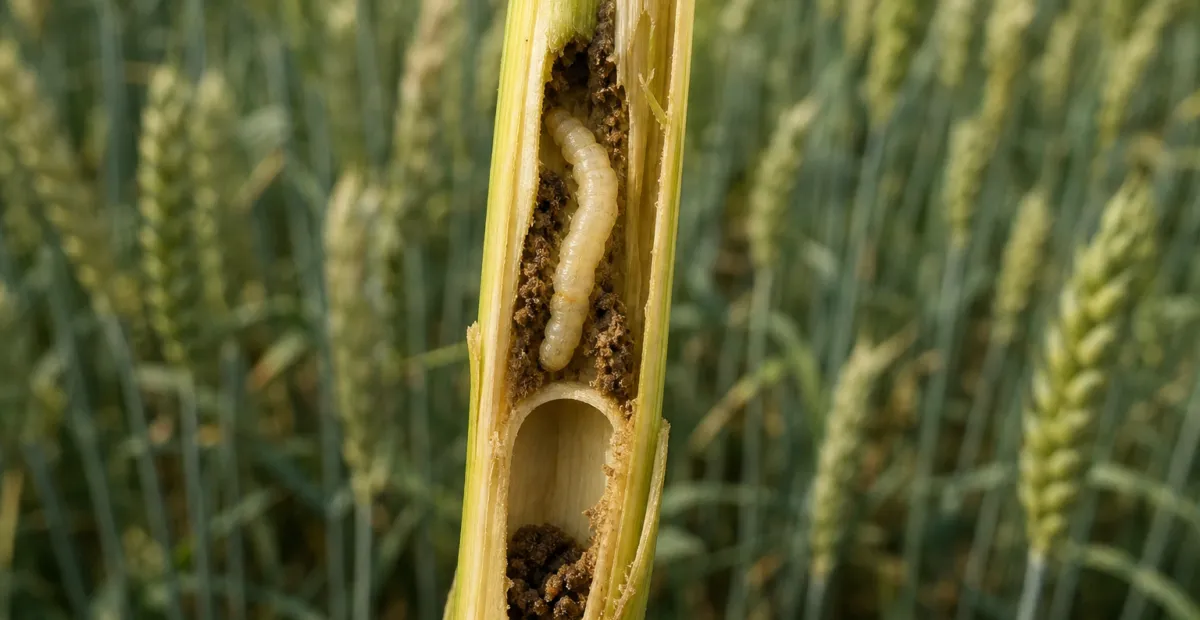
European Wheat Stem Sawfly
Cephus pygmaeus (Linnaeus)European Wheat Stem Sawfly overview
The European wheat stem sawfly, Cephus pygmaeus, is an introduced stem-boring pest of wheat and other grasses in parts of eastern North America. Larvae feed inside cereal stems, disrupt water and nutrient movement, and eventually girdle the lower stem, causing lodging or pale, poorly filled heads. Identification can be difficult because related stem sawflies cause similar injury, so inspect stems and larvae rather than relying on lodging alone.
Typical conditions
Overview
The European wheat stem sawfly is a hymenopteran pest in the family Cephidae. Adults are slender, dark sawflies with conspicuous yellow abdominal markings; the damaging stage is the legless larva, which lives inside grass and cereal stems.
In the United States, documented populations occur mainly in the East, including records from the mid-Atlantic region. It was introduced to North America and historically damaged small grains, but established parasitoids have reduced its importance in some areas. Similar injury from Cephus cinctus or Trachelus species is possible, especially where several stem sawflies occur.
Symptoms and identification
Early infestations are usually hidden inside the stem. Split stems may contain frass, feeding galleries and a pale yellowish larva with a relatively large brown head. As feeding progresses, vascular tissues and the stem interior are damaged.
- Prematurely pale or whitish heads above an injured stem.
- Reduced grain filling or shriveled kernels.
- Weak, broken or lodged stems, often near the lower internodes.
- A clean internal girdle or groove made by the mature larva before overwintering.
- Short basal stubs or cut stems after the larva separates the upper stem from its overwintering chamber.
Do not diagnose from lodging alone. Open several symptomatic stems and inspect for frass, galleries, a larval chamber and the larva or remains.
Causes and spread
Spread and persistence are favored when susceptible cereals or large-stemmed grasses are grown continuously and infested basal stems remain in the field. Volunteer wheat, barley or rye and nearby wild or cultivated grasses can provide additional breeding sites. Adults are weak fliers but can move between suitable stems, especially along field edges.
Infested straw, stubble and transplanted grass material can transport concealed larvae. Because the larva is protected inside the stem, visible adult numbers may underestimate the following season’s risk.
Life cycle and persistence
Cephus pygmaeus normally has one generation per year. Adults emerge in spring, usually as cereal and grass stems approach heading. Females use a saw-like ovipositor to insert generally one egg into a suitable stem; an individual female may lay several dozen eggs.
Larvae hatch after roughly one to two weeks and feed within the stem, moving through the pith and producing frass. The mature larva descends toward the stem base, cuts an internal groove and plugs the chamber. It overwinters in diapause near or below the soil surface, then pupates before adult emergence the following season. Exact timing varies with host growth, temperature and region.
Treatment and control
There is no reliable home-garden rescue treatment once larvae are established inside stems. In a small planting, remove and discard infested or lodged stems before adult emergence, then clean up basal stubble after harvest.
In commercial cereal production, management decisions should be based on confirmed species, stem infestation sampling, crop stage and local extension recommendations. Foliar insecticides generally have limited value against larvae protected within stems, and preventive applications can harm beneficial insects without providing dependable control. Consult the crop adviser or state extension service before any intervention.
Low-impact and biological control
For gardens, small grain plots and organic production, rely on prevention and destruction of infested material rather than attempting to treat larvae hidden inside stems.
- Harvest promptly when grain maturity permits, before mature larvae complete their basal girdling.
- Remove or thoroughly destroy infested cereal stems and stubble after harvest; do not retain suspicious straw for mulch or seedling support.
- Rotate out of wheat, barley and rye when practical, particularly where repeated lodging has occurred.
- Control volunteer cereals and heavily infested grassy weeds around planting areas, while avoiding unnecessary destruction of diverse field-margin habitat that supports parasitoids.
- Use locally adapted cultivars with stronger or solid stems when appropriate and available; resistance performance is crop- and cultivar-specific.
- Encourage naturally occurring parasitoids by reducing broad-spectrum insecticide use and maintaining flowering resources nearby.
Prevention
Inspect cereal stems regularly from late spring through heading, concentrating first on field edges and areas next to grassy margins. Split a representative sample of stems to look for larvae, frass and galleries rather than relying only on adult sightings.
- Rotate susceptible cereals with nonhost crops where production systems allow.
- Manage volunteer cereals and heavily infested grassy weeds before the next sawfly flight.
- Harvest without unnecessary delay once grain moisture and quality targets are met.
- Destroy or deeply incorporate infested stubble where appropriate for the soil, erosion and conservation plan.
- Record infestation hotspots so future plantings can avoid repeatedly affected sections.
Interesting facts
- The scientific name is also frequently encountered in older or informal sources as Cephus pygmeus; Cephus pygmaeus is the accepted spelling used in current agricultural references.
- Most of the insect’s life is concealed inside a grass stem, which makes scouting and pesticide timing difficult.
- European parasitoids, including Collyria calcitrator and Bracon terebella, were introduced in North America and became associated with suppression of this species.
- The pest is not interchangeable with the native western wheat stem sawfly, Cephus cinctus, which is the more important economic species in much of the northern Great Plains.
Use insecticides only if a product is legally authorized and specifically labeled for the target crop and this pest in your U.S. state. Follow the current label exactly, including crop, rate, timing, worker-protection, pollinator and preharvest requirements. Because larvae are protected inside stems, foliar treatments are often poorly timed or ineffective; do not apply an unverified pesticide program.