
Tomato spotted wilt virus
Orthotospovirus tomatomaculae (tomato spotted wilt virus; TSWV)Tomato spotted wilt virus overview
Tomato spotted wilt virus is a serious, thrips-transmitted disease that can stunt or kill young tomato plants and blemish fruit with rings, blotches and uneven ripening. Symptoms overlap with other viruses, herbicide injury and fungal or bacterial problems, so laboratory confirmation is often needed. In the United States, prevention depends on clean transplants, resistant cultivars where suitable, weed control and early thrips-focused IPM.
Typical conditions
Overview
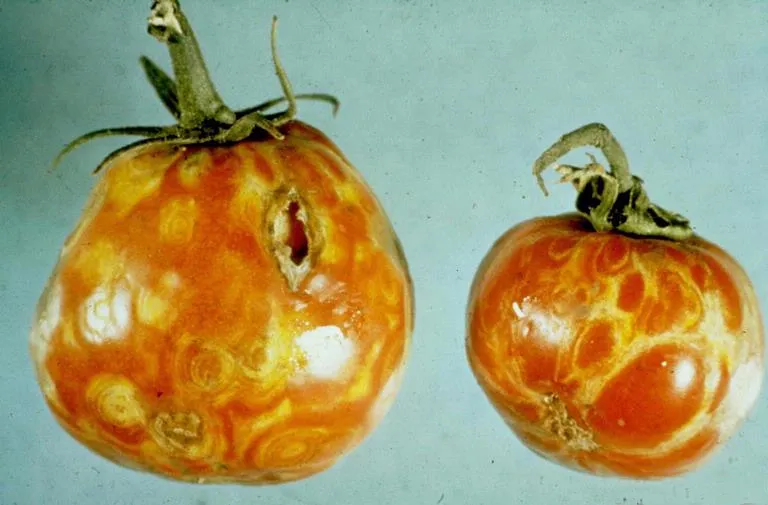
TSWV can infect tomatoes and many other vegetable, agronomic, ornamental and weed hosts. On tomato, the disease is often most destructive when plants are infected young. Plants may become stunted, bronzed, spotted, wilted or die back, while fruit can develop chlorotic blotches, raised or depressed rings and uneven coloration.
Symptoms can resemble other viruses, thrips injury, herbicide drift, nutritional stress or unrelated pathogens. Confirmation by a plant disease diagnostic laboratory or validated immunoassay is recommended, particularly before saving plants or making costly treatments.
Symptoms and identification
- Bronzing, yellowing or purplish discoloration on young upper leaves.
- Small necrotic spots, ring patterns, veinal or shoot-tip necrosis and downward cupping.
- Stunting, dieback, uneven growth or progressive wilt; early infections can kill seedlings and young plants.
- Fruit may show pale or yellow blotches, concentric rings, raised or depressed areas, uneven ripening and reduced market quality.
- Thrips feeding may occur at the same time, producing silvery scarring, distorted growth and tiny dark fecal specks.
Symptoms alone are not diagnostic. Confirm suspected cases through a state plant clinic, university diagnostic laboratory or another qualified testing service.
Causes and spread
The disease is spread primarily by infected thrips, including western flower thrips (Frankliniella occidentalis), onion thrips (Thrips tabaci) and, in some U.S. regions, chili thrips (Scirtothrips dorsalis). Thrips acquire the virus as immature stages and transmit it while feeding as adults.
Important reservoirs include infected tomatoes, peppers, lettuce, peanuts, tobacco, onions, ornamentals, volunteer plants and weeds. Movement of infested transplants, contaminated plant material and thrips on clothing or equipment can aid introduction. TSWV is not spread as a typical soilborne disease and is not normally passed through seed.
Life cycle and persistence
TSWV is acquired by immature thrips while feeding on infected plants. After the virus replicates inside the insect, infected adults can transmit it for the rest of their lives; the virus is not normally passed through the thrips egg to offspring. Adults move among plants by short flights and wind-assisted movement, while thrips may be transported on transplants, clothing and plant material.
The virus multiplies and moves systemically through susceptible plants. Infected weeds, volunteer crops, ornamentals and older crop residue can maintain the disease cycle between plantings. The complete thrips life cycle commonly takes about 30–45 days, but can be shorter under favorable conditions.
Treatment and control
No treatment reverses TSWV infection. Remove and destroy infected plants, especially seedlings and plants with early systemic symptoms, to reduce sources for additional thrips acquisition. Do not expect pruning, fertilizer, fungicides or antibiotics to restore infected tissue.
If infection is detected early and thrips are present, an IPM program aimed at reducing vector movement may limit secondary spread, but it cannot reliably cure infected plants or eliminate incoming viruliferous thrips. Replant only with clean material after addressing nearby reservoirs and sanitation. Submit representative samples for laboratory confirmation when symptoms are uncertain or resistance appears to have failed.
Low-impact and biological control
- Buy inspected, virus-free transplants from suppliers that manage thrips and avoid plants showing bronzing, rings, stunting or unexplained wilt.
- Remove and bag severely symptomatic young plants promptly; do not compost diseased tomato plants or nearby infected host weeds in a home compost pile.
- Control susceptible weeds in and around the planting, especially flowering weeds that can support thrips and TSWV.
- Use insect-exclusion screening, clean propagation areas and careful sanitation in greenhouses.
- Monitor thrips with sticky cards and flower or foliage inspections; preserve beneficial predators where possible and avoid unnecessary broad-spectrum sprays.
- Reflective mulch may reduce thrips landing and virus spread in some vegetable systems, although results are variable and it is not a stand-alone control.
Prevention
- Choose tomato cultivars carrying documented TSWV resistance, such as Sw-5 types, when adapted varieties are available; resistance is not absolute because resistance-breaking isolates occur.
- Start with virus- and thrips-free transplants. Inspect young plants, flowers and growing points before purchase and planting.
- Avoid establishing tomatoes beside known infected tomato, pepper, lettuce, peanut or ornamental crops when practical.
- Remove flowering weeds and volunteer host plants before planting and throughout the season, while avoiding actions that simply drive thrips into the crop.
- Scout early and regularly using sticky cards plus direct inspection of flowers and young foliage.
- In greenhouses, use screened vents, clean stock, weed-free surroundings and controlled entry; isolate new plant material before it enters production.
- Remove crop debris and volunteer plants promptly after harvest to reduce local virus and vector reservoirs.
Interesting facts
- TSWV infects more than 1,000 reported plant species across numerous plant families, including both broadleaf plants and grasses.
- The virus is not normally seed-transmitted, but infected plant material and infected thrips can introduce it to new sites.
- Only immature thrips acquire TSWV efficiently; adults are the principal stage that spreads it between plants.
- The tomato resistance gene Sw-5 has been valuable in management, but resistance-breaking TSWV strains have been documented, including recent reports from the southeastern United States.
- Because symptoms overlap with several disorders, a visual diagnosis should be treated as provisional.
There is no pesticide that cures an infected tomato plant or eliminates the virus. Use insecticides against thrips only when justified by monitoring, and only products legally authorized for the crop and problem in your state or country. Follow the current product label, including crop, rate, timing, reentry and harvest restrictions; rotate effective modes of action to reduce resistance. In field crops, insecticides alone may not prevent transmission because thrips can transmit the virus before they are killed.
Affected plants
The plants below are linked to this problem by structured host-plant data. The list updates automatically as new plant profiles are added.
 Onion (Allium cepa) care guideAllium cepa
 Allium christophii care guideAllium christophii
 Bunching onion (Allium fistulosum) care guideAllium fistulosum
 Giant Allium (Allium giganteum) care guideAllium giganteum
 Ornamental onion (Allium) care guideAllium
 Garlic (Allium sativum) care guideAllium sativum
 Chives (Allium schoenoprasum) care guideAllium schoenoprasum
 Ransoms (Allium ursinum) care guideAllium ursinum
 Solanum aethiopicum care guideSolanum aethiopicum
 Solanum macrocarpon care guideSolanum macrocarpon
 Eggplant (Solanum melongena) care guideSolanum melongena
 Garden Huckleberry (Solanum scabrum) care guideSolanum scabrum