
Grape Anthracnose (Bird’s-Eye Rot)
Elsinoë ampelinaGrape Anthracnose (Bird’s-Eye Rot) overview
Grape anthracnose, also called bird’s-eye rot or grapevine black spot, is a fungal disease caused by Elsinoë ampelina. It attacks young green tissues during wet spring and summer weather, producing sunken gray-centered lesions on shoots, leaves, clusters, and berries. Severe infections can kill shoots, defoliate vines, destroy fruit, and reduce ripening and winter survival.
Typical conditions
Overview
Grape anthracnose is most damaging in humid grape-growing regions, especially where spring and summer rainfall keeps young vine tissue wet. In the United States it is particularly important in the eastern half of the country and in other regions with frequent rain during the growing season; dry western climates are generally less favorable.
The disease can reduce yield directly through berry infection and indirectly through shoot injury, cluster loss, and defoliation. Diagnosis is strongest when the characteristic lesions occur together on several grapevine parts. Hail injury, black rot, Phomopsis, bacterial diseases, and other fruit rots can resemble some symptoms, so laboratory confirmation may be appropriate when management decisions are consequential.
Symptoms and identification
Leaves: Small circular brown, reddish-brown, or black spots develop gray centers and dark margins. Dead centers may fall out, producing ragged shot holes. Young leaves can become distorted.
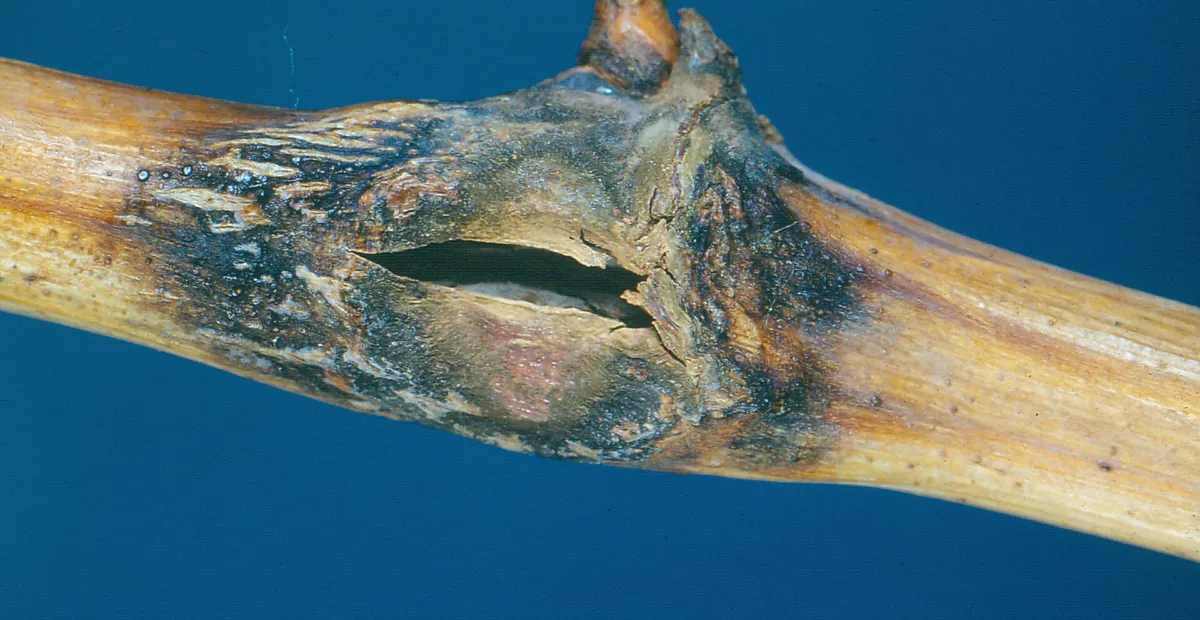
Shoots, petioles, tendrils, and rachises: Lesions are often sunken, with gray or gray-white centers and raised reddish-brown to black margins. Numerous or merging lesions can girdle young shoots, causing stunting, distortion, dieback, or death.
Berries: Small reddish-brown circular spots enlarge into slightly sunken lesions, commonly about 3/16–1/4 inch across. Gray centers surrounded by dark margins create the characteristic bird’s-eye appearance. Berries may crack, shrivel, become misshapen, mummify, or drop from the cluster.
Causes and spread
Elsinoë ampelina survives primarily in infected woody tissue, cankers, and sometimes mummified berries from the previous season. During wet weather, the pathogen produces conidia that are spread short distances by rain splash, dripping water, and contact with wet plant surfaces. Repeated infections can arise from lesions and cankers throughout the season.
New infections are most likely when susceptible green tissue remains wet for extended periods. Dense canopies, poor air circulation, overhead irrigation, frequent rainfall, and retained diseased wood increase risk. The fungus is not spread like an insect pest and is not caused by a nutrient deficiency.
Life cycle and persistence
The pathogen overwinters in dense fungal tissue in infected grape canes and related woody lesions. In spring, after sufficient wetting and temperatures above about 36°F, overwintering structures can produce abundant conidia. Rain or dew carries the spores onto young grape tissues, where they germinate in free moisture and penetrate susceptible surfaces.
Under very warm conditions, symptoms may appear in roughly four days; under cool conditions, symptom development can take up to about two weeks. Lesions on canes can produce additional spores during wet periods, creating multiple infection cycles from spring through the growing season.
Treatment and control
Prune out visibly infected woody tissue during dormancy or when practical during the growing season, cutting well below active lesions and disinfecting tools between vines when disease is severe. Dispose of infected material away from the planting. Remove heavily diseased berries and clusters if this can be done without spreading wet tissue through the canopy.
Correct canopy congestion promptly, improve drainage and irrigation practices, and protect new growth before infection periods when the disease is historically persistent. Fungicides are most effective preventively or at the earliest stages of disease development; they cannot restore dead tissue or reliably cure established lesions. Follow a current regional grape disease-management guide for timing and resistance-management decisions.
Low-impact and biological control
Use sanitation, dormant removal of infected wood, removal of mummified berries, and aggressive canopy drying as the primary low-input measures. Choose less susceptible grape cultivars when available and maintain balanced vine vigor without excessive nitrogen that produces a dense, slow-drying canopy.
Some copper- or sulfur-based products may be permitted in particular U.S. organic production systems, but legality, crop labeling, formulation, and potential phytotoxicity vary. Use only products listed by the Organic Materials Review Institute or otherwise permitted under the applicable organic standard, and follow the product label and local extension guidance.
Prevention
- Select cultivars and planting sites suited to the local disease climate; avoid highly susceptible cultivars where grape anthracnose is a recurring problem.
- During dormant pruning, remove infected canes, cankers, and mummified fruit. Remove prunings from the vineyard or garden rather than leaving them beneath the trellis.
- Train and prune vines to improve air movement and sunlight penetration. Maintain an open canopy so leaves, shoots, and clusters dry quickly after rain.
- Use drip irrigation where practical and avoid wetting foliage. Space vines appropriately and control dense surrounding vegetation.
- Monitor young shoots and clusters after rainy periods, especially from bud break through early fruit development, when tissues are most vulnerable.
Interesting facts
- The common name bird’s-eye rot refers to the gray-centered, dark-edged spots on grape berries.
- On leaves, the dead centers of lesions may drop out, creating a shot-hole appearance that can be mistaken for insect feeding.
- Hail injury can resemble shoot anthracnose, but anthracnose lesions typically develop raised dark margins and gray centers.
- Grape anthracnose is caused by a host-associated Elsinoë fungus; reports of wider host associations exist, but host specificity and species limits in the genus are still being refined.
- Severe disease can reduce fruit sugar accumulation by damaging leaves as well as destroying berries and flower clusters.
Use only fungicides legally authorized and currently labeled for grape anthracnose or the relevant grape disease use in your state and country. Follow the current label exactly, including crop, rate, preharvest interval, reentry interval, application timing, protective equipment, and resistance-management instructions. Product registrations and labels change; consult your state Extension grape disease guide or licensed crop adviser before treatment.