
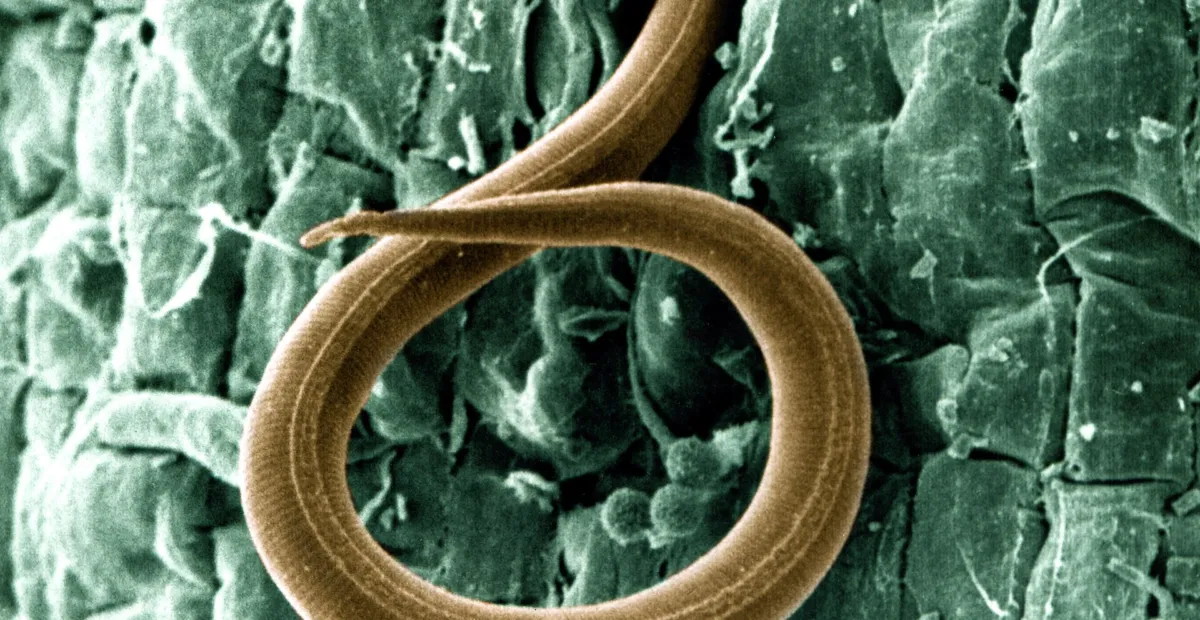
Southern root-knot nematode
Meloidogyne incognitaSouthern root-knot nematode overview
The southern root-knot nematode, Meloidogyne incognita, is a microscopic soil-dwelling pest that invades plant roots and induces characteristic galls. Infested plants may wilt during hot weather, remain stunted, yellow, and produce smaller crops despite adequate irrigation and fertilization. It is especially damaging in warm regions and sandy or coarse-textured soils.
Typical conditions
Overview
The southern root-knot nematode is a sedentary endoparasitic nematode of roots. Juveniles enter young roots and stimulate the formation of enlarged feeding cells and visible swellings, or galls. Aboveground injury can resemble drought, nutrient deficiency, or vascular disease, so species-level confirmation requires representative soil and root samples examined by a qualified diagnostic laboratory.
M. incognita is widespread in the southern United States and may occur in mixed populations with other root-knot species. A tomato variety resistant to some root-knot nematodes is not automatically resistant to every species or population.
Symptoms and identification
- Irregular, swollen galls on fine and lateral roots; roots may be shortened, branched abnormally, or otherwise poorly developed.
- Stunting, loss of vigor, pale or yellow foliage, and reduced leaf and fruit production.
- Wilting during the hottest part of the day even when soil moisture is adequate.
- Poor response to watering or fertilizer because damaged roots cannot efficiently absorb water and nutrients.
- Symptoms often occur in irregular patches, especially in warm, coarse-textured soil.
Root galls are suggestive but not conclusive: other root injuries and beneficial legume nodules can be confused with them. Wash roots gently and seek laboratory confirmation when the species or management decision matters.
Causes and spread
Spread occurs mainly through movement of infested soil, roots, transplants, tools, equipment, footwear, animals, and contaminated growing media. Surface runoff and irrigation water can move nematode-infested soil to nearby beds. Many weeds and cultivated crops can support reproduction, allowing populations to persist during fallow periods or rotations that are not truly nonhost rotations.
Warm soil favors activity and reproduction. Damage is generally greater where plants experience additional stress from drought, poor nutrition, root disease, compaction, or excessive crop density.
Life cycle and persistence
Eggs are deposited in a gelatinous matrix on or near infected roots, and may also remain in soil with root debris. The infective second-stage juvenile hatches, migrates through soil, and penetrates a young root. It becomes sedentary, induces specialized feeding cells, and develops through later juvenile stages into a swollen female or, under some conditions, a vermiform male.
Females produce eggs without requiring mating in many populations. Under warm conditions, one generation can be completed in roughly 3–6 weeks, although timing varies with temperature, host, soil, and nematode population. Several generations may occur during a long warm growing season.
Treatment and control
There is no dependable curative treatment that removes M. incognita from established landscape plants. First confirm the diagnosis with a soil-and-root sample, then map affected patches if practical. Remove badly damaged annual plants and roots, dispose of them without transferring soil, and avoid replanting a susceptible host of the same genus in the same soil.
For gardens and small beds, combine resistant cultivars, strict weed control, sanitation, and a carefully planned nonhost rotation. Where climate and bed conditions permit, soil solarization during the hottest part of summer can reduce nematodes in the upper soil layer, but it is temporary and less reliable in cool, cloudy, deep, or poorly sealed soil. Commercial growers should use preplant sampling and local Extension recommendations to select crop-specific integrated management.
Low-impact and biological control
Use an integrated, nonchemical approach centered on clean planting material, resistant varieties, sanitation, weed removal, crop rotation, removal of infested roots, and summer soil solarization where feasible. Solarization works best in the upper soil profile when moist soil is tightly covered with clear plastic during sustained hot weather for the locally recommended duration.
Compost and organic amendments may improve plant vigor and sometimes suppress nematode damage, but they should not be treated as a guaranteed eradication method. Biological products and beneficial organisms can provide variable suppression depending on formulation, soil, crop, and population; use only products with credible local evidence and legal registration for the intended use.
Prevention
- Start with clean, healthy plants from reputable suppliers and use sterile or verified nematode-free potting media for containers.
- Do not move soil from infested beds to clean beds. Clean soil from tools, shoes, tillers, and equipment before leaving an infested area.
- Plant resistant or tolerant cultivars documented for M. incognita and the specific crop, while recognizing that resistance can vary by nematode population.
- Rotate with crops verified to be nonhosts for the confirmed species and local population; do not assume that any crop labeled “rotation” is nonhost.
- Control weeds, especially known root-knot hosts, throughout the season and during fallow periods.
- Remove severely infested annual plants and their roots after harvest. Avoid spreading infested soil with runoff or irrigation.
- Maintain uniform moisture, balanced fertility, and good soil structure to reduce stress, but understand that irrigation alone does not reduce nematode numbers.
Interesting facts
- M. incognita is one of the most economically important plant-parasitic nematodes worldwide and is a major pathogen of cotton and many vegetable crops.
- The root swelling is produced by altered plant cells that become a nutrient source for the nematode; the nematode itself is usually microscopic and hidden within the root.
- Some plants can host and support reproduction with little or no obvious galling, so clean-looking roots do not always prove that a crop is a nonhost.
- Root-knot resistance is species- and population-dependent. Populations capable of reproducing on resistant tomato varieties can develop or be selected in some fields.
- Galls caused by root-knot nematodes are true root swellings, whereas nitrogen-fixing nodules on bean roots commonly detach or rub off more easily.
Chemical nematicides are highly crop-, site-, state-, and label-specific and may have significant worker, environmental, and regulatory restrictions. Use only products legally authorized for the specific crop and problem in your country and state, and follow the current label exactly, including application method, personal protective equipment, reentry interval, preharvest interval, and disposal requirements. Do not apply a product solely because it is labeled for another nematode, crop, or location.
Affected plants
The plants below are linked to this problem by structured host-plant data. The list updates automatically as new plant profiles are added.
 Okra (Abelmoschus esculentus) care guideAbelmoschus esculentus
 He tepary bea (Phaseolus acutifolius) care guidePhaseolus acutifolius
 Snap bean (Phaseolus coccineus) care guidePhaseolus coccineus
 Butter bea (Phaseolus lunatus) care guidePhaseolus lunatus
 String Bean (Phaseolus vulgaris) care guidePhaseolus vulgaris
 Maroon cucumbe (Cucumis anguria) care guideCucumis anguria
 Horned Melon (Cucumis metuliferus) care guideCucumis metuliferus
 Cucumber (Cucumis sativus) care guideCucumis sativus
 Solanum aethiopicum care guideSolanum aethiopicum
 Solanum macrocarpon care guideSolanum macrocarpon
 Eggplant (Solanum melongena) care guideSolanum melongena
 Aibika (Abelmoschus manihot) care guideAbelmoschus manihot