
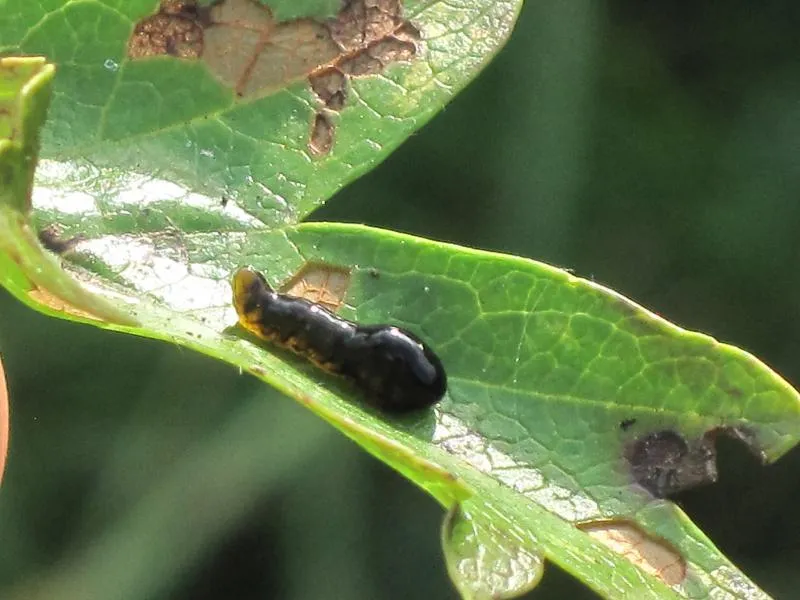
Pear sawfly (pear slug)
Caliroa cerasiPear sawfly (pear slug) overview
Pear sawfly, also called pear slug or cherry slug, is a foliage-feeding sawfly whose slimy larvae skeletonize leaves of pear, cherry, plum and related trees. The larvae are not true slugs: they are wasp relatives covered with an olive-green coating. Light infestations are usually tolerable, but repeated heavy feeding—especially by the second generation—can cause browning, premature leaf drop and reduced tree vigor.
Typical conditions
Overview
Pear sawfly is a non-native sawfly established in parts of the United States. Despite the common names pear slug and cherry slug, it is an insect rather than a mollusk. Adults are small, glossy, dark sawflies; the damaging stage is the slug-like larva.
Preferred hosts include pear and cherry, while plum, hawthorn, cotoneaster, mountain ash, serviceberry, quince and some related plants may also be attacked. Infestations are often sporadic, and healthy established trees can tolerate limited feeding.
Symptoms and identification
- Early feeding produces translucent or “windowpane” patches on the upper leaf surface.
- As feeding continues, tissue between the veins is removed, leaving a lacy skeletonized leaf.
- Heavily damaged leaves turn brown, shrivel and may drop prematurely.
- Larvae are up to about 1/2 inch long, broad toward the front, and covered with a shiny olive-green to black slime.
- Mature larvae may lose the slimy coating and appear yellowish or orange before dropping to the soil.
Feeding is easily confused with other slug sawflies or chewing insects, so confirm the larval appearance and host association before treatment.
Causes and spread
Damage is caused by larvae feeding on leaf epidermis and mesophyll between the veins. Adults insert eggs into small slits in the upper leaf surface. Larvae then develop on the foliage and later drop to the ground to pupate. Local spread mainly occurs when adults move between nearby host trees; movement of infested nursery stock or soil may also contribute to longer-distance spread.
Life cycle and persistence
Pear sawfly overwinters in the soil, usually as a mature larva or pupa within a cocoon. Adults emerge in spring or early summer, mate and insert eggs into leaves. Larvae feed for roughly two to three weeks before dropping to the soil. In much of the United States there are commonly two generations per year, with the second generation often more abundant or damaging. Timing varies with latitude, elevation, weather and accumulated heat units; larvae are commonly observed from early or midsummer into late summer.
Treatment and control
First confirm that the larvae are pear sawfly rather than a true slug, caterpillar or another slug sawfly. If only a small portion of the canopy is affected, hand-pick larvae or dislodge them with a firm stream of water directed at the foliage. Repeat monitoring and removal because a second generation may appear later in the season.
Consider treatment only when larvae are numerous, defoliation is progressing, or valuable young trees are at risk. Apply any permitted product when larvae are present and exposed; contact treatments are generally less useful after larvae have dropped to the soil.
Low-impact and biological control
For home gardens, hand removal and a strong water spray are practical first choices. Insecticidal soap or a product containing spinosad may be used only when the product is labeled for the crop and pest in the United States. Thorough coverage of exposed larvae is important, and repeat applications may be needed according to the label. Bt products used for caterpillars are not expected to control pear sawfly because sawflies are Hymenoptera, not moth or butterfly larvae.
Protect flowering plants and avoid unnecessary broad-spectrum applications to conserve predators and parasitoids that may help suppress sawfly populations.
Prevention
- Inspect susceptible trees weekly from early summer through late summer, concentrating on upper-canopy leaves.
- Maintain tree vigor with appropriate irrigation, mulching and pruning, while avoiding excessive nitrogen that promotes overly soft growth.
- Tolerate light damage because natural enemies and tree resilience often keep populations below damaging levels.
- Remove heavily infested fallen foliage where practical, but recognize that the principal immature stages develop in soil rather than inside leaves.
- Coordinate monitoring across nearby pear, cherry, plum and ornamental host plants because adults can move locally.
Interesting facts
- The “slug” is actually a sawfly larva related to wasps, bees and ants.
- The larval slime is responsible for the dark, wet, slug-like appearance.
- Adults are small wasps with a broader waist than many familiar wasps.
- The second generation commonly causes more visible injury than the first.
- Pear sawfly is distinct from pear fruit sawflies that attack developing fruit; similar common names can cause mistaken identification.
Use only pesticides legally authorized and currently labeled in the United States for the specific crop and pear sawfly or pear slug problem. Follow the current label exactly, including rates, timing, protective equipment, re-entry intervals, preharvest intervals and pollinator precautions. Product registrations and permitted crops can change; the label is the legal authority. Do not treat solely on the basis of minor cosmetic injury.
Affected plants
The plants below are linked to this problem by structured host-plant data. The list updates automatically as new plant profiles are added.
 Apple tree (Malus domestica) care guideMalus domestica
 Geranium ‘Blushing Turtle’Geranium 'Blushing Turtle'
 Geranium ‘Summer Skies’Geranium 'Summer Skies'
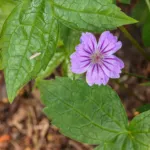 Knotted Crane’s-bill (Geranium nodosum) care guideGeranium nodosum
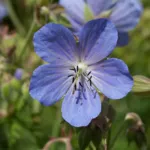 Meadow Geranium (Geranium pratense) care guideGeranium pratense
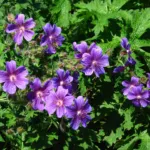 Geranium x magnificum (Geranium magnificum) care guideGeranium magnificum