
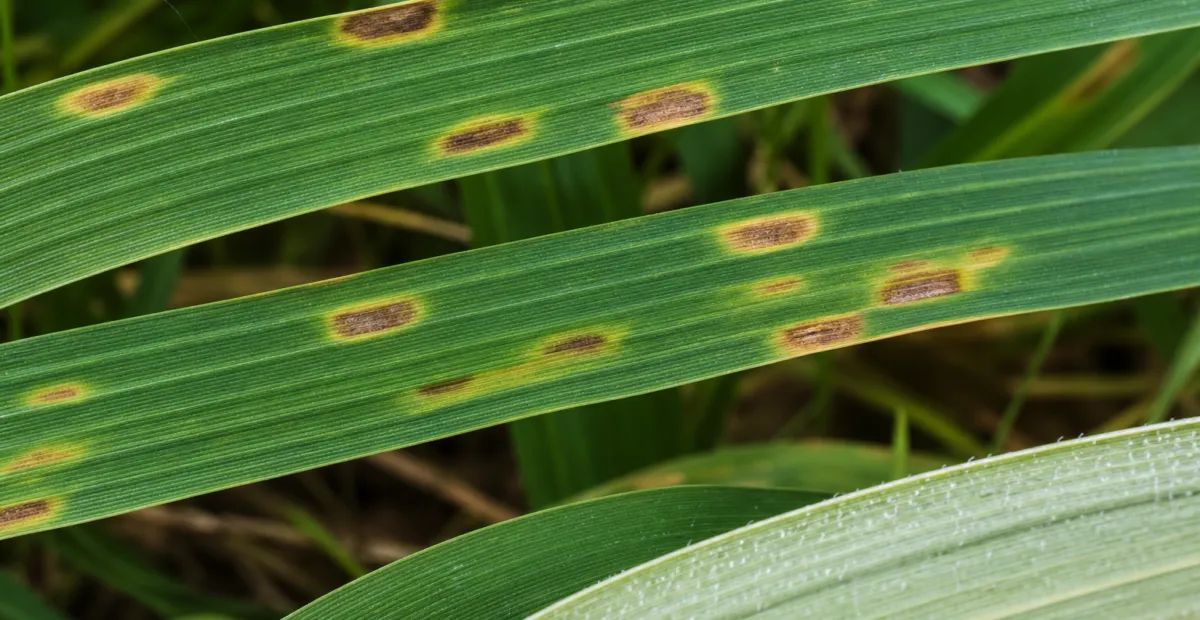
Ramularia leaf spot of barley
Ramularia collo-cygniRamularia leaf spot of barley overview
Ramularia leaf spot is a late-season fungal disease of barley caused by Ramularia collo-cygni. Infected plants may carry the fungus silently before flowering, then develop small reddish-brown, rectangular leaf lesions surrounded by yellow halos. Lesions can multiply rapidly after heading, killing green leaf tissue and reducing photosynthetic capacity. Confirmation is important because physiological leaf spots and other barley diseases can look similar.
Typical conditions
Overview
Ramularia leaf spot (RLS) is a late-season disease of barley caused by Ramularia collo-cygni. Symptoms are most conspicuous after heading or flowering, when small lesions may appear suddenly on the upper canopy and expand rapidly. Severe infection causes premature loss of green leaf area, which can reduce grain filling, yield, and malting quality.
Diagnosis should not rely on lesion appearance alone. RLS can resemble physiological leaf spotting, net blotch, spot blotch, and other causes of barley senescence. A plant disease clinic or qualified diagnostician can confirm the pathogen using microscopy and/or molecular testing, especially when management decisions have economic consequences.
Symptoms and identification
Typical symptoms include numerous tiny brown to reddish-brown or blackish spots, often about 1–2 mm long, surrounded by a yellow or chlorotic halo. Mature lesions are commonly rectangular, remain relatively constrained by leaf veins, and may be visible through the leaf. Neighboring spots can merge into larger necrotic areas.
- Symptoms usually become obvious after ear emergence, heading, or flowering.
- Upper leaves may senesce rapidly, turning yellow and then brown.
- Under magnification, rows or clusters of white conidiophores may be visible on the underside of affected leaves.
- Awns and leaf sheaths can also show spotting.
- Early systemic infection may be symptomless, so visibly clean seedlings do not prove that seed or plants are pathogen-free.
Causes and spread
The pathogen can spread vertically through infected seed and horizontally through airborne conidia from infected barley foliage, senescing leaves, and crop debris. Wet leaf surfaces facilitate spore germination and stomatal penetration. Disease severity is influenced not only by inoculum but also by barley growth stage, cultivar, light exposure, humidity, rainfall, and stress.
RLS is not caused by a nutrient deficiency, although nutrient imbalance, poor drainage, drought, excessive moisture, and other stresses can intensify symptoms or make look-alike physiological spotting more likely. Avoid diagnosing the disease from yellow halos alone.
Life cycle and persistence
Ramularia collo-cygni can be seedborne and may move systemically from infected seed into developing barley plants while remaining symptomless. The fungus can also persist in plant tissue and colonize crop debris. Later, airborne conidia produced on infected leaves or residue can spread to new foliage.
Conidia germinate on wet leaf surfaces and commonly penetrate through stomata. The fungus initially grows with few or no visible symptoms; during the symptomatic phase, it develops within leaf tissues, causes localized necrosis, and produces conidiophores and conidia. Disease expression often accelerates after the crop enters reproductive development, although the biological triggers are not fully resolved.
Treatment and control
There is no curative treatment that reliably removes R. collo-cygni after it has become established systemically. In commercial barley, treatment decisions should be based on confirmed diagnosis, crop value, growth stage, weather risk, cultivar susceptibility, and the value of protecting the upper canopy.
- Scout frequently from booting through flowering and inspect both leaf surfaces with a hand lens.
- Have uncertain samples tested because physiological leaf spots and other barley diseases can require different management.
- If treatment is justified, use only a currently registered U.S. product and label-supported timing for the crop and disease; follow state restrictions and all resistance-management instructions.
- Do not apply an unregistered product, copy a foreign program, or exceed label rates.
- After harvest, manage volunteer barley and residue and use clean seed for the next crop.
Low-impact and biological control
No dependable home-garden organic treatment is established for eliminating an internally or seedborne infection. Use an integrated, preventive approach:
- Plant high-quality, tested or certified barley seed from a reputable source; avoid saving seed from heavily diseased fields.
- Choose cultivars with the best locally documented resistance or reduced susceptibility when seed is available.
- Rotate crops and manage volunteer barley and cereal residue to reduce opportunities for inoculum carryover.
- Maintain balanced fertility, drainage, and irrigation; avoid prolonged canopy wetness and unnecessary crop stress.
- Scout from stem extension through grain filling and submit representative leaves for diagnosis before applying any product.
Biological products, compost teas, and household remedies should not be assumed effective against RLS unless they are supported by crop-specific replicated evidence and legally permitted use directions.
Prevention
Prevention is more reliable than rescue treatment because early infection may be invisible and fungicide timing can be difficult.
- Use certified or professionally tested barley seed and avoid planting grain from severely affected crops.
- Select locally adapted cultivars with documented RLS resistance or reduced susceptibility where available.
- Rotate away from barley when practical, control volunteer barley, and manage infected residue.
- Reduce crop stress through appropriate planting date, drainage, fertility, and irrigation management; avoid excessive nitrogen and dense, prolonged-wet canopies.
- Monitor the crop closely from stem extension through heading and flowering, concentrating on the upper leaves that support grain filling.
- When disease risk is high, use only a locally recommended and legally labeled preventive program, with resistance-management practices appropriate to the fungicide groups.
Interesting facts
- The species name collo-cygni refers to the distinctive swan-neck appearance of its conidiophores.
- The pathogen may behave as a symptomless endophyte or systemic colonist for much of the barley growing season before becoming visibly damaging.
- RLS was historically confused with physiological leaf spots and other foliar disorders, which likely contributed to underrecognition.
- The fungus produces phytotoxic compounds, including rubellin-related metabolites, that are associated with symptom development.
- Host compatibility beyond barley has been investigated in grasses, but reliable field importance and susceptibility are not equally established for all reported hosts.
Use fungicides only when a product is currently legally authorized and labeled in the United States for barley and this disease or use pattern. Follow the current federal and state label exactly, including crop, rate, timing, personal protective equipment, preharvest interval, resistance-management directions, and reentry restrictions. Do not assume that products or programs recommended in Europe are registered for U.S. use. Because Ramularia collo-cygni can be difficult to diagnose and fungicide performance is variable, obtain a professional diagnosis and consult the state extension service before treatment.