
 Source:
 Pine Wilt Disease (Pinewood Nematode)
Bursaphelenchus xylophilusPine Wilt Disease (Pinewood Nematode) overview
Pine wilt disease is a rapidly progressive disease of susceptible pine trees caused by the pinewood nematode, Bursaphelenchus xylophilus. Pine sawyer beetles in the genus Monochamus carry the nematode between trees. Needles typically fade from green to gray-green, yellow, tan, or brown, and affected trees may die within weeks to a few months. Laboratory confirmation is essential because drought and other disorders can look similar.
Typical conditions
Overview
Pine wilt is a vascular disease of pine trees caused by the aboveground-feeding nematode Bursaphelenchus xylophilus. Unlike most plant-parasitic nematodes, it does not normally begin in the soil or roots. It moves through resin canals and associated tissues in the trunk, branches, and twigs.
The nematode is transported from tree to tree by adult pine sawyer beetles (Monochamus spp.), which acquire dispersal-stage nematodes from dying or recently dead conifers and introduce them into feeding wounds on healthy shoots. Disease severity varies with pine species, nematode population, temperature, drought stress, and the associated fungi and bacteria in the wood.
In U.S. landscapes, rapid crown discoloration and death are most concerning in Scots, Austrian, jack, Japanese black, red, and other susceptible pines. Detection of the nematode alone does not always prove that it caused the decline, because it can reproduce in wood colonized by fungi after a tree has died from another cause.
Symptoms and identification
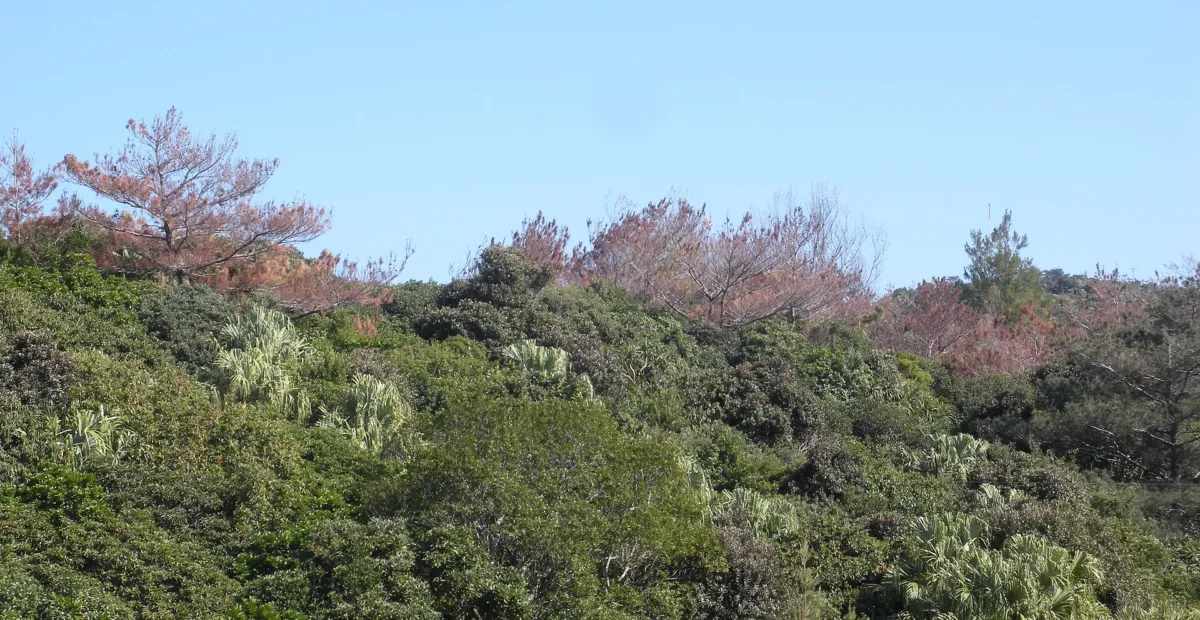
- Needles lose their normal luster and change from green to gray-green, yellow, tan, reddish brown, or brown.
- Discoloration may begin in one branch or at the upper crown and then spread through the tree, although patterns vary with tree size and season.
- Foliage often remains attached after it turns brown rather than dropping promptly.
- Resin flow from fresh cuts or bark wounds may be markedly reduced or absent, but this field sign is not fully reliable.
- Susceptible exotic pines may wilt and die within several weeks to a few months; slower decline can occur in some hosts or cooler conditions.
- Beetle feeding scars, entrance holes, galleries, or oviposition niches may occur on the trunk and branches.
These symptoms overlap with drought, root damage, bark beetles, canker diseases, and needle diseases. Confirmation requires an appropriately collected wood sample examined by a qualified diagnostic laboratory, often using nematode extraction and morphological or molecular identification.
Causes and spread
The primary cause is infection by Bursaphelenchus xylophilus. Adult Monochamus beetles transmit the nematode while feeding on the bark of young pine shoots. Nematodes enter through these wounds, migrate into resin canals and surrounding tissues, multiply, and disrupt water transport.
Dead and dying pines provide breeding material for pine sawyer beetles. Beetles emerging from infested wood can carry nematodes to additional trees. Movement of untreated firewood, logs, branches, chips, nursery stock, and other conifer material can therefore increase spread risk. Drought, heat, root injury, overcrowding, and other stressors can increase the likelihood of severe disease, but stress alone does not establish a diagnosis.
Life cycle and persistence
- Adult pine sawyer beetles emerge from dead or severely declining conifer wood carrying dispersal-stage nematodes in their respiratory passages.
- During maturation feeding on pine shoots, beetles create small wounds through which nematodes enter a healthy tree.
- Nematodes migrate through resin canals and adjacent tissues, feed on living cells and associated microorganisms, and reproduce inside the tree.
- Damage to resin canals and the water-conducting system reduces transpiration and causes rapid foliage decline and wilt.
- As the tree weakens or dies, blue-stain and other wood-colonizing fungi become abundant and support further nematode reproduction.
- Female beetles lay eggs in stressed, dying, or recently dead pine wood. Developing larvae create galleries, and emerging adults carry nematodes to new trees.
The speed of symptom development depends on host susceptibility, temperature, tree condition, nematode strain, and the interaction of nematodes with microorganisms in the wood.
Treatment and control
There is no dependable curative treatment that restores a pine after systemic pine wilt is established. Trees showing rapid crown discoloration should be assessed promptly by a certified arborist, state diagnostic laboratory, university plant clinic, or forestry professional.
For confirmed or highly suspicious trees, removal and destruction of the tree and potentially infested wood is the principal management action. Chip, burn, bury, or otherwise process material according to local regulations and recommendations so that pine sawyer beetles cannot emerge. Do not retain infested logs, slash, or firewood near healthy pines.
Pruning may remove isolated dying limbs and reduce breeding material, but it is not a cure for a tree with widespread infection. Avoid injecting or treating a tree without a confirmed diagnosis because similar symptoms may result from drought, root injury, bark beetles, or fungal diseases.
Low-impact and biological control
Organic and low-input management is based mainly on prevention and sanitation rather than direct eradication of the nematode inside an infected tree. Maintain tree vigor with appropriate irrigation during drought, mulch the root zone without piling mulch against the trunk, and correct compaction or mechanical injury where feasible.
- Remove dying or dead pine material before beetle emergence.
- Use clean tools and limit pruning wounds.
- Do not transport untreated pine firewood or logs.
- Replace high-risk, repeatedly affected pines with suitable nonhost trees or better-adapted species.
- Support professional monitoring for pine sawyer activity and seek laboratory confirmation before making large removals.
Commercial biological or botanical products have not replaced sanitation and host selection as the core controls for established pine wilt in landscape trees.
Prevention
- Choose pine species well adapted to the local U.S. climate and site, giving preference to documented resistant or less susceptible native species where appropriate.
- Maintain consistent watering during drought, improve rooting conditions, avoid unnecessary root or trunk injury, and reduce severe competition and overcrowding.
- Inspect pines regularly from spring through fall for rapid needle discoloration, wilt, beetle wounds, and unusual crown decline.
- Remove and properly dispose of confirmed or strongly suspected dying pines before pine sawyer beetles complete development. Follow state, municipal, or quarantine requirements for handling and movement of conifer wood.
- Do not move firewood or untreated pine logs between locations. Use locally sourced firewood or obtain wood that meets applicable heat-treatment requirements.
- Clean pruning and cutting equipment between trees when working in a suspected disease area, and avoid creating unnecessary wounds during periods of pine sawyer activity.
- Before replanting, consider nonhost trees or pine species with better documented adaptation and lower disease risk for the site.
Interesting facts
- Bursaphelenchus xylophilus is native to North America, but it has caused severe pine wilt epidemics after introduction into parts of Asia and Europe.
- The nematode is unusual because its damaging plant-parasitic phase occurs in aboveground wood rather than primarily in roots or soil.
- Several closely related wood-inhabiting nematodes may be found in dead trees, so the name “pinewood nematode” should not be assigned from symptoms alone.
- In the United States, the nematode may be present in many areas without causing the dramatic pine wilt syndrome seen in highly susceptible non-native pines.
- Native and non-native pine species differ greatly in susceptibility; a tree may be colonized without developing the classic rapid wilt pattern.
No pesticide program should be used as a substitute for diagnosis and sanitation. Any insecticide, nematicide, tree injection, or wood treatment must be specifically legally authorized for the crop, site, pest or disease, and use pattern in the United States and applied exactly according to the current product label. Product registration and permitted uses can change; consult state regulators, extension specialists, or a licensed applicator.