
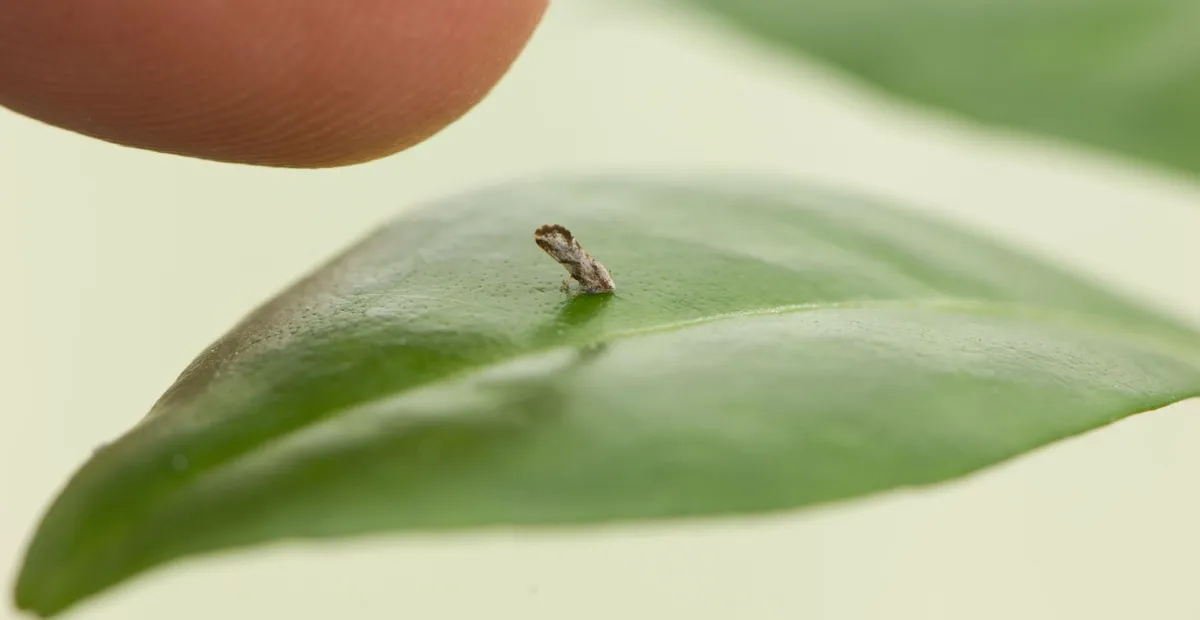
Asian Citrus Psyllid
Diaphorina citri KuwayamaAsian Citrus Psyllid overview
The Asian citrus psyllid, Diaphorina citri, is a small sap-feeding insect that attacks tender citrus flush and closely related Rutaceae plants. Its direct feeding distorts new leaves and produces waxy deposits, but its greater importance is as the principal U.S. vector of the bacterium associated with huanglongbing, or citrus greening. Early detection, regulated plant movement, and integrated pest management are essential.
Typical conditions
Overview
Adults are mottled brown-gray insects about 0.1–0.125 inch long. When feeding, they hold the head close to the leaf and raise the abdomen in a distinctive tail-up posture. Eggs and nymphs occur mainly on unfolding leaves and young green stems. Adults may also be found on mature foliage, especially when citrus is not producing new growth.
In the United States, the pest is most important in citrus-growing regions because infected adults can spread HLB from tree to tree. Finding the insect does not by itself prove that a tree has HLB; suspected detections should be confirmed through local extension or plant-health authorities.
Symptoms and identification
- New leaves may be distorted, curled, stunted, or poorly expanded.
- Nymphs produce conspicuous white waxy tubules and sugary honeydew, which may encourage sooty mold.
- Heavy feeding can weaken young shoots and reduce normal flush development.
- Symptoms of HLB may occur separately from direct feeding: blotchy, asymmetrical leaf mottling, twig dieback, premature fruit drop, small or lopsided fruit, and uneven fruit coloring. These symptoms are not diagnostic alone and can resemble nutritional or root disorders.
Causes and spread
Diaphorina citri acquires the HLB-associated bacterium while feeding on infected citrus and can transmit it during later feeding. Adults disperse by short flights and wind-assisted movement; longer-distance spread is strongly associated with movement of infested citrus plants, cuttings, branches, and other regulated plant material. Eggs and nymphs are concentrated on tender flush, so periods of active growth are the main risk periods.
Life cycle and persistence
Females lay small yellow-orange, almond-shaped eggs in folds and crevices of newly expanding citrus leaves and around young shoots. There are five nymphal stages, all associated primarily with tender flush. Nymphs are slow moving and often clustered, with white waxy tubules. Adults are mobile, reproduce repeatedly, and may live roughly one to two months under favorable conditions. A generation can be completed in about two to seven weeks, depending on temperature and host growth, allowing overlapping generations during much of the growing season.
Treatment and control
Begin with confirmation of the insect and assessment of flush density, tree age, pest abundance, and local HLB status. On small landscape trees, prune only when appropriate and dispose of infested material without moving it. A strong water spray may dislodge exposed nymphs and adults but will not provide lasting control. In commercial or high-risk settings, management commonly targets overwintering adults and newly emerging flush, using monitoring, coordinated area-wide action, and insecticide rotation by mode of action. Protect pollinators and beneficial insects, and avoid unnecessary broad-spectrum applications.
Low-impact and biological control
Use an IPM approach that prioritizes clean nursery stock, inspection, sanitation, removal of heavily infested flush when practical, and protection of natural enemies. Documented natural enemies include the parasitoid wasp Tamarixia radiata, other parasitoids, lacewings, syrphid larvae, and lady beetles. Biological control may suppress psyllids but should not be assumed to prevent HLB transmission, particularly where disease pressure is high. Horticultural oils, insecticidal soaps, and other lower-risk products may help against exposed stages when labeled for the crop and pest, but coverage and repeat timing are critical.
Prevention
- Purchase citrus and related host plants only from reputable sources and use USDA- or state-certified nursery stock where required.
- Do not move citrus plants, budwood, cut branches, green waste, or home-grown citrus out of federal or state quarantine areas.
- Inspect new flush frequently, especially during spring and summer growth, for eggs, nymphs, wax, and tail-up adults.
- Report suspected ACP or HLB findings to the state plant regulatory agency, State Plant Health Director, or local county extension office.
- Coordinate treatments with nearby citrus plantings when possible; isolated, poorly timed applications are less effective against a mobile vector.
- Remove and dispose of confirmed HLB-infected trees according to state guidance to reduce sources of inoculum, because there is currently no curative treatment for infected trees.
Interesting facts
- Asian citrus psyllid nymphs develop primarily on tender new growth, while adults can survive on mature leaves between flushes.
- Females may lay several hundred eggs during their lifetime, and warm conditions can produce many overlapping generations.
- The psyllid can transmit the HLB-associated bacterium after feeding on infected tissue; nymphs are especially important for acquiring the pathogen.
- Orange jasmine (Murraya paniculata) is a documented non-citrus host and can support psyllid populations in suitable climates.
- Direct feeding damage and HLB symptoms can look similar to nutritional problems, so laboratory or regulatory confirmation is important.
Use only products legally authorized for Asian citrus psyllid on the specific crop and site in the United States, and follow the current EPA-approved label exactly. Check state registration, quarantine requirements, preharvest intervals, pollinator precautions, reentry restrictions, resistance-management directions, and whether the product controls adults, nymphs, or both. Do not use antibiotics or unregistered pesticide mixtures as a home remedy; HLB-infected trees have no proven curative treatment.